


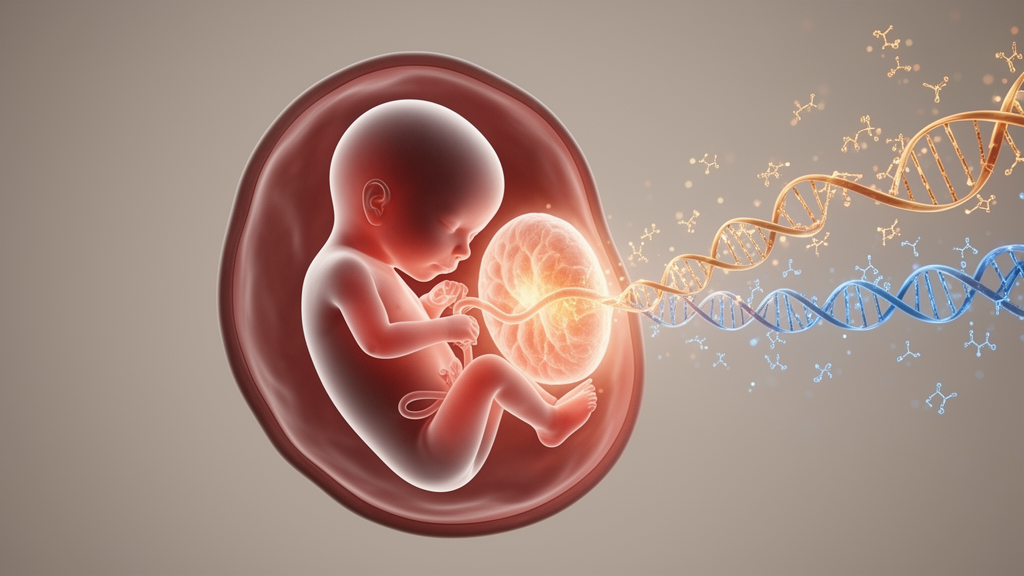
Scientists have long suspected that a mother’s stress during pregnancy can leave biological fingerprints on her developing child, but a new study has now traced those fingerprints to a surprisingly small messenger: microRNAs carried in the blood and embedded in the placenta. In research published in the journal Biology of Sex Differences, a team led by Rosalind J. Wright of the Icahn School of Medicine at Mount Sinai reports that the levels of specific microRNAs measured during pregnancy and at birth are linked to internalizing problems—symptoms of anxiety and depression—in preschool-aged children, and that these links depend in striking ways on both the mother’s lifetime stress burden and whether the child is a boy or a girl.
Internalizing problems, which include anxiety and depressive disorders, remain among the leading contributors to the global burden of disease, and their roots often reach back into fetal life. The developing brain grows rapidly during pregnancy under the control of genes that direct how neural circuits are built and operated. MicroRNAs—tiny RNA molecules that do not code for proteins but instead regulate which genes are switched on or off—are key players in this process. Because microRNA levels can shift when a pregnant woman experiences stress, and can differ depending on whether she is carrying a male or female fetus, researchers have suspected they may serve as a molecular bridge between maternal experience and child mental health.
The new study is the first to examine microRNA levels in both prenatal maternal blood samples and placental tissue collected at delivery in relation to internalizing symptoms in preschool-aged children, while simultaneously accounting for chronic maternal stress and the biological sex of the baby. Rather than looking at microRNAs floating freely in the blood, the team focused on microRNAs packaged inside extracellular vesicles—microscopic membrane-bound particles that cells release into circulation and use to shuttle molecular cargo, including RNA, between tissues. These vesicles are thought to be a communication channel between the mother, the placenta, and the fetus, making their microRNA cargo a plausible vehicle for transmitting stress signals.
To measure children’s mental health, the researchers used the Child Behavior Checklist, a well-validated parent-report instrument, capturing total problems, internalizing problems, and diagnostic-oriented scales for anxiety and affective problems in the preschool years. On the molecular side, they profiled microRNAs in extracellular vesicles isolated from blood drawn during pregnancy and in placental tissue obtained at birth. The analysis pipeline was deliberately conservative. First, the team applied Least Absolute Shrinkage and Selection Operator regression—a machine learning technique that shrinks the coefficients of less informative variables toward zero—embedded within a stability selection procedure, which repeatedly refits the model on resampled data to identify microRNAs whose associations with child outcomes are most consistent. Only microRNAs that survived this rigorous filtering were carried forward.
Next, the researchers used multivariable linear regression to examine all of the selected microRNAs together in a single model for each behavioral outcome, allowing them to estimate each microRNA’s contribution while accounting for the others. Finally, and most importantly for the study’s central question, they stratified the associations by lifetime maternal stress measured prenatally and by fetal sex, and fit models that included a three-way interaction term combining stress, sex, and microRNA expression. This design allowed the team to test whether the same microRNA behaves differently depending on the mother’s stress history and the child’s sex, rather than assuming a uniform effect across all pregnancies.
Two molecules emerged as top candidates. In maternal blood extracellular vesicles, microRNA miR-330-5p stood out, while in placental tissue it was miR-548aw. But the most revealing findings came from the interaction analyses. When fetal sex and lifetime maternal stress were considered jointly, the association between blood miR-330-5p and affective problems—symptoms related to depression—was positive in females exposed to low stress, with a standardized effect estimate of 0.73 and a 95 percent confidence interval of 0.15 to 1.3. In males with high stress exposure, however, the association reversed direction, becoming negative with an estimate of -1.64 and a confidence interval of -3.01 to -0.28. The interaction p-value was 0.03, indicating that this reversal was unlikely to be due to chance alone.
A similarly striking pattern appeared for placental Let-7b, a member of the evolutionarily ancient let-7 microRNA family known to regulate developmental timing. Let-7b expression in the placenta was negatively associated with total behavioral problems among males whose mothers reported high lifetime stress, with an estimate of -6.58 and a confidence interval of -12.45 to -0.71, but positively associated among males whose mothers reported low stress, with an estimate of 3.63 and a confidence interval of 1.26 to 6.01. The interaction p-value was 0.04. In other words, the same placental microRNA was linked to better behavioral outcomes in high-stress pregnancies and worse outcomes in low-stress pregnancies—but only in boys, underscoring how tightly fetal sex and maternal context are intertwined in shaping these molecular signals.
To understand what these microRNAs might actually be doing, the team performed pathway enrichment analysis, which maps genes targeted by a microRNA onto known biological networks. The top pathways implicated were Hippo, FoxO, and PI3K/mTOR signaling. These are not obscure players. The Hippo pathway governs organ size and cell proliferation, the FoxO family of transcription factors regulates stress resistance and cellular survival, and PI3K/mTOR signaling controls cell growth, metabolism, and protein synthesis. All three have documented roles in neurodevelopment, suggesting plausible mechanistic routes by which altered microRNA signaling during pregnancy could influence how the fetal brain is wired and, ultimately, how children regulate emotions and behavior years later.
The authors emphasize that the findings point toward novel directions for future research aimed at unraveling the mechanistic underpinnings of how maternal stress and fetal sex jointly shape the developmental origins of common mental health trajectories such as anxiety and depression. Because the study is observational, it cannot prove that microRNA changes cause later internalizing problems; the associations could reflect confounding by other factors, and the effect sizes, while statistically significant, come from a modest sample. Still, the sex-specific reversals are difficult to dismiss as noise, and they align with a growing body of evidence that prenatal stress operates differently in male and female fetuses, possibly through placental adaptations that differ by sex.
If the findings hold up in larger and more diverse cohorts, they could reshape early prevention. Identifying children at risk for anxiety and depression as early in life as possible would allow interventions to be applied when the developing brain is most malleable, with significant implications for preventing mental health problems across the lifespan. MicroRNAs in circulating extracellular vesicles are particularly attractive as biomarkers because they can be measured from a simple maternal blood sample during pregnancy, potentially offering a minimally invasive window into fetal neurodevelopment. For now, the study stands as a vivid demonstration that the biology of childhood mental health begins long before childhood—and that the messages carried between mother, placenta, and fetus are written in a molecular language that scientists are only beginning to translate.
Subject of Research: Prenatal microRNA signaling in maternal blood extracellular vesicles and placenta in relation to children's internalizing problems
Article Title: Lifetime maternal stress, fetal sex, and microRNAs in prenatal extracellular vesicles and placenta in relation to children’s internalizing problems
Article References: Wright, R. J., Saddiki, H., Dominguez, R., Wu, H., Cowell, W., Wright, R. O., Baccarelli, A. A., & Colicino, E. (2026). Lifetime maternal stress, fetal sex, and microRNAs in prenatal extracellular vesicles and placenta in relation to children’s internalizing problems. Biology of Sex Differences. https://doi.org/10.1186/s13293-026-00996-5
Image Credits: AI Generated
DOI: 10.1186/s13293-026-00996-5
Keywords: microRNAs, extracellular vesicles, placenta, prenatal stress, fetal sex, internalizing problems, Child Behavior Checklist, miR-330-5p, Let-7b, anxiety, depression, neurodevelopment
Cite Scienmag News
Glenn Wilkins. (October 16, 2026). Maternal Stress and Fetal Sex Shape Prenatal microRNA Signals Tied to Children’s Anxiety Risk. Scienmag. https://scienmag.com/maternal-stress-and-fetal-sex-shape-prenatal-microrna-signals-tied-to-childrens-anxiety-risk/
Glenn Wilkins. "Maternal Stress and Fetal Sex Shape Prenatal microRNA Signals Tied to Children’s Anxiety Risk." Scienmag, 16 October 2026, https://scienmag.com/maternal-stress-and-fetal-sex-shape-prenatal-microrna-signals-tied-to-childrens-anxiety-risk/. Accessed 16 October 2026.
Glenn Wilkins. "Maternal Stress and Fetal Sex Shape Prenatal microRNA Signals Tied to Children’s Anxiety Risk." Scienmag. October 16, 2026. https://scienmag.com/maternal-stress-and-fetal-sex-shape-prenatal-microrna-signals-tied-to-childrens-anxiety-risk/


