


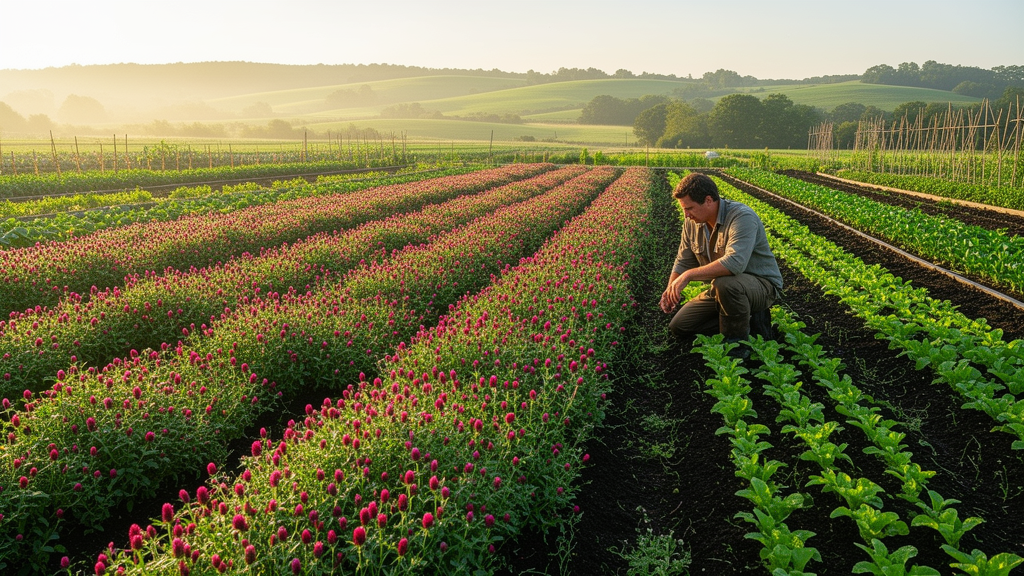
Organic agriculture has evolved from a niche movement into one of the fastest-growing sectors of the global food economy, now practiced in more than 180 countries across nearly 99 million hectares by at least 4.8 million farmers. Global sales of organic food and drink reached almost €145 billion, with U.S. certified organic sales alone hitting $76.6 billion in 2025, growing at 6.8 percent annually—double the rate of the conventional marketplace. Yet despite this commercial momentum, organic producers face persistent agronomic challenges: soil fertility, nutrient availability, weed management, and overall crop productivity. A comprehensive new review published in Frontiers in Horticulture synthesizes the evidence that cover crops—non-harvested plants grown before, after, or between cash crops—can serve as multifunctional ecological regulators capable of addressing these challenges simultaneously, but only when their selection, termination, and integration are managed with precision.
The review, conducted by researchers at Tennessee State University, distinguishes four distinct management pathways that are often conflated in the literature. Cover crops retained on the soil surface after termination function primarily as dead mulch, associated with reduced or minimum tillage. Green manures are incorporated into the soil by tillage to accelerate decomposition and nutrient release. Living mulches remain in place during part or all of the cash crop season, providing continuous soil cover but potentially competing with the crop for water, light, and nutrients. Finally, cover crop-based reduced- or no-tillage systems combine cover crop biomass with low-disturbance termination methods such as roller-crimping, mowing, undercutting, strip tillage, or flaming. This distinction matters because yield, weed suppression, nutrient cycling, and soil carbon responses depend not only on the species chosen but on whether residues are incorporated, retained on the surface, or maintained as a living stand.
Functional diversity among cover crop species is central to their effectiveness. Legumes such as hairy vetch, crimson clover, faba bean, and subterranean clover are prized for biological nitrogen fixation, with well-managed legume cover crops supplying 50 to 180 kilograms of nitrogen per hectare per season. Grasses and cereals like winter rye, oats, and barley produce high above-ground biomass and fibrous root systems that promote surface cover, erosion control, and weed suppression through persistent high-carbon-to-nitrogen residues. Brassicas including fodder radish, white mustard, and oilseed radish generate rapid canopy closure, taproot biopores, and glucosinolate-derived allelopathic compounds that can suppress soil nematode pests. Broadleaf forbs such as sunflower, phacelia, and buckwheat offer rapid soil cover, pollinator resources, and contrasting root traits. Mixtures of these functional groups can deliver complementary services—nitrogen fixation, nutrient retention, soil aggregation, microbial biodiversity, and weed suppression—that no single species provides alone.
The physical benefits of cover crops on soil structure are well documented. Multiple cover cropping cycles increase soil aggregate stability, decrease bulk density, and improve water infiltration and retention, particularly when biomass inputs are sustained over several seasons. Dense, fibrous root systems from high-biomass species such as winter rye and sorghum-sudan grass form extensive biopore networks and fuel aggregate-binding microbial activity. A global meta-analysis confirmed positive physical soil responses across climates, though with high variability depending on species and environment. In subtropical vegetable systems, three consecutive years of cover crop management produced measurable increases in soil organic matter and labile carbon pools, with the magnitude of physical improvements increasing progressively across seasons. In colder climates such as the Canadian prairies, meaningful soil health responses also occurred over three years, though different indicators responded at different rates—reinforcing that short, single-season trials underestimate the long-term trajectory of physical soil improvement.
Chemical soil properties respond to cover cropping in ways that depend on residue chemistry and functional group composition. Repeated cover cropping increases soil organic carbon, total nitrogen, cation exchange capacity, and available phosphorus, with pH buffering capacity improving alongside organic matter accumulation. Leguminous species produce the greatest increases in mineral nitrogen, while grasses generate larger carbon inputs due to their higher residue biomass and carbon-to-nitrogen ratios. Combinations of legume and cereal functional groups produced the most consistent and broadest multi-parameter chemical soil improvements, as nitrogen from legume residues and carbon from cereal residues together enhanced soil organic matter. However, research in certified organic vegetable production in Maine found that compost amendment rather than cover crop species alone produced the most reliable improvements in soil pH, organic matter, and nutrient availability—underscoring that cover crops function best when paired with complementary organic amendments rather than positioned as the sole fertility input.
Biological soil health benefits are equally significant. Meta-analyses confirm that cover cropping consistently increases soil microbial biomass carbon and nitrogen, microbial diversity indices, and functional enzyme activity associated with nitrogen mineralization, phosphorus solubilization, and carbon cycling. The largest microbial biomass increases are associated with high-residue, nitrogen-rich legume treatments such as hairy vetch and crimson clover. High-carbon-to-nitrogen cereal residues such as winter rye shift microbial community structure toward increased fungal-to-bacterial ratios, with functional consequences for the rate and temporal pattern of nitrogen mineralization. Species identity—not just the presence of any cover crop—determines community structure, with legume-dominant and grass-dominant treatments producing significantly different bacterial community profiles in tomato rotation systems. In citrus orchards, cover crop effects on microbial communities and biological activity were vertically structured through the soil profile, with the uppermost 0–10 centimeter layer showing the strongest biological responses.
Weed suppression represents one of the most strategically important but context-dependent functions of cover crops in organic systems. Cover crops suppress weeds through living competition, surface mulch, allelopathic residue effects, and longer-term changes in weed seedbank density and species composition. Biomass production is the single most significant factor for weed suppression, though species identity can have even greater effects than residue mass. In certified organic vegetable sites across Europe, roller-crimped hairy vetch, black oat, and cereal rye produced substantial reductions in weed density and species richness across all pedo-climatic conditions. In southern Italy, a locally adapted Brindisino ecotype of subterranean clover used as a living mulch in globe artichoke production suppressed weed cover to below 1 percent of ground area—without reducing bud yield. However, cover crops rarely provide season-long weed control alone; their effectiveness depends on biomass, timing, weed community composition, seedbank history, and integration with cultivation, rotation, and other organic weed management tactics.
Termination strategy plays a critical role in determining whether cover crop benefits are realized or undermined. Mechanical incorporation accelerates residue decomposition and nitrogen release, especially for low-carbon-to-nitrogen legumes, but causes soil structural disruption and carbon oxidation. Roller-crimping retains residue on the surface, preserving soil protection and weed suppression, but delays nitrogen release and can reduce cash crop yield when nitrogen is limiting. In certified organic white cabbage production in Denmark, roller-crimping legume-rye mixtures reduced marketable yield in nitrogen-limiting seasons, while full incorporation increased yield by enhancing soil nitrogen availability. The timing of termination also matters: early flowering of hairy vetch maximizes the labile fraction and speeds nitrogen release, while delaying termination of winter rye to full anthesis maximizes biomass and mulch persistence but risks planting delay for the next cash crop.
Despite the growing evidence base, significant trade-offs constrain cover crop adoption. Nitrogen immobilization from high-carbon-to-nitrogen residues—particularly when incorporated under cool or dry conditions—can temporarily reduce nitrogen availability to subsequent crops. Water competition from high-biomass cereals such as winter rye and triticale can deplete soil moisture if termination is not timed to allow sufficient recharge before planting. In Mediterranean viticulture, water competition has been identified as the primary limitation to cover crop adoption in rainfed vineyards. Management complexity and economic considerations further constrain adoption, particularly for specialty crop producers who face logistical challenges including varied production schedules, equipment compatibility limitations, and reduced access to specialized agronomic support. A survey of certified organic vegetable producers in Wisconsin found that adoption intensity was influenced more by management experience and operational capacity than by awareness of cover crop benefits.
Looking forward, the review identifies several critical research priorities. Studies conducted under certified organic management remain underrepresented relative to the overall volume of published research, and findings from conventionally managed systems cannot be assumed to transfer. Long-term experimental data exceeding five years remains scarce, making it difficult to understand how cover crop-driven changes in soil biological communities and carbon fractions translate into sustainable productivity gains. Reduced-tillage organic systems relying on roller-crimped, mowed, or winter-killed cover crops represent a key research frontier, as weed control, termination reliability, equipment access, nitrogen synchrony, and water use vary strongly by region. Climate adaptation is an emerging priority, as warmer winters may alter biomass production of winter cereals and increased summer drought frequency can intensify water competition from living mulches. Integrating cover crops with no-till, conservation tillage, and precision management offers promising opportunities to enhance overall effectiveness, positioning cover crops not as a universal solution but as a system-thinking technology whose benefits emerge from the coordination of species choice, management practices, and agroecosystem context.
Subject of Research: The role of cover crops as multifunctional ecological regulators in organic crop production systems
Article Title: A review on cover crops as a multifunctional ecological regulator in organic crop production systems
Article References: Naroju, S. P., Nandwani, D., & Witcher, A. (2026). A review on cover crops as a multifunctional ecological regulator in organic crop production systems. Frontiers in Horticulture, 5, Article 1866996. https://doi.org/10.3389/fhort.2026.1866996
Image Credits: AI Generated
DOI: 10.3389/fhort.2026.1866996
Keywords: cover crops, organic agriculture, soil health, nitrogen fixation, weed suppression, no-till farming, soil organic carbon, green manure, living mulch, roller-crimping, sustainable agriculture, agroecology
Cite Scienmag News
Alan Morgan. (October 16, 2026). Cover Crops Emerge as Multifunctional Ecological Regulators in Organic Farming. Scienmag. https://scienmag.com/cover-crops-emerge-as-multifunctional-ecological-regulators-in-organic-farming/
Alan Morgan. "Cover Crops Emerge as Multifunctional Ecological Regulators in Organic Farming." Scienmag, 16 October 2026, https://scienmag.com/cover-crops-emerge-as-multifunctional-ecological-regulators-in-organic-farming/. Accessed 16 October 2026.
Alan Morgan. "Cover Crops Emerge as Multifunctional Ecological Regulators in Organic Farming." Scienmag. October 16, 2026. https://scienmag.com/cover-crops-emerge-as-multifunctional-ecological-regulators-in-organic-farming/


