


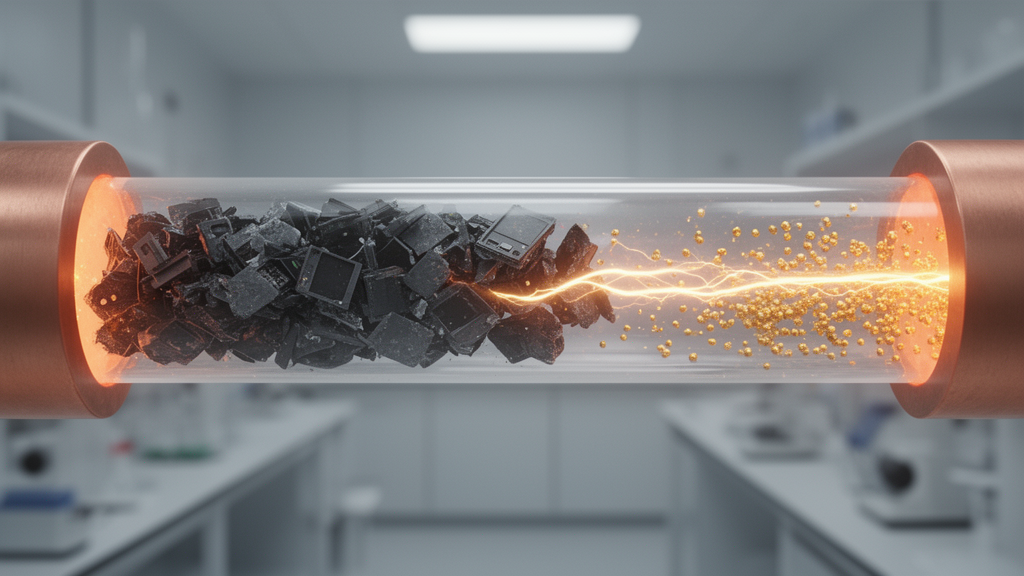
Every discarded smartphone, laptop and television set carries a hidden chemical burden that recyclers have struggled to lift for decades. Inside the plastic housings and circuit boards of electronic waste sits a cocktail of brominated flame retardants bound to antimony trioxide, a synergist that makes the retardants work but turns the plastic into one of the most problematic waste streams on the planet. Now a team at Rice University led by James Tour and Leo Haoxin Ye has unveiled a process that attacks both problems at once, using a burst of electricity to strip bromine from the plastic while simultaneously recovering the antimony as a pure metallic resource. The work, published in Nature Chemical Engineering, could reshape how the world handles the growing mountain of flame-retardant e-waste.
The scale of the challenge is enormous. Electronic waste is among the fastest-growing waste categories globally, and plastics loaded with brominated flame retardants represent a substantial fraction of it. These plastics, typically acrylonitrile butadiene styrene or high-impact polystyrene, are deliberately engineered to resist fire, which makes them nearly impossible to recycle safely. When heated through conventional pyrolysis, the brominated compounds release toxic organic species, including brominated dioxins and furans, while the antimony tends to volatilize or become trapped in ash, escaping recovery entirely. Existing recycling routes cause metal losses and toxic emissions, and antimony itself is classified as a critical metal with constrained supply, mined predominantly in a handful of countries.
The Rice team’s answer is a technique they call isothermal-clamped flash Joule heating, or IC-FJH. Flash Joule heating has already gained attention in recent years for its ability to convert waste materials into valuable products in seconds, from turning plastic into graphene to regenerating spent battery cathodes. The new variant clamps the reaction zone isothermally, creating a spatially uniform high-temperature environment within seconds rather than the slow, uneven heating that conventional furnaces produce. This uniformity is not merely a technical nicety; it fundamentally changes the chemistry that unfolds inside the plastic.
When the researchers applied IC-FJH to flame-retardant ABS plastic, three key chemical effects emerged. First, the ultrafast heating suppressed volatilization of brominated organic intermediates, preventing them from escaping into the gas stream as toxic pollutants. Second, the process promoted hydrogen-assisted hydrodebromination, a reaction in which hydrogen strips bromine atoms from the organic flame retardant molecules and converts them into hydrogen bromide, a capturable and industrially useful acid. Third, the intense reductive environment drove the formation of elemental antimony, Sb(0), from the antimony trioxide synergist, transforming a widely dispersed oxide into a concentrated metallic phase that can be physically separated.
The performance numbers are striking. IC-FJH recovered approximately 90 percent of the antimony from the plastic at over 97 percent purity, a level of selectivity that conventional thermal treatments cannot approach. At the same time, 83 percent of the bromine was captured as HBr rather than released as hazardous organic species. Compared with slow heating, the flash process reduced toxic brominated organic species by 34 to 51 percent, meaning that even the fraction of bromine not converted to HBr was far less likely to end up as dioxin-forming intermediates. The recovered antimony emerges as a metallic resource that can re-enter the supply chain for new flame retardants, semiconductors or other antimony-dependent technologies.
To understand why the flash process works so differently from conventional heating, the team combined experimental characterization with computational modeling. Density functional theory calculations, using climbing-image nudged elastic band methods to map reaction pathways, revealed how the reductive environment and rapid thermal cycling favor Sb(0) formation over antimony volatilization. Heat-transfer simulations confirmed that the isothermal clamping produces a uniform temperature field across the plastic sample, eliminating the cold zones where brominated intermediates would otherwise survive and later escape. Machine learning analyses helped the researchers correlate process parameters with product outcomes, providing a data-driven framework for optimizing the reaction.
The generality and scalability of the approach were tested across different plastic formulations and batch sizes, with the results documented in figures showing Sb recovery performance under different heating rates and debromination behavior under IC-FJH conditions. The team also examined how bromine partitions between gas, liquid and solid phases during the process, and how antimony transforms through successive oxidation states as the reaction proceeds. These mechanistic insights into ABS plastic pyrolysis suggest the method is not a narrow trick tuned to one specific waste stream but a robust platform applicable to the broader family of halogenated flame-retardant plastics found in real electronic waste.
Perhaps the most consequential findings come from the life-cycle assessment and techno-economic analysis that accompanied the experimental work. The LCA indicates reductions of 72 percent in resource consumption, 65 percent in climate-change burdens, 80 percent in water use and 100 percent in polycyclic aromatic hydrocarbon formation relative to conventional antimony recovery and plastic treatment pathways. The complete elimination of PAH formation is particularly significant, as these carcinogenic compounds are a persistent byproduct of slow pyrolysis of halogenated plastics. The techno-economic analysis, whose source code is publicly available on GitHub, suggests the process could be economically viable, supported in part by the fact that flash Joule heating consumes electricity rather than fossil fuel heat and operates on timescales of seconds rather than hours.
The research builds on a growing body of work from the Tour laboratory demonstrating that electrothermal processing can transform waste management across multiple domains. Previous studies from the group have shown flash Joule heating converting waste plastic into graphene at zero net cost, regenerating spent lithium cobalt oxide cathodes, separating rare earth elements in seconds, and removing iron and heavy metals from bauxite residues through flash chlorination. The common thread is that passing current directly through a waste material, rather than heating it externally, enables reaction chemistries that are inaccessible to conventional thermal processing. The new antimony and debromination work extends this paradigm to one of the most toxic and economically fraught corners of the recycling world.
The implications reach beyond the laboratory. Antimony supply is concentrated in a few countries, and the metal is essential not only for flame retardants but also for semiconductors, photovoltaics and military applications. Recovering it from e-waste at high purity could reduce dependence on primary mining while simultaneously detoxifying a waste stream that currently ends up in landfills or informal recycling operations where brominated pollutants threaten workers and ecosystems. A US provisional patent application on the Sb and Br recovery process has been filed by Rice University, and the team notes that the approach provides a rapid, integrated route for sustainable end-of-life management of flame-retardant plastics. As electronic waste volumes continue to climb worldwideFlash Joule heating turns toxic e-waste plastics into antimony resource in seconds.{
Subject of Research: Simultaneous antimony recovery from and debromination of flame-retardant electronic-waste plastics
Article Title: Simultaneous antimony recovery from and debromination of flame-retardant electronic-waste plastics
Article References: Ye, L. H., Cheng, Y., Silva, K. J., Xu, S., Zhu, H., Aina, O., Viscomi, N. L., Chen, S., Seguron, P., Liu, Q., Sharp, J., Cheng, L., Tang, J. C., Abdel Nour, R. S., Li, B., Si, T., West, J. G., Yakobson, B. I., Zhao, Y., & Tour, J. M. (2026). Simultaneous antimony recovery from and debromination of flame-retardant electronic-waste plastics. Nature Chemical Engineering. https://doi.org/10.1038/s44286-026-00455-3
Image Credits: AI Generated
DOI: 10.1038/s44286-026-00455-3
Keywords: flash Joule heating, antimony recovery, debromination, electronic waste, flame retardants, ABS plastics, critical metals, recycling, life-cycle assessment, hydrodebromination, Nature Chemical Engineering, Rice University
Cite Scienmag News
Denise Maddox. (October 16, 2026). Flash Joule Heating Transforms Toxic E-Waste Plastics Into Antimony Goldmine. Scienmag. https://scienmag.com/flash-joule-heating-transforms-toxic-e-waste-plastics-into-antimony-goldmine/
Denise Maddox. "Flash Joule Heating Transforms Toxic E-Waste Plastics Into Antimony Goldmine." Scienmag, 16 October 2026, https://scienmag.com/flash-joule-heating-transforms-toxic-e-waste-plastics-into-antimony-goldmine/. Accessed 16 October 2026.
Denise Maddox. "Flash Joule Heating Transforms Toxic E-Waste Plastics Into Antimony Goldmine." Scienmag. October 16, 2026. https://scienmag.com/flash-joule-heating-transforms-toxic-e-waste-plastics-into-antimony-goldmine/


