


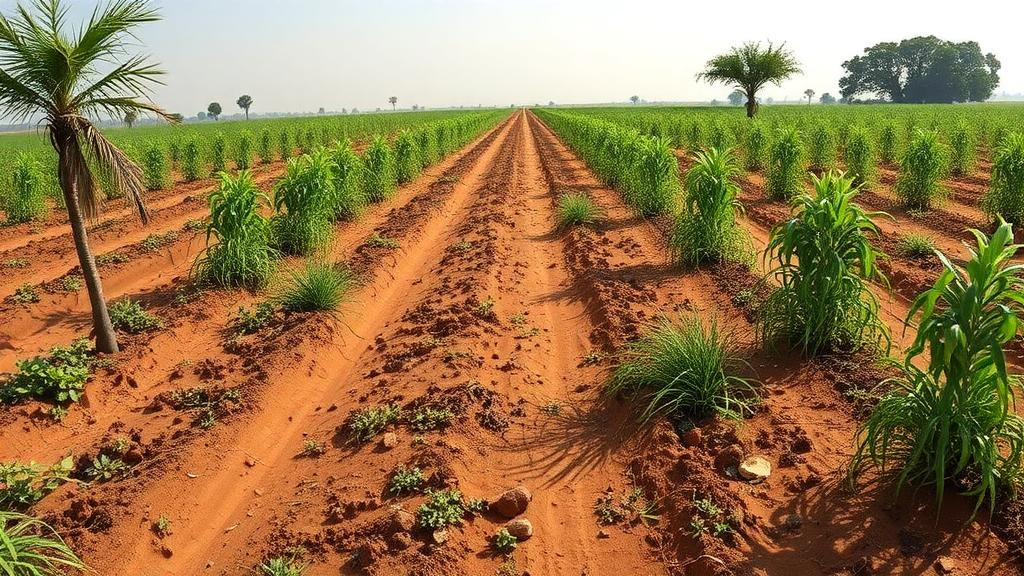
For decades, environmental regulators have treated contaminated agricultural soil as a problem that can be measured with a single number: the total concentration of a pollutant in the ground. If a field holds a known amount of cadmium, pesticide residue, or per- and polyfluoroalkyl substances, the assumption goes, that figure captures the hazard. A new review published in Environmental Geochemistry and Health argues that intensifying drought is dismantling this assumption. The authors, led by Burhan Khalid of Huazhong Agricultural University and the University of Agriculture Faisalabad, propose that drought acts as a hydro-biogeochemical driver that reshapes the bioavailability, chemical speciation, and biological accessibility of soil contaminants without changing their total inventories at all. In other words, the same field can become dramatically more dangerous while its measured pollutant load stays exactly the same.
The review advances the concept of a climate-sensitive soil exposome, the totality of exposures that soils deliver to crops, livestock, and people as environmental conditions shift. Under this framing, drought is not merely a stress that withers plants; it is an active reorganizer of the soil’s chemistry and biology. When porewater connectivity collapses during drying, solutes become concentrated within disconnected microsites, and the air-water interfacial area inside soil pores expands. These physical changes alter where pollutants sit, how they interact with one another, and how easily living organisms can reach them. Metals, antibiotics, pesticides, PFAS, and microplastics that were previously locked away or spatially separated can be brought into new co-localizations, creating mixture-level exposure potentials that single-contaminant assessments simply cannot predict.
The mechanistic details matter here. Metals such as cadmium, a legacy contaminant in many intensively farmed regions, can shift between chemical forms as soil moisture, pH, and microbial activity change. Research cited in the review, including a 2024 study in Communications Earth & Environment, found that climate-induced microbiome alterations increase cadmium bioavailability in agricultural soils with pH below 7. PFAS, the notoriously persistent fluorinated chemicals used in countless industrial and consumer products, display their own moisture-dependent behavior; their interfacial mobility and leaching from solid matrices depend on mineralogy and water flux, meaning drying and rewetting can redistribute them through soil profiles in ways that static sampling misses. Pesticides, meanwhile, exhibit adsorption-desorption dynamics that are highly sensitive to soil water content, and microplastics act as mobile carriers that can concentrate and transport other pollutants.
Perhaps the most striking part of the review concerns what drought does to the soil’s microbial inhabitants. Drying imposes ecological filtering on microbial communities, selectively enriching stress-tolerant, biofilm-forming, and resistance-bearing taxa. In soils co-contaminated with persistent metals and antibiotic residues, this filtering disproportionately expands antibiotic resistance genes and the mobile genetic elements that shuttle them between bacteria. The mechanism is co-selection: heavy metals and other environmental contaminants impose selective pressure that favors bacteria carrying resistance determinants, which often sit on the same plasmids or integrons as antibiotic resistance genes. A 2024 review in FEMS Microbiology Reviews detailed these co-selection mechanisms, and a 2026 study in Nature Microbiology reported that drought drives elevated antibiotic resistance across soils, providing direct experimental support for the climate-resistance connection the review synthesizes.
The public health implications extend far beyond the field boundary. The review highlights global evidence associating aridity with elevated hospital-level antibiotic resistance rates, defined as the frequency of resistant clinical isolates recorded in hospital surveillance data, across 116 countries. That correlation implicates climate-driven soil microbial filtering in clinical outcomes, suggesting that what happens in a desiccated field can eventually register in a hospital ward. Soil antibiotic resistance genes are increasingly connected to the human resistome, and the review cites work in Nature Communications linking global soil resistance genes to rising human health risk. The soil, in this view, is not a passive reservoir but an active incubator whose output is amplified by climate stress.
Drying-rewetting cycles emerge as the periods of potentially greatest concern. When rain finally returns after a prolonged drought, the sudden rewetting of dry soil triggers a burst of microbial activity and a pulse of previously immobilized solutes. The review characterizes these transitions as generating acute pulses of contaminants, resistant microorganisms, and resistance genes through three main pathways: crop uptake, contaminated dust inhalation, and post-drought hydrological export. Studies of rewetting in temperate and riparian soils confirm that these transitions mobilize carbon and alter biogeochemistry dramatically, and a 2022 study in mSystems found that a single drying-rewetting cycle imposes larger shifts on soil microbial communities than reduced precipitation does over longer periods. The pulse, not the plateau, may be the key exposure window.
Among the three exposure pathways, contaminated agricultural dust stands out as critically undercharacterized. As soils dry, they become friable and wind-erodible, and tillage, harvest, and vehicle traffic loft particulate matter carrying metals, pesticide residues, PFAS-laden particles, microplastic fragments, and microbial bioaerosols. Research on dust-transportable bioaerosols originating from the Gobi Desert has documented bacterial stress adaptation and antibiotic resistance in airborne communities, and metagenomic co-assembly studies have uncovered mobile antibiotic resistance genes in airborne microbiomes. The review argues that inhalation of this dust is a research frontier in climate-sensitive soil exposome science, one that existing monitoring frameworks, which are anchored to soil concentration measurements, largely ignore.
Crop uptake adds a dietary dimension to the risk. Meta-analyses of cadmium transfer from soil to leafy vegetables have long established that plant accumulation depends on soil chemistry, and greenhouse experiments have quantified PFAS bioconcentration in lettuce, tall fescue, and tomato. Pharmaceuticals and pesticides also move from soil into crops, with systematic reviews documenting uptake across a range of compounds. Under drought, altered water flux and concentrated solutes can modify these transfer coefficients, meaning that the same crop grown in the same field may carry different contaminant loads in a dry year than in a wet one. Manure-derived dissolved organic matter can further facilitate colloid-facilitated transport of metals such as cadmium in arable soils, compounding the mobility problem.
The review’s recommendations amount to a fundamental redesign of soil risk assessment. Rather than treating drought-rewetting transitions as anomalies, the authors argue they should be primary sampling targets, because they concentrate exposure into acute windows that routine annual monitoring can miss. Monitoring should be bioavailability-resolved, measuring the fraction of contaminants actually accessible to organisms rather than total concentrations, and mixture-sensitive, accounting for the interactions among co-occurring pollutant classes. Contaminated agricultural dust should be explicitly incorporated as an inhalation exposure route. These proposals align with a broader one-health perspective, in which soil health is recognized as a common focus for interventions spanning human, animal, and environmental health.
The stakes are considerable. Global soil pollution by toxic metals already threatens agriculture and human health on a planetary scale, according to a 2025 assessment in Science, and climate projections indicate that drought frequency and intensity will increase across many of the world’s most intensively farmed regions. If drought converts static pollutant repositories into dynamic exposure engines, then the number of fields that pose meaningful risk may be far larger than current maps suggest. The review’s central message is that the hazard of a contaminated soil is not a fixed property written in its chemistry, but a moving target set by the climate above it. Understanding that target, the authors contend, requires watching soils most closely at the moments when they swing from parched to soaked, and listening for the resistance genes that ride the dust.
Subject of Research: How drought alters the bioavailability, microbial ecology, and exposure pathways of contaminated agricultural soils
Article Title: Climate-extreme soil exposome: how drought converts contaminated agricultural soils into one-health risk hotspots
Article References: Khalid, B., Wassay, M., Hussain, M. A., Ikram, M., & Maqbool, R. (2026). Climate-extreme soil exposome: how drought converts contaminated agricultural soils into one-health risk hotspots. Environmental Geochemistry and Health, 48(16), Article 644. https://doi.org/10.1007/s10653-026-03535-8
Image Credits: AI Generated
DOI: 10.1007/s10653-026-03535-8
Keywords: drought, soil contamination, soil exposome, antibiotic resistance, PFAS, microplastics, heavy metals, drying-rewetting cycles, agricultural dust, one health, bioavailability, soil microbiome
Cite Scienmag News
Sloane Callahan. (October 16, 2026). Drought Turns Polluted Farmland Into Hidden Superbug Hotspots, Scientists Warn. Scienmag. https://scienmag.com/drought-turns-polluted-farmland-into-hidden-superbug-hotspots-scientists-warn/
Sloane Callahan. "Drought Turns Polluted Farmland Into Hidden Superbug Hotspots, Scientists Warn." Scienmag, 16 October 2026, https://scienmag.com/drought-turns-polluted-farmland-into-hidden-superbug-hotspots-scientists-warn/. Accessed 16 October 2026.
Sloane Callahan. "Drought Turns Polluted Farmland Into Hidden Superbug Hotspots, Scientists Warn." Scienmag. October 16, 2026. https://scienmag.com/drought-turns-polluted-farmland-into-hidden-superbug-hotspots-scientists-warn/


