


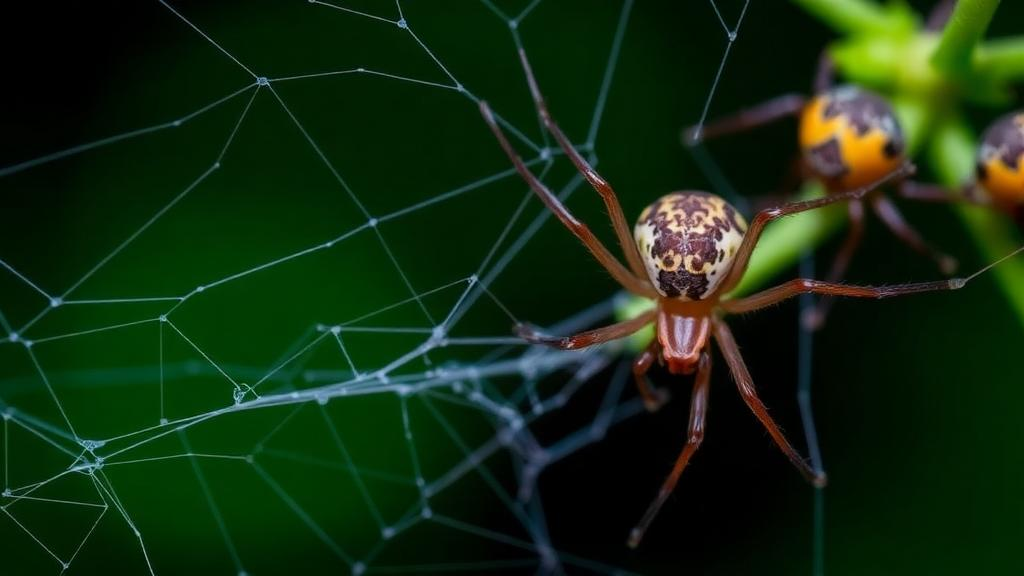
Spider mites are among the smallest herbivores on Earth, yet the tiny arachnids that plague crops and gardens worldwide have quietly built one of the most diverse behavioral repertoires in the animal kingdom. A comprehensive review published in Frontiers in Arachnid Science by Yutaka Saito of Hokkaido University and Yukie Sato of the University of Tsukuba synthesizes decades of research showing that these mites, all members of the subfamily Tetranychinae, can be sorted into three fundamental life types defined by how they spin and use silk: the little web type, the complicated web type, and the woven nest type. Far from being trivial variations, these life types shape nearly every aspect of mite biology, from predator defense and competition to reproduction and even the origins of social behavior.
Silk production is the thread that ties the whole story together. Spider mites extrude silk from specialized glands at the tips of their pedipalps, and the threads serve as lifelines for locomotion on smooth, downward-facing leaf surfaces where the mites would otherwise slide off. The simplest strategy, the little web type, is found in genera such as Panonychus and Aponychus. Some little web species produce no silk at all, while others, like the citrus red mite Panonychus citri, spin only thin guy ropes that anchor their stalked eggs to the leaf. At the opposite end of the spectrum, the woven nest type seen in the genus Stigmaeopsis involves dense, systematically constructed nests that function as fortresses, nurseries, and sanitation systems all at once.
Between these extremes lies the complicated web type, exemplified by the notorious two-spotted spider mite Tetranychus urticae, a major agricultural pest. These mites spin silk continuously as they walk, and because females tend to aggregate in leaf depressions such as along midribs, their threads accumulate into tangled webbing. The review argues that this webbing is not merely a by-product of movement but a purposeful adaptation. Experimental work showed that T. urticae females lose their footing on smooth, webless leaf undersides and must climb their own silk threads to recover, suggesting that the primary functions of complicated webs are to provide firm footing and a safety net against gravity, while the leaf underside itself shields the mites from damaging ultraviolet-B radiation.
The choice of leaf surface is itself a calculated trade-off. Studies cited in the review demonstrated that egg hatching and juvenile development are significantly suppressed on sunlit upper leaf surfaces, and laboratory tests revealed that the nutritional advantage of upper surfaces does not explain the mites’ strong preference for the underside. Solar radiation and heat, not food quality, drive the distribution. But living beneath the leaf creates the falling hazard that silk solves, and it also concentrates mites in a habitat shared with predators, which has driven the evolution of an impressive array of defensive behaviors tied to each life type.
Against predators, the life types act as distinct defense systems. Complicated webs impede the entry of both generalist and specialist predators, and female Tetranychus kanzawai and T. urticae have been observed shifting their eggs onto webs immediately after encountering predators, a strategy that reduces predation even though strong rainstorms can wash web-deposited eggs away, creating a survival trade-off. Woven nests provide even stronger protection. In removal experiments on the bamboo-dwelling species Schizotetranychus recki and several Stigmaeopsis species, nests significantly reduced predation by most sympatric predator species, although one predator, Agistemus summersi, actually used the web as a cue to locate prey, showing that no defense is universally effective.
Even mites that build no webs have evolved morphological defenses. The extremely flat-bodied Aponychus corpuzae presses itself against the leaf surface, and experiments showed that predators consumed far more deutonymphs that had been tipped onto their sides than normally positioned ones, while egg-covering webs reduced predation by two predator species. The citrus red mite P. citri lies flat with its dorsal setae pointing upward, and the elastic contact created when a predator touches these hairs repels the attacker. Such findings demonstrate that body posture and hair structure, not just silk architecture, function as anti-predator adaptations.
Perhaps the most striking discoveries involve active counterattack. Stigmaeopsis longus, S. miscanthi, and S. nanjingensis females and males collectively kill larvae of the specific phytoseiid predator Typhlodromus bambusae that intrude into their nests, with roughly 30 to 80 percent of intruding predator larvae killed depending on the number of defenders. S. nanjingensis goes further, reinforcing its nest with silk after detecting predator cues until nearly all openings are sealed, effectively locking young predators outside to starve. Predators, in turn, have evolved countermeasures: specialist phytoseiids such as Phytoseiulus persimilis cut web threads with their chelicerae, and T. bambusae mothers rip open reinforced nests and purge dangerous adult mites so their offspring can feed safely on eggs inside.
The life types also leave fingerprints on life history and reproduction. Compiling intrinsic rates of natural increase across species, the review found that complicated web species reproduce significantly faster than woven nest species, with little web species intermediate, a pattern the authors link to habitat stability. Complicated web mites exploit ephemeral herbaceous hosts where rapid population growth and dispersal pay off, while woven nest species live on long-lived bamboo and woody plants where colonies persist for generations, making investment in costly defenses worthwhile. Sex ratios are female-biased across all types, consistent with local mate competition among related males, although no statistically clear relationship emerged between life type and sex ratio, likely because temperature, density, and species-specific control abilities also shape offspring sex.
Where the woven nest type truly stands apart is in its social consequences. Nests provide recognizable domains that males defend, and in several Stigmaeopsis species males engage in fatal combat, thrusting their stylets into rivals and sucking out their body fluids, a rare form of lethal fighting in the animal kingdom. Geographic variation in fight intensity tracks the relatedness of nest-mates, with game-theoretical analysis showing that aggression declines when males are close kin and cooperation against predators yields greater benefits. Nest aggregation combined with iteroparous reproduction, which overlaps generations, creates the preconditions for advanced sub-sociality, and the review argues that these traits have pushed some woven nest species toward cooperative social behavior.
Silk even serves as a cleaning tool. Research on S. longus showed that females use adhesive silk threads to regularly clean nest space and eggs, an active behavior rather than a by-product of nest construction, and faeces manipulation in both complicated web and woven nest species appears to keep feeding surfaces hygienic, with some species using volatile chemical cues to concentrate faecal piles near nest entrances. The authors conclude that life types function as extended phenotypes shaped by natural selection, primarily as strategies for securing enemy-free space, and they call for integrating life-type descriptions with molecular phylogenetics to fully unravel how these remarkable lifestyles evolved. For creatures barely visible to the naked eye, spider mites have assembled an evolutionary toolkit that would be remarkable in any animal.
Subject of Research: Life-type diversity and behavioral ecology of phytophagous spider mites (Tetranychinae)
Article Title: Diversity in life types of spider mites
Article References: Saito, Y., & Sato, Y. (2024). Diversity in life types of spider mites. Frontiers in Arachnid Science, 3, Article 1436082. https://doi.org/10.3389/frchs.2024.1436082
Image Credits: AI Generated
DOI: 10.3389/frchs.2024.1436082
Keywords: spider mites, Tetranychinae, silk webs, predator defense, life history, sex ratio, social behavior, Stigmaeopsis, Tetranychus urticae, woven nests, counterattack, evolutionary ecology
Cite Scienmag News
Gavin Prescott. (October 16, 2026). Silk, Nests, and Lethal Fights: The Hidden Life Strategies of Spider Mites. Scienmag. https://scienmag.com/silk-nests-and-lethal-fights-the-hidden-life-strategies-of-spider-mites/
Gavin Prescott. "Silk, Nests, and Lethal Fights: The Hidden Life Strategies of Spider Mites." Scienmag, 16 October 2026, https://scienmag.com/silk-nests-and-lethal-fights-the-hidden-life-strategies-of-spider-mites/. Accessed 16 October 2026.
Gavin Prescott. "Silk, Nests, and Lethal Fights: The Hidden Life Strategies of Spider Mites." Scienmag. October 16, 2026. https://scienmag.com/silk-nests-and-lethal-fights-the-hidden-life-strategies-of-spider-mites/


