


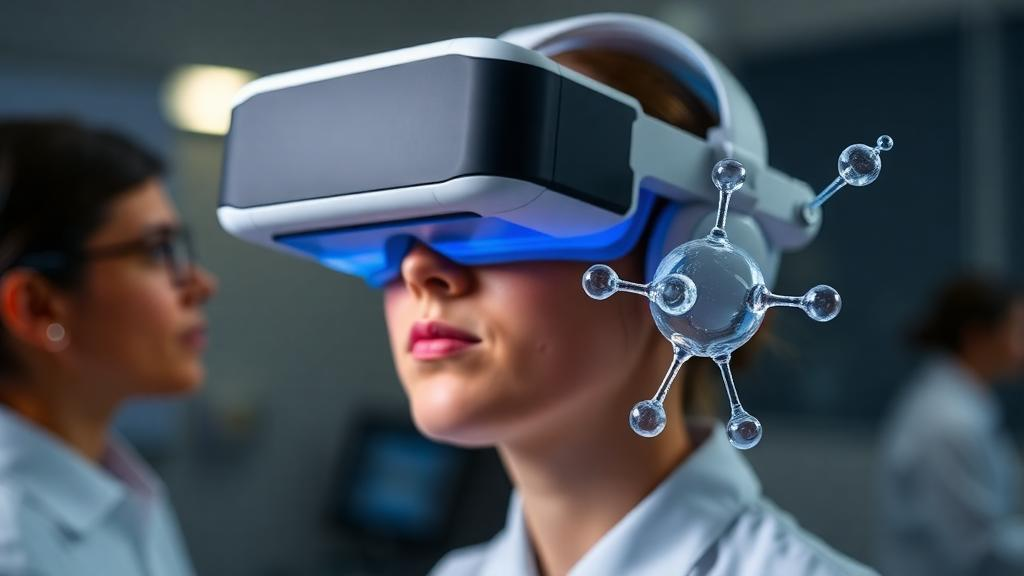
Some of the most important ideas in science are the hardest to see. Molecules jostling through a drop of water, hydrogen bonds flickering into and out of existence, particles drifting from regions of high concentration to low — these processes underpin all of chemistry and biology, yet they unfold on scales of space and time utterly alien to human experience. A team at the University of Wyoming has now built a set of augmented reality lessons that drag those invisible phenomena into the classroom, floating them in mid-air where teams of students can walk around them, grab them, and argue about them together. The work, published in Discover Education, describes the conceptualization, design, and iterative refinement of what the researchers call socially mediated augmented reality, or SoAR.
The problem the team set out to solve is a stubborn one. In many chemistry and biochemistry courses, a foundational learning goal is understanding how molecules behave in aqueous solutions. Instructors typically rely on lectures, illustrations, and videos, but these are limited by the difficulty of conveying non-intuitive three-dimensional phenomena with words and two-dimensional images. Students frequently report difficulty grasping these concepts, and previous studies note that misconceptions can persist even in advanced learners — in fact, confidence in incorrect ideas can actually increase as students progress through their undergraduate education. Compelling students to accept facts they do not understand, the authors argue, inhibits both learning and curiosity.
The SoAR modules were built on constructivist learning theory and social learning frameworks, which hold that knowledge is acquired through inherently social activity. Students work in teams of four, each wearing a Microsoft HoloLens headset that projects simulated images onto a transparent visor. Because the visor is see-through, participants retain full awareness of their surroundings and, crucially, of each other — preserving the facial expressions and non-verbal cues that make rich communication possible. Each headset carries enough computing power to render simulations on board, so there are no cables to trip over, and the headsets can be wirelessly networked so that all four students view and manipulate the same virtual objects, each from their own independent perspective.
The first module tackles Brownian motion. After a brief pre-test, students don their headsets and press a holographic button to enter a shared simulation space. A translucent cube roughly one meter on each side appears, tinted light blue to suggest water, containing fifty orange simulated molecules about the size of baseballs, each moving along the random trajectories that characterize Brownian motion. Students can walk around the cube, grab its frame with either hand, and reposition or rescale it. This orientation phase typically lasts about three minutes before the group advances together.
The heart of the design is a jigsaw-style division of information. Each student receives a role title displayed above their head: a thermal engineer who alone can manipulate a holographic slider adjusting the temperature from just above freezing to just below boiling; two data visualization specialists, one seeing a single molecule leave a tail tracing its random path and the other seeing real-time vectors indicating a molecule’s direction and magnitude of movement; and a quantitative specialist with a private graph showing the real-time relationship between average molecular movement and temperature. Because no single student can see everything, the team is compelled to talk, teach each other, and collaboratively assemble a complete explanatory model of what the simulation is showing.
Assessment is woven directly into the experience. At two points, floating questions appear in the simulated environment, each with six possible answers rendered as dynamic 3D depictions of molecular movement — one correct, showing random motion, and others showing non-random progressions or periodic patterns. Students answer by poking their choice with a finger. In the first round, disagreement is allowed to stand; after a second exploration phase in which all controls and displays become available to everyone, the module requires unanimous agreement on the correct answers before it will let the team advance. Only after collaborating toward a shared, accurate conceptualization can students complete the lesson, which is followed by an individual post-test.
The development process itself offers lessons for anyone hoping to build similar tools. The three faculty educators — a zoologist, an education professor, and a molecular biologist — met weekly to brainstorm, but found that their programmer collaborators wanted a linear process rather than academic tinkering. The solution was storyboarding, borrowed from film production: educators translated module content into a series of images depicting what should happen at each point, creating a shared lexicon that let programmers contribute their own improvements. Over roughly a year of agile collaboration, ideas matured into interactive modules deployed across groups of four networked headsets.
Iterative refinement surfaced practical constraints and clever workarounds. Synchronizing four headset recordings, each started at a different time, was solved with a single clap that functions like a film clapboard, marking an alignment point across all audio and video tracks. Spatial synchronization relies on QR codes placed on the floor or a table, which the software recognizes as the origin for spawning the simulation cube and as a reset mechanism if views drift out of alignment. Computational limits cap the simulation at roughly fifty molecules — beyond that, motion becomes so staccato that immersion collapses — and 3D spheres were replaced with shaded 2D circles whose orientation updates in real time to reduce processing load.
Not every design decision survived contact with students. Early deployments allowed unrestricted repositioning and rescaling of the simulation cube, with predictable chaos: users shrank the cube into a corner where teammates lost track of it, or enlarged it until the entire group was engulfed inside, which proved especially disorienting for a mobility-impaired student. Proctors could fix problems, but taking a headset from a participant halted conversations and shattered the immersive feeling. Later iterations constrained scaling and repositioning, preserving the sense of control while preventing extremes. Feedback from participants also revealed that groups with different degrees of preexisting relationships engaged in different levels of collaboration, prompting the team to add a questionnaire measuring social connections before each session.
The researchers frame the work within design-based research, documenting theoretical foundations, design rationale, and refinement across multiple deployment cycles, and they distill three generalizable design principles: choose hardware that preserves natural interpersonal communication, give individual team members private knowledge and private capabilities that compel them to talk, and lead students to apply new knowledge collaboratively to solve problems. An initial analysis of the first lesson showed increased knowledge of Brownian motion and increased use of relevant technical language, and the team reports that the approach has shown benefits across elementary, middle, and high school as well as undergraduate and graduate classrooms. Headsets remain expensive at roughly two to three thousand dollars each, but the software is built on the widely used Unity platform, making it portable across hardware, and the authors point to artificial intelligence as a promising route to accelerating the development of future content. For now, the modules stand as a demonstration that the molecular world, once locked behind static diagrams, can be made a place students explore together.
Subject of Research: Socially mediated augmented reality modules for teaching molecular-scale concepts in STEM education
Article Title: Using augmented reality to make the invisible visible and promote socially mediated learning in STEM classrooms
Article References: Prather, J. F., Buss, A. R., Bowman, G. R., & Summerfield, K. (2026). Using augmented reality to make the invisible visible and promote socially mediated learning in STEM classrooms. Discover Education, 5(1), Article 1180. https://doi.org/10.1007/s44217-026-02235-w
Image Credits: AI Generated
DOI: 10.1007/s44217-026-02235-w
Keywords: augmented reality, STEM education, socially mediated learning, collaborative learning, Brownian motion, molecular visualization, Microsoft HoloLens, constructivism, design-based research, science education, hydrogen bonding, diffusion
Cite Scienmag News
Courtney Benton. (October 16, 2026). Augmented Reality Headsets Turn Invisible Molecules Into Shared Classroom Experiences. Scienmag. https://scienmag.com/augmented-reality-headsets-turn-invisible-molecules-into-shared-classroom-experiences/
Courtney Benton. "Augmented Reality Headsets Turn Invisible Molecules Into Shared Classroom Experiences." Scienmag, 16 October 2026, https://scienmag.com/augmented-reality-headsets-turn-invisible-molecules-into-shared-classroom-experiences/. Accessed 16 October 2026.
Courtney Benton. "Augmented Reality Headsets Turn Invisible Molecules Into Shared Classroom Experiences." Scienmag. October 16, 2026. https://scienmag.com/augmented-reality-headsets-turn-invisible-molecules-into-shared-classroom-experiences/


