


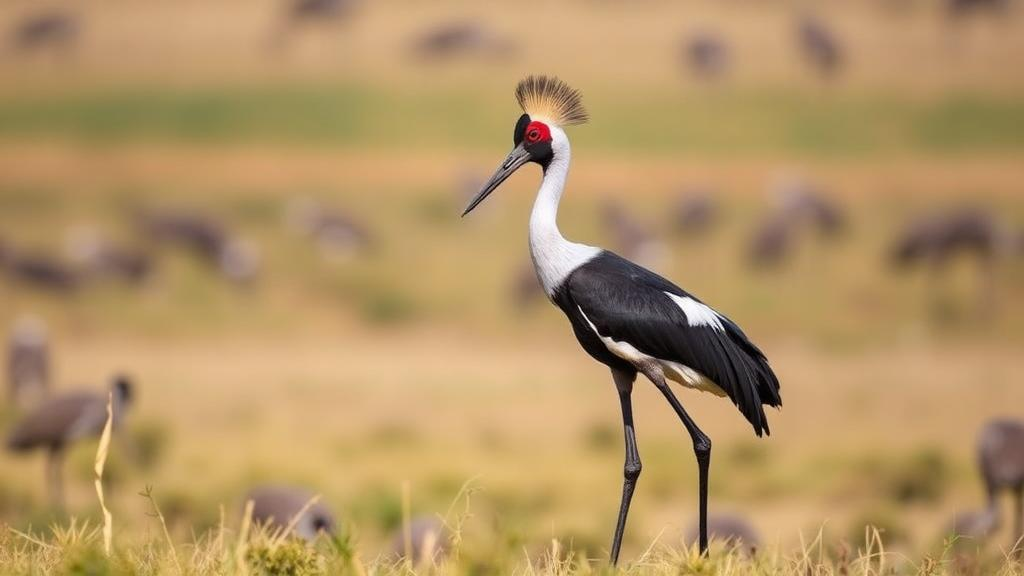
High in the Ethiopian highlands, where the air thins and night frosts bite, a team of researchers has spent three breeding seasons documenting one of Africa’s most elusive birds. The Wattled Crane, the largest and rarest of the continent’s six crane species, has revealed its breeding secrets in the Afroalpine ecosystem of Bale Mountains National Park. The findings, published in Frontiers in Bird Science, offer the first comprehensive account of how these Vulnerable birds nest, lay eggs, and raise chicks at elevations that would challenge most other birds on Earth.
The research team, led by Hadis Tadele of Madda Walabu University alongside Afework Bekele of Addis Ababa University and George Archibald and Mark van Niekerk of the International Crane Foundation, conducted intensive ground surveys across three consecutive breeding seasons from 2015 to 2017. Their work covered approximately 95 percent of the Afroalpine habitat within the park, a landscape that contains the world’s largest expanse of Afroalpine vegetation and forms part of the Eastern Afromontane biodiversity hotspot. Using a 20-60x Swarovski telescope and 10×42 Bushnell binoculars, supplemented by firsthand information from local residents and park experts, the team located and characterized every nest they could find.
Nine breeding pairs were recorded across the study period, corresponding to nine active nests. Six of these were built on isolated islands in the Sanetti Plateau, while three were constructed within wetlands at Sodota. The nests spanned an altitudinal range of 3,502 to 4,034 meters above sea level, with a mean elevation of 3,848.60 meters. This makes the Wattled Crane the second-highest breeding crane among the world’s fifteen species, surpassed only by the Black-necked Crane, which nests at elevations of up to 4,328 meters in regions such as Ladakh. The Sanetti Plateau nests sat consistently at higher elevations, clustering between 3,962 and 4,034 meters, while all Sodota nests occurred at a single lower elevation of 3,502 meters.
Nest construction relied heavily on locally dominant grasses. In the Sodota habitat, Luzula abyssinica accounted for roughly 76 percent of nest material, with Koeleria capensis contributing around 24 percent. In the Sanetti Plateau, Koeleria capensis was present in every nest and averaged 65.7 percent across the seasons, supplemented by Kniphophia foliosa, Alchemilla pedata, and Cotula abyssinica. Nest dimensions varied considerably, with mean nest length measuring 78.2 centimeters, mean width 74.0 centimeters, and mean height above the surrounding water surface 41.9 centimeters. Island nests in the Sanetti Plateau stood significantly taller above the water than wetland nests in Sodota, a difference the researchers attribute to the natural topography of the islands rather than active selection by the birds.
Clutch initiation occurred exclusively between August and October, with peak activity in September and October. Clutch sizes ranged from one to two eggs, with a mean of 1.78 eggs per nest. Seven of the nine nests contained two eggs, while two contained a single egg. No clutch exceeded two eggs, confirming the Wattled Crane’s reputation as having one of the smallest clutch sizes among all crane species worldwide. The eggs themselves were elongated and oval, with a mean length of 93.1 millimeters, mean width of 65.1 millimeters, and mean weight of 250.7 grams. Measurements from 16 eggs revealed that the first egg in a clutch was consistently larger and heavier than the second, with mean differences of 5.67 millimeters in length and 7.00 grams in weight between the two.
Hatching success proved remarkably low. Of the 16 eggs laid across the three seasons, only six hatched successfully, yielding a hatching success rate of 37.5 percent. Nest failures were attributed primarily to abandonment and predation by Thick-billed Ravens. In one directly observed predation event in 2016, an incubating female left her nest briefly to feed, and a Thick-billed Raven descended and began pecking at the eggs. The parent returned and drove the predator away before it could consume the egg, but the raven had already broken into it. Although the female resumed incubation of the remaining egg, she abandoned the nest entirely after two days. Annual nest failure showed a steady increase over the study period, with no failures in 2015, one in 2016, and two in 2017.
Yet fledging success told a strikingly different story. All six chicks that hatched survived to independence, producing a fledging success rate of 100 percent with zero chick mortality. The researchers attribute this remarkable outcome to several factors. Strong parental defense was observed against Tawny Eagles in both 2015 and 2016, with adult cranes confronting predators by flapping, leaping, and chasing them away while the other parent guided the chick to safety. Camouflage strategies proved equally critical, particularly during the first one to two weeks after hatching when chicks could not travel long distances. Parents concealed their young in patches of Charex monostachya, a grass whose brown hue closely matched the chicks’ coloration, and later in dense Helichrysum splendidum shrubs whose structure and color provided excellent cover.
Nest-site fidelity was high across the study period, estimated at 66.67 percent. Pairs in the Sanetti Plateau returned to the same two small islands year after year, with one island hosting nesting at precisely the same spot for three consecutive seasons. In the Sodota wetland, pairs exhibited strong fidelity to the general nesting area, constructing nests in the same wetland across breeding seasons despite slight variation in specific locations. However, because individual birds were not ringed, the researchers could not confirm whether the same pairs returned to these sites each year. The overall nesting density was calculated at 0.0025 pairs per hectare across 3,585 hectares of suitable habitat, reflecting the extremely sparse distribution of this population.
The study highlights the Wattled Crane’s reliance on undisturbed wetlands with islands, abundant food, and minimal human disturbance as the key drivers of its remarkable fledging success in the Afroalpine habitat. The park’s legal protection from human activity appears to have created conditions where chick survival approaches the theoretical maximum, contrasting sharply with populations elsewhere that face crop harvesting, deliberate killings, and habitat encroachment. The researchers note that the open Afroalpine nesting environment, characterized by very limited vegetation cover above nests, likely increases visibility to aerial predators and may elevate the risk of avian predation, explaining the low hatching success despite the high fledging rate.
Conservation implications extend beyond the immediate findings. The relatively low reproductive success, combined with the limited number of nesting sites, underscores the vulnerability of this population. The researchers recommend strengthening collaboration with existing conservation programs, habitat restoration including the creation of artificial islands, and continuous ecological monitoring to ensure the long-term survival of the species in the Afroalpine habitat. Future studies should aim to quantify habitat availability, evaluate nesting success in relation to environmental variables, and assess movement patterns and site fidelity through individual marking. The Afroalpine wetlands of Bale Mountains National Park represent one of the most important breeding habitats for Wattled Cranes in Ethiopia, and maintaining their hydrological integrity while minimizing disturbance during the breeding season will be essential for the persistence of this threatened species at the roof of Africa.
Subject of Research: Nest-site selection and breeding ecology of the Wattled Crane (Bugeranus carunculatus) in the Afroalpine ecosystem of Bale Mountains National Park, Southeast Ethiopia
Article Title: Nest-site selection and breeding ecology of the Wattled Crane (Bugeranus carunculatus) in the Afroalpine ecosystem of Bale Mountains National Park, Southeast Ethiopia
Article References: Tadele, H., Bekele, A., Archibald, G., & van Niekerk, M. (2026). Nest-site selection and breeding ecology of the Wattled Crane (Bugeranus carunculatus) in the Afroalpine ecosystem of Bale Mountains National Park, Southeast Ethiopia. Frontiers in Bird Science, 5, Article 1787991. https://doi.org/10.3389/fbirs.2026.1787991
Image Credits: AI Generated
DOI: 10.3389/fbirs.2026.1787991
Keywords: Nest-site, selection, breeding, ecology, Wattled, Crane, Bugeranus, carunculatus, Afroalpine, ecosystem, Bale, Mountains
Cite Scienmag News
Gavin Prescott. (October 16, 2026). Ethiopia’s Wattled Cranes Reveal Breeding Secrets at 4,000 Meters. Scienmag. https://scienmag.com/ethiopias-wattled-cranes-reveal-breeding-secrets-at-4000-meters/
Gavin Prescott. "Ethiopia’s Wattled Cranes Reveal Breeding Secrets at 4,000 Meters." Scienmag, 16 October 2026, https://scienmag.com/ethiopias-wattled-cranes-reveal-breeding-secrets-at-4000-meters/. Accessed 16 October 2026.
Gavin Prescott. "Ethiopia’s Wattled Cranes Reveal Breeding Secrets at 4,000 Meters." Scienmag. October 16, 2026. https://scienmag.com/ethiopias-wattled-cranes-reveal-breeding-secrets-at-4000-meters/


