


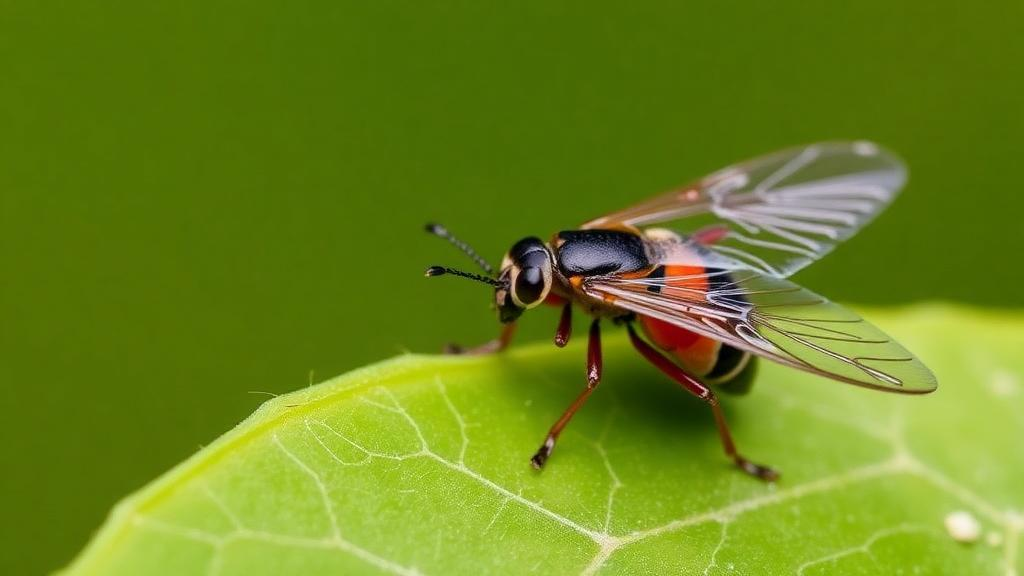
Aphids are among agriculture’s most persistent adversaries, and a new modeling study has revealed just how cunning these tiny sap-suckers can be when facing their deadliest enemies. Researchers have developed a preliminary mathematical framework showing that the mere presence of predators—such as ladybugs—can trigger a remarkable transformation in aphid populations, causing wingless mothers to produce winged offspring capable of escaping to previously uninfested crops. The findings, published in the journal BioRisk, could reshape how farmers and pest managers think about biological control strategies that rely on predatory insects.
The study, led by researchers investigating the green peach aphid Myzus persicae, integrates population theory with experimental greenhouse data to simulate a tri-trophic interaction between wingless (apterous) aphids, winged (alate) aphids, and their predators. The model, built on a system of three ordinary differential equations, extends the classic Lotka–Volterra predator–prey framework by partitioning the aphid population into two distinct morphs, each with its own dynamics. The wingless form focuses on reproduction, while the winged form serves as an escape mechanism, emigrating from danger zones to colonize new territory.
Polyphenism—the ability of a single genotype to produce different phenotypes in response to environmental cues—is a hallmark of aphid biology. Temperature, diet, and predator threats can all trigger developmental switches that yield vastly different body forms from the same genetic blueprint. When wingless aphids detect cues such as alarm pheromones or physical disturbance from predators, they begin allocating their reproductive effort toward winged offspring rather than more wingless young. This transgenerational shift effectively sacrifices immediate reproductive output to safeguard the lineage through dispersal.
While this plasticity is a marvel of evolutionary adaptation, it creates a genuine paradox for biological control. Predators such as ladybugs are essential allies in managing aphid populations, yet their very presence can inadvertently trigger the dispersal of winged aphids to new, unaffected areas of a plantation. A farmer who releases ladybugs to control an aphid outbreak may, in effect, be accelerating the spread of the pest to neighboring fields. Understanding this dynamic is therefore critical for designing effective and sustainable pest management strategies that harness predation without provoking mass escape events.
The new model draws heavily on experimental work by Sentis and colleagues, who demonstrated in the pea aphid Acyrthosiphon pisum that the presence of the harlequin ladybird Harmonia axyridis increases the production of winged offspring, with the strength of this response depending on the host plant. Alfalfa-specialized lineages showed a stronger plastic response than clover-specialized ones, suggesting that host plant specialization shapes herbivore reactions to predators within a tri-trophic context. The researchers behind the new framework adapted this insight to their own system, using Myzus persicae on broccoli as a favorable host—akin to alfalfa—and basil as a repellent host—akin to clover—acknowledging that direct equivalence is not implied due to species and plant differences.
To ground the model in real biological parameters, the team conducted greenhouse experiments at the ESALQ/USP Department of Entomology and Acarology in Piracicaba, Brazil. Using a randomized block design with two treatments—broccoli grown alone and broccoli intercropped with basil—they placed three adult wingless aphids on each broccoli plant and recorded total aphid numbers after 72 hours. The intrinsic growth rate on broccoli was estimated at 0.31, while on basil-intercropped broccoli it dropped to –0.16, indicating that basil’s repellent properties significantly lowered aphid population growth (p = 0.0375). These experimentally derived growth rates were then incorporated into the model’s equations.
The model’s structure captures the essence of aphid–predator interactions with impressive technical detail. Wingless aphids grow logistically but divert reproduction to winged forms under threat, suffer background mortality, and are consumed by predators through a type II functional response that accounts for predator saturation at high prey densities. Winged aphids are produced via polyphenism from wingless mothers, grow logistically, suffer the same mortality and predation pressures, and emigrate at a constant per-capita rate—reflecting their adaptive role in escaping threats. Predators grow by consuming both aphid morphs, with their population dynamics governed by conversion efficiency and natural mortality.
The simulation results are striking. Without predators, wingless aphids predominate and winged forms quickly go extinct due to the lack of an induction cue. With predation, however, the model shows that winged aphid populations become sustained and reach approximately twice the size of the wingless population, highlighting the dramatic polyphenic response triggered by predator presence. The repellent effect of basil in an intercrop scenario drives both aphid populations—and consequently the predator population—to extinction, demonstrating how host plant choice can fundamentally alter the outcome of predator–prey interactions.
Bifurcation analysis, used here primarily as a sensitivity tool, revealed that the predator’s attack rate and conversion efficiency are pivotal parameters in determining the strength of alate induction. Aphid populations decline across a range of conversion efficiencies from 0 to 0.1, followed by a peak where winged forms exceed wingless ones. A similar decline occurs across attack rates from 0 to 0.35, with winged aphids peaking just before the attack rate reaches 0.3. These findings underscore how the intensity of predation pressure directly shapes whether aphid colonies respond with modest or massive dispersal events.
The researchers acknowledge limitations in this preliminary framework, particularly the lack of experimental estimates for several model parameters. The initial values were chosen to enable simulations across a parameter range that demonstrates the model’s potential to describe the mechanisms modulating wing polyphenism. Nevertheless, the growth rate estimates were obtained experimentally under scenarios designed to assess plant-specific effects on aphid repellency, and the attack rate and conversion efficiency parameters were explored through parametric sensitivity analysis. As a first step toward a predictive tool for sustainable pest management, this framework opens a compelling new frontier in understanding how the invisible arms race between predators and prey plays out across agricultural landscapes—one winged aphid at a time.
Subject of Research: Predator-induced wing polyphenism in aphids modeled through a tri-trophic differential equation framework
Article Title: A preliminary framework to model wing polyphenism in aphids threatened by predators
Article References: Carvalho, R. M. R., & Godoy, W. A. C. (2026). A preliminary framework to model wing polyphenism in aphids threatened by predators. BioRisk, 24, 17-26. https://doi.org/10.3897/biorisk.24.171467
Image Credits: AI Generated
DOI: 10.3897/biorisk.24.171467
Keywords: aphids, wing polyphenism, biological control, predator-prey dynamics, Myzus persicae, polyphenism, pest management, host plant effects, ladybugs, mathematical modeling, tri-trophic interactions, greenhouse experiments
Cite Scienmag News
Reid Dalton. (October 16, 2026). When Ladybugs Strike, Aphids Grow Wings: New Model Reveals Predator-Triggered Escape Strategy. Scienmag. https://scienmag.com/when-ladybugs-strike-aphids-grow-wings-new-model-reveals-predator-triggered-escape-strategy/
Reid Dalton. "When Ladybugs Strike, Aphids Grow Wings: New Model Reveals Predator-Triggered Escape Strategy." Scienmag, 16 October 2026, https://scienmag.com/when-ladybugs-strike-aphids-grow-wings-new-model-reveals-predator-triggered-escape-strategy/. Accessed 16 October 2026.
Reid Dalton. "When Ladybugs Strike, Aphids Grow Wings: New Model Reveals Predator-Triggered Escape Strategy." Scienmag. October 16, 2026. https://scienmag.com/when-ladybugs-strike-aphids-grow-wings-new-model-reveals-predator-triggered-escape-strategy/


