


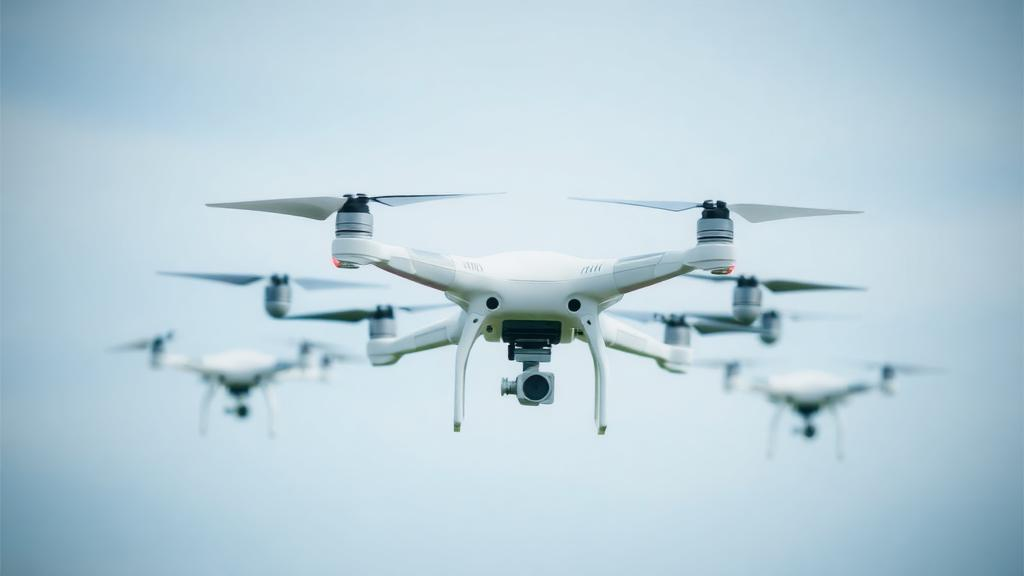
Coordinating a swarm of unmanned aerial vehicles is hard enough when every aircraft is identical. It becomes exponentially harder when the fleet mixes different vehicle types, each with its own speed, endurance, and sensor payload, and when the mission demands that specific groups of vehicles arrive at their targets not just in the right order but at exactly the same moment. A new study published in the International Journal of Aeronautical and Space Sciences presents a unified computational framework that tackles this integrated task-path coordination problem, and its results suggest that large heterogeneous swarms can be orchestrated with a precision that previous approaches could not reliably achieve.
The research, led by Yan Zhang of the National Key Laboratory of Radar Signal Processing at Xidian University together with Guangxun Du, Feng Luo, and Yueqian Liang of the Information Sciences Academy of CETC in Beijing, addresses a gap that has persisted across the mission-planning literature. While individual studies have tackled task allocation, path planning, or synchronization in isolation, the authors note that no prior work has simultaneously handled the full combination of constraints their framework targets: capability-based task requirements, variable-sized vehicle subsets, strict multi-vehicle simultaneity, cross-domain compatibility between different types of unmanned platforms, and complex precedence and synchronization dependencies among tasks.
At the heart of the problem is a coupling that has long frustrated mission planners. Deciding which vehicles should perform which tasks and deciding what flight paths those vehicles should follow are not independent questions. The timing of a synchronized strike, for example, depends on how long each vehicle takes to reach the target, which depends on its path, which in turn depends on where it was sent in the first place. Solving these layers sequentially with naive methods risks producing plans that look feasible on paper but fall apart once real trajectories are substituted for rough estimates.
The framework the researchers propose is a two-layer swarm intelligence architecture that hierarchically decomposes the problem. The upper layer handles task allocation using a continuous encoding scheme, a mathematical representation that allows metaheuristic search algorithms to explore the space of possible assignments smoothly rather than jumping between discrete configurations. Offline preprocessing steps guarantee that constraint satisfaction is built into the encoding itself, so that infeasible assignments are filtered out before they ever reach the trajectory stage.
The lower layer is devoted to path synchronization, and it is here that the framework introduces what the authors identify as a key innovation: a bias-free coupling between the two layers. The allocation layer computes travel costs using a max-time formulation, meaning it evaluates each candidate assignment according to the slowest vehicle in the group rather than the average. A rigorous endurance check then embeds the exact temporal slack that the synchronization layer will later need. The result is a guarantee that no plan deemed feasible during allocation becomes infeasible after the actual trajectories are adjusted to meet synchronization requirements.
To absorb that temporal slack, the synchronization layer deploys four adaptive strategies: circular loitering, in which a vehicle orbits a holding point until its appointed arrival time; constant-altitude transition, which adjusts timing while maintaining a fixed altitude; constant-heading transition, which preserves a vehicle’s direction of travel while modulating its path; and free transition, which allows full three-dimensional maneuvering when no directional or altitudinal constraints apply. A four-layer selection mechanism chooses among these strategies based on the operational domain, the available maneuvering space, heading requirements, and the magnitude of the delay that must be absorbed.
The elegance of this design lies in its conservatism. Because the allocation layer deliberately overestimates travel time using the max-time cost, it reserves more endurance budget than any real trajectory will actually consume. When the synchronization layer later refines the paths, it draws on that reserved slack, tightening the timing without ever exceeding the resources the allocation layer already accounted for. This eliminates a failure mode common in loosely coupled approaches, where trajectory refinement invalidates the assumptions under which tasks were assigned.
Validation was extensive. The researchers ran simulations across scenarios involving up to 50 vehicles and 16 tasks, evaluated under four different objective functions. They compared eight metaheuristic algorithms within their framework and benchmarked the overall approach against an exact mixed integer linear programming solver. The comparative studies confirmed that the framework achieves a superior balance between solution quality and computational efficiency, finding near-optimal plans in a fraction of the time required by exact methods while scaling to problem sizes that would overwhelm classical solvers.
The significance of this work extends beyond the specific benchmarks. Heterogeneous swarms are increasingly central to both civilian and defense applications, from coordinated environmental monitoring that pairs aerial and maritime platforms to search-and-rescue operations that must combine the endurance of fixed-wing aircraft with the hovering precision of rotorcraft. Each of these scenarios embeds the same structural difficulty: tasks that require specific capabilities, groups of vehicles that must act together, and sequences in which the completion of one task gates the start of another. A framework that handles all of these features simultaneously, while guaranteeing that feasibility survives the transition from assignment to trajectory, provides a reusable foundation for mission planners across domains.
The authors acknowledge the broader context of swarm research, citing surveys that document the rapid growth of UAV swarm studies and the persistent challenge of integrating task assignment with path planning under realistic operational constraints. Their contribution is to show that the coupling problem, long treated as a reason to simplify assumptions, can instead be engineered around: by designing the two layers to share a common, conservative accounting of time and endurance, the framework turns a source of fragility into a source of rigor. As unmanned systems grow more capable and missions grow more complex, approaches that preserve feasibility by construction rather than by after-the-fact repair may prove to be the template that autonomous swarm coordination has been waiting for.
Subject of Research: Integrated task allocation and path synchronization for heterogeneous unmanned vehicle swarms using a two-layer swarm intelligence optimization framework
Article Title: Task-Path Coordination for Heterogeneous Swarms with Complex Dependency and Synchronization Requirements: A Swarm Intelligence Framework
Article References: Zhang, Y., Du, G., Luo, F., & Liang, Y. (2026). Task-Path Coordination for Heterogeneous Swarms with Complex Dependency and Synchronization Requirements: A Swarm Intelligence Framework. International Journal of Aeronautical and Space Sciences. https://doi.org/10.1007/s42405-026-01304-6
Image Credits: AI Generated
DOI: 10.1007/s42405-026-01304-6
Keywords: heterogeneous swarms, task allocation, path synchronization, swarm intelligence, UAV mission planning, metaheuristic optimization, mixed integer linear programming, multi-vehicle coordination, unmanned aerial vehicles, constraint satisfaction, computational efficiency, aerospace engineering
Cite Scienmag News
Grant Pearson. (October 16, 2026). New Swarm Intelligence Framework Orchestrates Heterogeneous Drone Fleets With Split-Second Timing. Scienmag. https://scienmag.com/new-swarm-intelligence-framework-orchestrates-heterogeneous-drone-fleets-with-split-second-timing/
Grant Pearson. "New Swarm Intelligence Framework Orchestrates Heterogeneous Drone Fleets With Split-Second Timing." Scienmag, 16 October 2026, https://scienmag.com/new-swarm-intelligence-framework-orchestrates-heterogeneous-drone-fleets-with-split-second-timing/. Accessed 16 October 2026.
Grant Pearson. "New Swarm Intelligence Framework Orchestrates Heterogeneous Drone Fleets With Split-Second Timing." Scienmag. October 16, 2026. https://scienmag.com/new-swarm-intelligence-framework-orchestrates-heterogeneous-drone-fleets-with-split-second-timing/


