


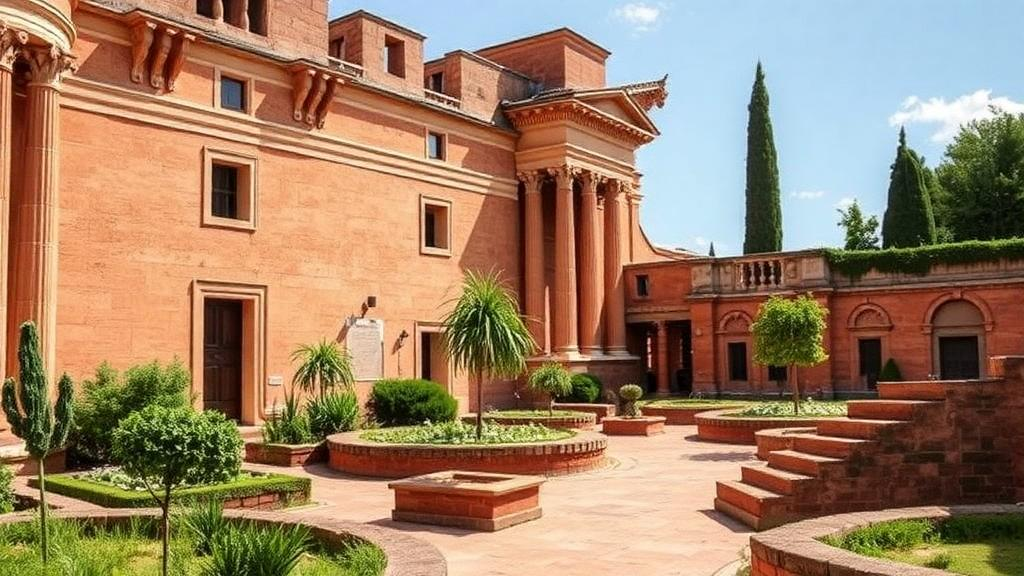
Long before green roofs and urban heat-island maps, the Romans were already running a deliberate program of urban environmental engineering—using gardens, groves, water features, and even window boxes to fight the heat, noise, and pollution of their overcrowded capital. That is the central claim of a new review published in Frontiers in Horticulture, in which classicist Maciej Helbig of Poland re-reads Latin literary sources from Pliny the Elder to Martial and argues that Roman green spaces were not eccentric luxuries of the elite but purposeful refuges, deliberately designed to mitigate the stressors of ancient city life. The study, Helbig writes, shows that the struggle with the polluted, overheated city is not a modern problem at all: humans have been battling it for millennia, and the Romans left behind a sophisticated, time-tested playbook.
Helbig’s method is philological. Rather than treating Roman gardens purely as symbols of status, he mines the texts of prose authors such as Pliny the Elder, Pliny the Younger, Columella, and Seneca, alongside poets like Vergil, Horace, Catullus, and Martial, for concrete descriptions of how green spaces were built, planted, and used. The sources consistently depict these green enclaves as noticeably cooler, shaded retreats that temper oppressive heat—what the Romans called aestus—and dampen the din of the city, or strepitus. Integrated water features and dense canopies were credited with purifying the air and restoring both bodily health and mental tranquility. In other words, the ancient testimonies describe what modern science would recognize as microclimate engineering.
The technical details in the sources are strikingly precise. Ornamental pools, or piscinae, could occupy nearly half of a peristyle garden, and their function went far beyond decoration. Water’s high specific heat capacity—roughly four times that of soil or masonry—allowed a large pond to absorb surplus heat during the afternoon and release it slowly overnight, acting as a diurnal thermal store. Miniature cascades and jet fountains, the salientes, drove evaporative cooling, stripping sensible heat from the adjacent air. Roman proprietors sited these basins deliberately at the heart of peristyle gardens so that prevailing summer breezes would carry cooled, moistened air into colonnaded walkways and dining rooms, a detail Pliny the Younger himself describes in his letters. Pliny the Elder even records an estate with modest fishponds selling for 40 million sesterces, underlining how valuable these watery retreats were considered to be.
Plant selection was equally calculated. The oriental plane tree, a staple of the Roman viridarium, has large thin leaves and a notoriously high transpiration rate—ancient writers noted that the plane
What makes the Roman case more than a curiosity is that the mechanisms their authors described map closely onto processes that modern environmental science has since quantified. Evaporative cooling, for instance, is now understood as one of the most effective passive strategies for tempering hot microclimates: every gram of water that evaporates removes a substantial quantity of latent heat from the surrounding air. The salientes and cascades celebrated in Latin poetry were, in effect, unpowered evaporative coolers, and the shaded colonnades that ringed a peristyle trapped the cooled air in exactly the way a modern courtyard design intends to. Similarly, the thermal buffering that Helbig attributes to large pools reflects the well-documented capacity of water bodies to flatten temperature extremes, moderating both afternoon peaks and nighttime lows in the spaces immediately around them.
The plane tree that ancient writers singled out deserves particular attention. Platanus orientalis is among the most transpiration-hungry temperate trees known, and its broad, thin leaves maximize both light interception and water vapor exchange. Modern urban climatology has confirmed that a single mature tree can transpire hundreds of liters of water on a hot day, lowering the local air temperature by several degrees relative to unshaded pavement. The Romans, without the vocabulary of latent heat or stomatal conductance, nonetheless observed the outcome: the plane’s shade was famously cool, so much so that Pliny noted its habit of shedding its bark and offering little fruit as acceptable trade-offs for the comfort it provided. Their willingness to accept a tree valued for function rather than yield is itself evidence that the choice was performance-driven.
The literary record also captures an intuitive grasp of what modern researchers call the psychological restoration pathway. Seneca and the poets describe gardens not merely as cooler places but as settings that restore the mind, a claim that contemporary research on attention restoration and stress reduction has repeatedly supported. Views of vegetation, the sound of moving water, and the masking of street noise all measurably lower physiological stress markers. The Roman pairing of water features with dense planting and seclusion from the street thus anticipated, in practical form, the design principles that underpin today’s therapeutic landscapes and biophilic architecture. The philosophical framing Helbig traces—Epicurean and Stoic ideals linking rural seclusion to otium et salus, leisure and health—gave these spaces a moral legitimacy that reinforced their persistence across centuries.
It is worth emphasizing how distributed the practice was across social strata. The elite villa with its forty-million-sesterce fishponds sits at one end of a spectrum that includes modest peristyle gardens in Pompeian townhouses, container plants squeezed into light wells, and the window boxes Martial describes with evident affection. This gradient matters for modern policy debates, because it suggests that the benefits of urban greenery were understood to scale: even a few pots in a courtyard addressed sensory needs—fragrance, shade, visual relief—when space for a full garden was unavailable. Rooftop cultivation, which Seneca mentions with a note of amusement at pomaria grown atop walls, appears again in later sources describing multi-storey buildings irrigated by animal-driven water wheels, indicating that vertical greening was technically feasible in the ancient world wherever water could be lifted economically.
The public dimension of Roman greening is equally instructive. Maecenas’s conversion of a burial ground on the Esquiline into a planted park is one of the earliest documented examples of repurposing marginal urban land for green amenity, a strategy that modern cities have rediscovered under names like brownfield reclamation and park-in-a-plot. Vespasian’s shaded precincts near the Temple of Pax show imperial patronage extending green relief into the densest districts, while the practice of opening private estates for communal use blurred the line between private luxury and public infrastructure. In modern terms, the Romans were experimenting with what planners now call green-space equity: distributing the cooling and calming benefits of vegetation beyond the wealthiest households.
None of this implies that ancient Rome solved its environmental problems. The city’s smoke, its crowds, and its summer heat remained constants that literary sources complain about across generations, and the green refuges described in the texts served a minority of residents most of the time. But that is precisely the lesson Helbig’s review offers the present: urban environmental stress is a persistent condition of dense settlement, not a novel failure of the modern age, and the response to it—layered vegetation, water, shade, and deliberate design—has a track record measured in millennia. The Roman evidence suggests that the current wave of urban greening, from sponge cities to pocket parks, is less an innovation than a rediscovery, and that the oldest surviving playbook for making dense cities habitable was written in Latin.
Subject of Research: The groves and the gardens as horticultural strategies for urban environmental resilience in ancient Rome: a multidisciplinary analysis of green oases as mitigation of stressors
Article Title: The groves and the gardens as horticultural strategies for urban environmental resilience in ancient Rome: a multidisciplinary analysis of green oases as mitigation of stressors
Article References: Helbig, M. (2026). The groves and the gardens as horticultural strategies for urban environmental resilience in ancient Rome: a multidisciplinary analysis of green oases as mitigation of stressors. Frontiers in Horticulture, 5, Article 1870097. https://doi.org/10.3389/fhort.2026.1870097
Image Credits: AI Generated
DOI: 10.3389/fhort.2026.1870097
Keywords: groves, gardens, horticultural, strategies, urban, environmental, resilience, ancient, Rome, multidisciplinary, analysis, green
Cite Scienmag News
Martin Reynolds. (October 16, 2026). Ancient Rome’s Gardens Were Engineered Climate Refuges, Not Just Luxury. Scienmag. https://scienmag.com/ancient-romes-gardens-were-engineered-climate-refuges-not-just-luxury/
Martin Reynolds. "Ancient Rome’s Gardens Were Engineered Climate Refuges, Not Just Luxury." Scienmag, 16 October 2026, https://scienmag.com/ancient-romes-gardens-were-engineered-climate-refuges-not-just-luxury/. Accessed 16 October 2026.
Martin Reynolds. "Ancient Rome’s Gardens Were Engineered Climate Refuges, Not Just Luxury." Scienmag. October 16, 2026. https://scienmag.com/ancient-romes-gardens-were-engineered-climate-refuges-not-just-luxury/


