


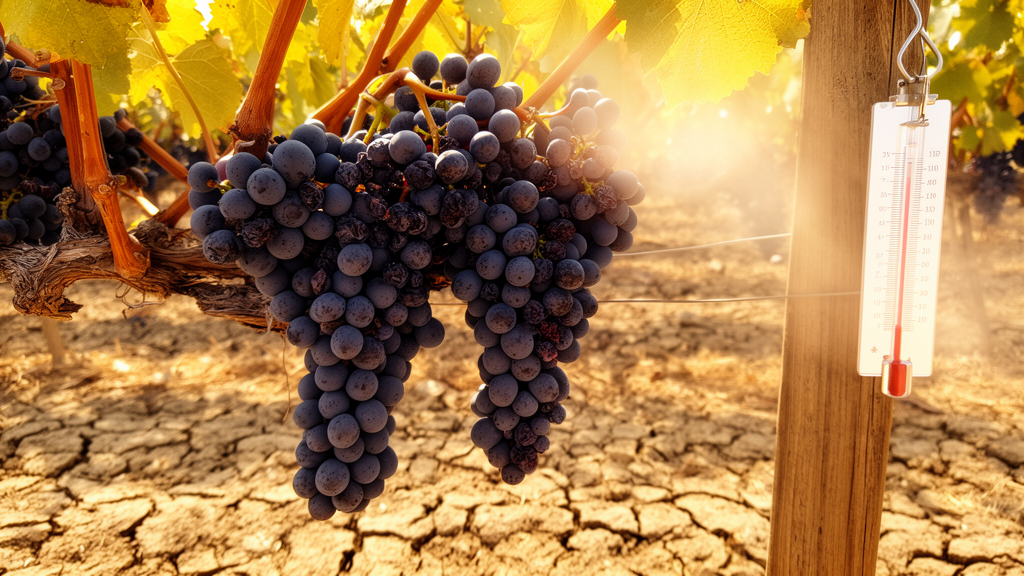
In the cool-climate vineyards of Marlborough, New Zealand, researchers have simulated a summer heatwave directly on Pinot noir grape bunches and watched the berries respond in real time. A team from Plant & Food Research, part of the New Zealand Institute for Bioeconomy Science, heated Pinot noir clusters for seven days at the onset of ripening, pushing berry temperatures to a diurnal range of 20 to 39 degrees Celsius while unheated control bunches sat at a cooler 11 to 31 degrees. The findings, published in Frontiers in Plant Physiology, show that this single week of heat measurably eroded two of the pillars of premium red wine quality: the acidity of the pulp and the pigmentation of the skin.
The experiment was designed to isolate the direct effect of temperature from the confounding influence of sunlight and whole-vine physiology. Using a fan-assisted air delivery system adapted from whole-tree gas exchange equipment, the researchers directed warm air through flexible ducts positioned beneath individual bunches, achieving a target temperature differential of roughly 10 degrees Celsius. Thermocouples inserted just under the berry skin recorded temperatures every five minutes, revealing that heated bunches never dropped below 17 degrees and peaked near 40 degrees during the hottest part of the day. The accumulated heat, measured as growing degree days, roughly doubled for heated bunches compared with controls during the treatment window.
Heating was applied continuously over seven days when the bunches had reached mid-véraison, the stage at which half the berries show the first signs of color change. In 2014 the treatment ran from midday on February 11 until midday on February 18, and in 2015 from February 16 to 23. Berry sampling was intensive: composite samples of 24 berries per experimental bay were collected every four hours during the first 48 hours of heating in 2014, then daily during heating in 2015 and every four to seven days afterward until harvest. Berries were frozen at minus 80 degrees, and the skins were carefully scored and lifted from the pulp so that pigments, acids, sugars, and hormones could be quantified in separate tissues.
The chemical analysis delivered a clear verdict on the pulp. Sugar accumulation was essentially untouched: glucose, fructose, and sucrose concentrations showed little response to heating, consistent with earlier bunch-heating studies. Tartaric acid, the other major grape organic acid, was not consistently altered. Malic acid, however, told a different story. By day 6 of the experiment, malic acid concentrations were 25 percent lower in heated berries in 2014 and 16 percent lower in 2015 compared with unheated bunches. Titratable acidity fell in parallel, and juice pH rose, although these differences had largely disappeared by harvest time. The study established that for a 10-degree increase in berry temperature above ambient, it takes three to four days for the hastened decline in malic acid to become apparent.
The skin pigments responded on a different schedule and with seasonal nuance. Five anthocyanin species were detected in the skins, with malvidin-3-O-glucoside the most abundant, accounting for roughly half of the anthocyanin glucosides throughout ripening. In 2014, heating significantly reduced malvidin, peonidin, and petunidin glucosides as well as total anthocyanins from day 4 of heating onward, and the suppression persisted until harvest. In 2015, the effect was far milder: only petunidin and delphinidin glucosides were significantly reduced, while the other anthocyanins and the total pool were largely unaffected. Notably, no effect of heating on anthocyanin concentrations was observed during the first 48 hours of treatment in either year, indicating a lag of up to four days between heat perception and measurable pigment change.
The key to that seasonal disparity appears to be abscisic acid, the hormone that triggers grape ripening and the onset of anthocyanin accumulation. Peak concentrations of free, active ABA at the onset of véraison were 30 percent higher in 2015 than in 2014, and the 2015 season was notably drier, with significantly less rainfall before and during véraison. The researchers speculate that mild-to-moderate water stress in the drier year elevated berry ABA concentrations enough to augment anthocyanin accumulation and thereby mask the inhibitory effect of heat seen in 2014. Supporting this interpretation, the conjugated storage form of ABA, the ABA-glucose ester, increased by as much as 40 percent in heated berries by the end of the heating period and remained elevated afterward in both years.
Gene expression analysis revealed how quickly the berries registered the heat. The heat shock transcription factor HsfA2 showed strong elevation in transcript abundance within four hours of heating commencing, peaking around midday during the first three to four days of treatment. Yet the downstream responses unfolded much more slowly. Changes in the expression of genes and transcription factors regulating malic acid and anthocyanins took two or more days to respond, and the magnitude of those transcriptional shifts was mostly proportional to the metabolite concentrations ultimately observed. This temporal decoupling between heat perception and compositional change is a central technical insight of the study.
On the anthocyanin side, qPCR showed that the structural genes chalcone synthase, dihydroflavonol reductase, and UDP-glucose flavonoid glucosyltransferase were downregulated by heating in 2014, with the reduction in UFGT, the gene controlling the final step of anthocyanin synthesis, taking at least two days to manifest. The transcription factor MYB5a, a general activator of phenylpropanoid genes, was reduced one day after heating, while the repressor MYB4a was upregulated within eight to sixteen hours of heat perception, apparently triggered by the HsfA2 spike. RNA sequencing on day 4 of heating in 2015 confirmed the downregulation of chalcone synthase and revealed broader suppression of phenylpropanoid variants and flavonoid hydroxylase genes, even as some late-pathway genes appeared upregulated in that single snapshot.
For malic acid, the regulatory picture centered on malic enzyme. Cytosolic NADP-dependent malic enzyme expression was upregulated by heating in both seasons, consistent with accelerated breakdown of malate into pyruvate. Fumarate hydratase, which can contribute to malate synthesis, was also upregulated, but the researchers conclude that any potential increase in synthesis was counteracted by the concurrent rise in malic enzyme activity. Genes associated with glycolysis and gluconeogenesis, including phosphoenolpyruvate carboxylase and carboxykinase, were downregulated, effectively closing off alternative routes for malate accumulation or dissimilation. The net effect of these interacting processes was a temporary but significant reduction in malic acid in heated berries.
The broader implication is sobering for cool-climate wine regions. Pinot noir carries a nonsense mutation in the gene encoding anthocyanin 3-O-glucoside-6-O-acyltransferase, rendering it unable to synthesize the acylated anthocyanins that lend other red varieties greater stability against heat, light, and the rigors of fermentation. Without that biochemical buffer, Pinot noir berries appear more vulnerable to heat-driven pigment loss. The study demonstrates that hot periods with daily maxima approaching 40 degrees Celsius sustained over a week can directly alter the ripening trajectory of Pinot noir, reducing organic acids and anthocyanins and desynchronizing the accumulation of primary and secondary metabolites that together define berry maturity balance at harvest.
Subject of Research: Effects of bunch heating on Pinot noir grape ripening, anthocyanin and malic acid concentrations, and their gene regulation
Article Title: Effects of bunch heating on Pinot noir grape ripening: changes in berry anthocyanin and malic acid concentrations and their regulation
Article References: Bennett, J. S., Albright, A. L., Friend, A. P., Boldingh, H., Cooney, J., Elborough, C., Kirk, R. A., Nguyen, H. M., Deng, C., Plunkett, B. J., Martin, D., & Espley, R. V. (2026). Effects of bunch heating on Pinot noir grape ripening: changes in berry anthocyanin and malic acid concentrations and their regulation. Frontiers in Plant Physiology, 3, Article 1701827. https://doi.org/10.3389/fphgy.2025.1701827
Image Credits: AI Generated
DOI: 10.3389/fphgy.2025.1701827
Keywords: Pinot noir, grape ripening, heat stress, anthocyanins, malic acid, abscisic acid, véraison, climate change, wine quality, gene expression, New Zealand, viticulture
Cite Scienmag News
Juliet Wilcox. (October 16, 2026). Simulated Heatwaves Strip Pinot Noir Grapes of Acidity and Color. Scienmag. https://scienmag.com/simulated-heatwaves-strip-pinot-noir-grapes-of-acidity-and-color/
Juliet Wilcox. "Simulated Heatwaves Strip Pinot Noir Grapes of Acidity and Color." Scienmag, 16 October 2026, https://scienmag.com/simulated-heatwaves-strip-pinot-noir-grapes-of-acidity-and-color/. Accessed 16 October 2026.
Juliet Wilcox. "Simulated Heatwaves Strip Pinot Noir Grapes of Acidity and Color." Scienmag. October 16, 2026. https://scienmag.com/simulated-heatwaves-strip-pinot-noir-grapes-of-acidity-and-color/


