


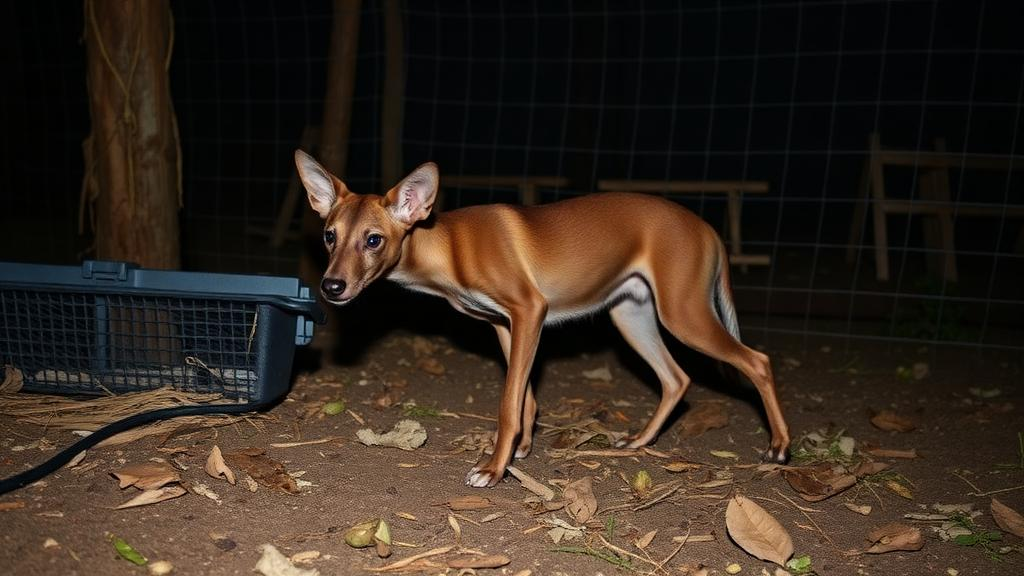
Deep in the Amazonian forests of Bolivia, one of the world’s most mysterious carnivores has been quietly slipping past camera traps for decades. Now, a landmark 25-year study has pulled back the curtain on the short-eared dog (Atelocynus microtis), an elusive canid so rarely seen that scientists have dubbed it the
The short-eared dog’s elusiveness is not merely anecdotal; it is quantifiable. Across 34 intensive camera-trap surveys spanning nearly a quarter century, the species was detected in only 21 of them, or roughly 62 percent of sampling efforts. Even within surveys where the animal appeared, capture rates varied enormously, from a low of 0.18 independent events per 100 camera-trap nights to a high of 2.4. To put those figures in perspective, a single camera-trap station operating for 100 nights would record the short-eared dog fewer than three times at the best-studied sites, and in some forests would record it only once every several hundred nights of effort. This is precisely the kind of detection profile that makes conventional wildlife surveys unreliable for the species and explains why so much of its natural history remained speculative for so long.
The study’s use of jaguar-oriented camera arrays is methodologically significant. Camera-trap grids designed for jaguars are spaced at 1.6 to 2 kilometers, a density appropriate for an animal with large home ranges, and they operate for extended periods across large survey areas. Such grids incidentally capture medium-sized carnivores like the short-eared dog, ocelot, and tayra, but they are not optimized for those species. This means the short-eared dog estimates derived from them carry important caveats: detection probability for a smaller-bodied, forest-interior species on a jaguar-spaced grid is likely lower than for the jaguar itself, so true densities could differ from the extrapolated figure. The authors addressed this by comparing short-eared dog capture rates with those of ocelots, a species for which density estimates are well established across Neotropical sites, and then scaling the short-eared dog’s relative capture frequency against known ocelot densities. The resulting estimate of roughly 15 individuals per 100 square kilometers places the short-eared dog in an intermediate position within the carnivore community: less abundant than ocelots and other medium-sized mesocarnivores, yet considerably more numerous than jaguars, whose densities in comparable Amazonian landscapes typically fall in the range of one to a few individuals per 100 square kilometers.
The temporal dimension of the dataset adds another layer of insight. Four sites were sampled repeatedly across years, including the Tuichi-Hondo area seven times between 2001 and 2023 and the Upper Madidi four times between 2004 and 2022. This repeated sampling revealed that short-eared dog relative abundance was not constant through time. The Upper Madidi surveys illustrate this vividly: the 2004 survey yielded a relative abundance index of 0.80, while the 2011 survey at the same site produced an index of 2.21, nearly three times higher, with 406 photographs of the species in that single effort. Such fluctuations could reflect genuine population dynamics, shifts in local habitat conditions, changes in prey availability, or simply the stochasticity inherent in detecting a rare species. Distinguishing among these explanations will require continued monitoring, but the fact that a single site can swing so dramatically underscores how little we can infer from any one snapshot of this species.
The diurnal activity pattern documented by the camera traps is one of the most striking findings, and it carries both ecological and conservation implications. Most Neotropical carnivores of similar size, including ocelots and other small cats, are predominantly nocturnal or crepuscular. A canid that is primarily active during daylight hours occupies a different temporal niche, potentially reducing direct competition with sympatric felids for prey such as small mammals, ground birds, and fruit. Diurnality also has practical consequences for fieldwork: it suggests that diurnal line-transect surveys, which are routinely conducted for primates and ungulates in Amazonian forests, may actually be a viable supplementary method for detecting short-eared dogs, provided observers know what to look for. The species’ reputation for vanishing into undergrowth at the slightest disturbance, however, means that even diurnal visual encounters remain rare, as the historical record of only a handful of direct observations in Bolivia attests.
The occupancy findings carry the study’s clearest conservation message. Across the 23 study sites, which spanned a gradient from Sub-Andean and Pre-Andean Amazonian forests to Inundated Moxos Savanna, Yungas montane forest, and Cerrado-influenced mosaics, short-eared dogs showed a pronounced association with intact, closed-canopy forest. Sites dominated by open savanna, flooded grassland, or heavily modified habitats yielded few or no records. This pattern aligns with continental-scale habitat modeling that has characterized the species as a forest specialist, and with work in southern Peru suggesting a particular affinity for terra firme forests, the upland forests that lie beyond the seasonal influence of rivers. In the Madidi-Tambopata landscape, where terrain rises from lowland Amazonia toward the Andean foothills, the species was recorded across a broad elevational span, from roughly 170 meters above sea level in the lowland river corridors to several hundred meters in the pre-Andean zones, but the montane Yungas sites at Pampas de Apolo, Sipia, Mamacona, Sarayoj, and along the so-called Death Road produced comparatively limited evidence of presence.
The dependence on intact forest makes the short-eared dog an effective flagship for protected-area conservation in the Amazon. The study sites where the species was most consistently recorded lie within or adjacent to major management units: Madidi National Park, the Pilón Lajas Biosphere Reserve, the Tacana Indigenous Territories, Tambopata National Reserve in Peru, and municipal protected areas around Ixiamas. These areas preserve large blocks of unlogged, unhunted forest with intact hydrological regimes. As Amazonian forests outside such units continue to be converted to pasture, cropland, and roadside colonization frontiers, the short-eared dog’s habitat base contracts accordingly. Because the species appears to occur at low densities even within prime habitat, its populations are inherently vulnerable to fragmentation; a forest block that can support only a handful of individuals cannot sustain them if connectivity to neighboring blocks is severed. Maintaining landscape-scale corridors between protected areas, and recognizing the conservation role of Indigenous territories that retain forest cover, are therefore directly relevant to this species’ persistence.
The compilation of 500 distributional records for Bolivia represents a dramatic expansion of documented knowledge. Prior to the systematic national mammal assessments of the early 2010s, only six localities were known in the country, four from museum specimens and two from direct observations by seasoned field biologists. The subsequent systematization efforts raised the confirmed count to 64 localities, and the present study’s integration of published literature, gray literature from seven Bolivian libraries, 25 years of field observations, camera-trap photographs, track records, and structured interviews with park guards and 16 Tacana communities has multiplied that figure several times over. The interview component deserves particular emphasis: park guards and Indigenous hunters possess intimate, long-term knowledge of their landscapes, and their reports, when georeferenced against satellite imagery on a one-square-kilometer grid, can reveal presence in areas that no camera trap could feasibly cover. This blending of scientific and local knowledge systems is increasingly recognized as essential for mapping rare species across vast, remote tropical landscapes.
Geographic patterns within Bolivia are also informative. The confirmed records cluster heavily in the northern and northwestern lowlands, particularly the Madidi, Tuichi, Heath, Quendeque, Tequeje, and Undumo river drainages, and across the Llanos de Moxos in the Beni Department. The apparent absence of records from much of eastern and southern Bolivia likely reflects a combination of genuine range limits, where Amazonian forest gives way to drier Chiquitano dry forest, Cerrado, and Chaco vegetation, and of uneven survey effort. The species’ range as currently understood extends across the western Amazon basin into Peru, Colombia, Ecuador, and presumably Brazil, but the Bolivian synthesis provides one of the most complete national pictures available for any portion of its range.
Several research priorities emerge from this work. First, dedicated camera-trap grids spaced and baited for medium-sized carnivores, rather than jaguars, would refine density estimates and reduce the uncertainty inherent in extrapolating from ocelot comparisons. Second, genetic analysis of feces or hair, and of the camera-trap photographs themselves for individual recognition, would clarify social organization, ranging behavior, and effective population sizes. Third, telemetry on even a small number of captured individuals would resolve home-range size, habitat selection at fine scale, and activity budgets, all of which remain essentially unknown. Fourth, systematic occupancy monitoring across a network of permanently established survey grids would allow the temporal fluctuations documented at Tuichi-Hondo and the Upper Madidi to be interpreted as trends rather than noise. Finally, investigating the species’ relationship with domestic dogs, which occur in and around Indigenous communities and protected-area boundaries, is a priority, because canine distemper and parvovirus, along with direct persecution, represent plausible but undocumented threats.
The short-eared dog remains the only species in its genus, an evolutionary lineage distinct from the foxes, wolves, and other South American canids, and its phylogenetic isolation adds scientific weight to its conservation. With the evidence now assembled from Bolivia, the ghost dog is no longer quite so invisible: its distribution is mapped, its activity rhythm is characterized, its abundance is estimated, and its habitat needs are defined. What remains is to translate that knowledge into sustained protection of the intact forests on which it depends, before the ghost fades further.
Subject of Research: Distribution, activity patterns, habitat use, relative abundance, and occupancy of the short-eared dog in Bolivia
Article Title: Unveiling the ghost: short-eared dog ( Atelocynus microtis ) distribution, activity patterns, habitat use, relative abundance, and occupancy in Bolivia
Article References: Wallace, R. B., Ayala, G., Viscarra, M., & Porcel, Z. (2026). Unveiling the ghost: short-eared dog (Atelocynus microtis) distribution, activity patterns, habitat use, relative abundance, and occupancy in Bolivia. Neotropical Biology and Conservation, 21(1), 49-66. https://doi.org/10.3897/neotropical.21.e183324
Image Credits: AI Generated
DOI: 10.3897/neotropical.21.e183324
Keywords: short-eared dog, Atelocynus microtis, Bolivia, camera trapping, occupancy, Amazon, carnivore conservation, Madidi, activity patterns, habitat use, Neotropical mammals, protected areas
Cite Scienmag News
William Thompson. (October 16, 2026). Ghost dog of the Amazon: 25-year camera-trap study reveals secrets of Bolivia’s short-eared dog. Scienmag. https://scienmag.com/ghost-dog-of-the-amazon-25-year-camera-trap-study-reveals-secrets-of-bolivias-short-eared-dog/
William Thompson. "Ghost dog of the Amazon: 25-year camera-trap study reveals secrets of Bolivia’s short-eared dog." Scienmag, 16 October 2026, https://scienmag.com/ghost-dog-of-the-amazon-25-year-camera-trap-study-reveals-secrets-of-bolivias-short-eared-dog/. Accessed 16 October 2026.
William Thompson. "Ghost dog of the Amazon: 25-year camera-trap study reveals secrets of Bolivia’s short-eared dog." Scienmag. October 16, 2026. https://scienmag.com/ghost-dog-of-the-amazon-25-year-camera-trap-study-reveals-secrets-of-bolivias-short-eared-dog/


