


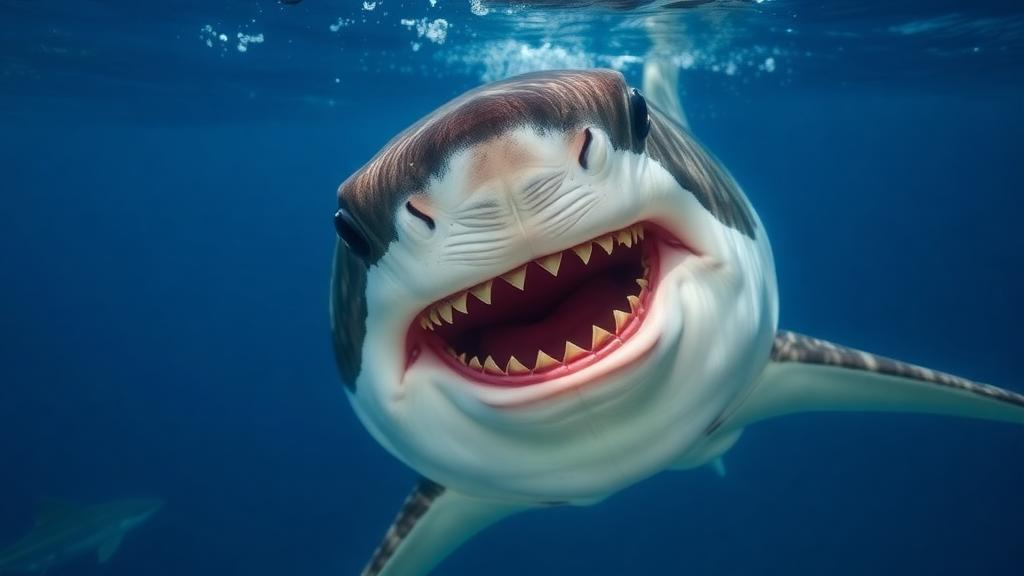
Sharks rarely bite people. Worldwide, roughly a hundred bites are recorded each year, and in recent decades fewer than ten have proved fatal annually. By comparison, dogs bite around 4.5 million people every year and kill more than 30,000. Yet the shark retains a grip on the public imagination as an ambush predator lying in wait for human prey, an image reinforced by the enduring “mistaken identity” hypothesis, which holds that bites occur because a shark confuses a swimmer or surfer with a seal or turtle. A new review in Frontiers in Conservation Science argues that this framing misses something important: many bites are not attempts to feed at all, but defensive strikes delivered by animals that feel cornered and threatened.
The paper, by Eric Clua of the École Pratique des Hautes Études in French Polynesia and Carl Meyer of the Hawaii Institute of Marine Biology, revisits a concept that shark behaviour researchers first described in the 1960s and 1970s: anti-predatory motivation, or APM. In this scenario, a shark that perceives a human as a potential predator responds the way it would to any other threat, first with a stereotyped warning display and, if the warning is ignored, with a pre-emptive bite. As long ago as 1969, researchers Baldridge and Williams asked in the title of their paper whether shark attacks were a matter of “feeding or fighting,” and subsequent work by Johnson and Nelson in 1973 was among the first serious challenges to the assumption that most bites were predatory.
The behavioural signature of APM is best documented in the grey reef shark. When pursued or approached too closely, this species performs a conspicuous agonistic display combining two locomotor components, exaggerated lateral swimming and rolling or spiral looping, with four postural components: a lifted snout, lowered pectoral fins, an arched back and a lateral bend of the body. Johnson and Nelson concluded that the display occurs in approach-withdrawal conflict situations and that a rapid approach by a diver can act as the releasing stimulus. A similar “hunching posture” was later described in the bonnethead shark, and researchers have catalogued comparable threat displays in at least seven species across two families, including the Galapagos, silvertip, blacktip reef, oceanic whitetip, lemon and sandtiger sharks.
Crucially, the classic list of APM species does not include the three large sharks most often associated with severe or fatal bites: the white shark, the tiger shark and the bull shark. That gap is what makes the new analysis timely. The authors systematically reviewed the literature on APM, following PRISMA reporting standards, and then searched publicly available online videos for modern interactions involving technologies that did not exist when the concept was formulated. In the 1960s and 1970s, approaching a shark underwater required scuba gear or, in a few cases, small submersibles, tools available mainly to researchers. Today, underwater scooters are owned by hundreds of thousands of people, and the global market for surface and underwater “aqua scooters” approached two billion US dollars in 2025 and is projected to exceed three billion by 2030.
The video analysis identified four illustrative cases. Three involved jet skis: incidents with bull sharks recorded off Florida in 2024 and in Australia in 2021, and an interaction with a white shark recorded in Australia in 2016. The Florida case is especially informative because both aerial and underwater footage exist. The video shows a surface scooter repeatedly pursuing a bull shark estimated at more than two metres in length at a depth of about three metres. The shark initially flees, but then turns toward the scooter several times and attempts to bite it. A short underwater sequence captures a clear “finnage” display, the lowering of both pectoral fins, the classic agonistic signal described by Johnson and Nelson. Shortly afterwards, the shark breaches between two scooters in an apparent biting attempt, though no one is injured.
The fourth case comes from a video attached to the Chondrichthyan Ethogram, a multi-species behavioural reference published in 2023. It shows a grey reef shark performing the complete agonistic posture before biting a scuba diver who was pursuing it with an underwater scooter. In all four cases, the shark displayed partial or complete agonistic signals before the bite attempt, and in all four the human had repeatedly approached at high speed and close range. Notably, the humans did not necessarily block the shark’s escape route, one of the two triggers identified in the classic literature. The combination of rapid approach speed and shrinking distance appears sufficient on its own, consistent with a framework proposed by Gruber in 1988, who suggested that APM is triggered when a human trespasses within a shark’s permissible spatial limits of position, approach distance and approach speed.
From these comparisons, the authors build a behavioural continuum linking three distinct motivations for bites: territoriality or dominance, anti-predation, and self-defence. The diagnostic variable is the presence or absence of a warning display. In territorial interactions, the mere presence of a human inside the shark’s idiosphere, the three-dimensional personal space around the animal, may be enough to provoke a bite, and an agonistic display typically precedes it. In anti-predatory interactions, a perceived threat such as pursuit triggers the display first, and the bite follows only if the warning is ignored. In self-defence or retaliatory bites, by contrast, the shark has already suffered material aggression, such as being speared or struck, and the bite comes immediately, with no warning display, because the animal is under acute stress or the aggression happens too suddenly to allow one.
This framework has practical consequences for how bites are classified and prevented. Under the International Shark Attack File system, APM-type incidents fall within the category of “provoked bites,” defined as cases in which humans initiate the interaction, a category that also includes divers touching or harassing sharks, spearfishing and shark feeding. But the authors argue that the current classification does not fully capture the diversity of motivations. Bites during spearfishing often reflect competition for food, bites during feeding sessions may be clumsy or exploratory responses to a food stimulus, and bites while removing sharks from fishing gear correspond most closely to self-defence. Territorial and dominance-motivated bites, they note, are not explicitly recognized in the classification at all.
The findings also carry a conservation message. The suggestion that white sharks and bull sharks may exhibit defensive responses consistent with APM broadens the range of species capable of such behaviour and reinforces the need for caution during close encounters. Recognizing the warning signals, the hunched posture, the lowered fins, the abrupt changes in speed and direction, could allow ocean users to read escalating risk and withdraw before a bite occurs. The authors also point out that some of the manoeuvres seen in the videos may reflect an acoustic startle response, since sharks are known to react strongly to the high-amplitude sounds generated by motorized devices, adding another layer to how pursuit disturbs these animals.
For the authors, the way forward combines education with regulation. Public awareness campaigns could teach jet ski users and other ocean-goers that chasing a shark is not a harmless thrill but a provocation that can end in a defensive bite, reinforcing the shark’s unjust reputation in the process. Because some users may be reluctant to acknowledge that their behaviour is inappropriate, the authors suggest that authorities consider legislation tailored to curbing the harassment of sharks with motorized devices. Framing bites as the predictable consequence of harassment, rather than as random predation, they argue, could both reduce incidents and improve the public image of sharks, an outcome that would ultimately serve their conservation.
Subject of Research: Anti-predatory motivation as a defensive cause of shark bites on humans, triggered by harassment such as jet ski pursuit
Article Title: Harassment has a cost: anti-predatory behaviour as a motivation for sharks to bite humans
Article References: Clua, E. E. G., & Meyer, C. G. (2026). Harassment has a cost: anti-predatory behaviour as a motivation for sharks to bite humans. Frontiers in Conservation Science, 7, Article 1861931. https://doi.org/10.3389/fcosc.2026.1861931
Image Credits: AI Generated
DOI: 10.3389/fcosc.2026.1861931
Keywords: sharks, shark bites, anti-predatory behaviour, agonistic display, jet skis, human-wildlife conflict, shark conservation, grey reef shark, bull shark, white shark, provoked bites, risk management
Cite Scienmag News
Margaret Porter. (October 16, 2026). Harassment has a cost: anti-predatory behaviour as a motivation for sharks to bite humans. Scienmag. https://scienmag.com/harassment-has-a-cost-anti-predatory-behaviour-as-a-motivation-for-sharks-to-bite-humans/
Margaret Porter. "Harassment has a cost: anti-predatory behaviour as a motivation for sharks to bite humans." Scienmag, 16 October 2026, https://scienmag.com/harassment-has-a-cost-anti-predatory-behaviour-as-a-motivation-for-sharks-to-bite-humans/. Accessed 16 October 2026.
Margaret Porter. "Harassment has a cost: anti-predatory behaviour as a motivation for sharks to bite humans." Scienmag. October 16, 2026. https://scienmag.com/harassment-has-a-cost-anti-predatory-behaviour-as-a-motivation-for-sharks-to-bite-humans/


