


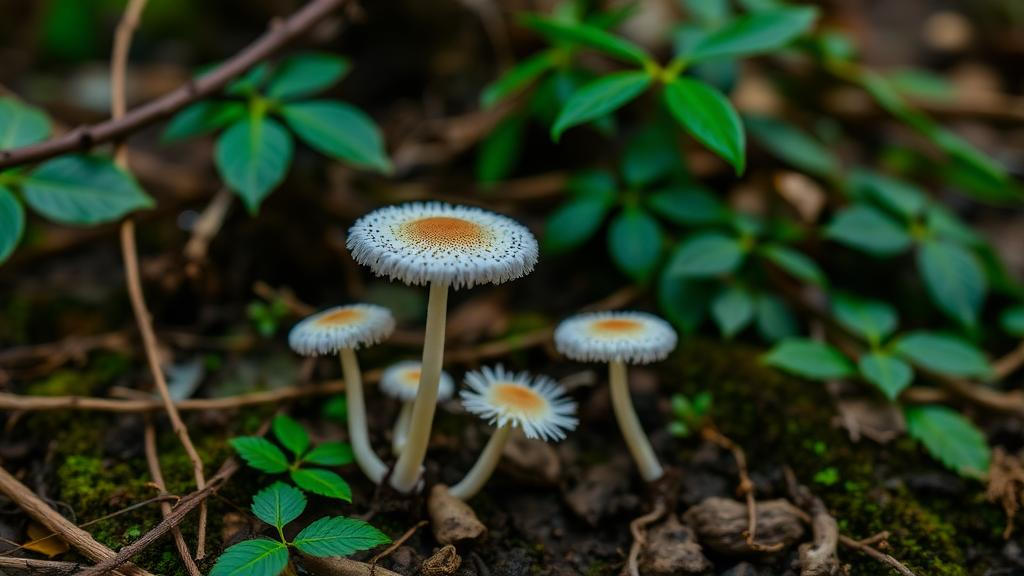
Deep in the tropical forests of Hainan Province, China, two previously unknown species of one of the world’s most notorious fungal genera have been quietly living on the leaves of native trees. Researchers surveying fungi associated with woody plants collected diseased leaves from two hosts — a Castanopsis tree in Wuzhishan National Nature Reserve and Mallotus japonicus in Changjiang Li Autonomous County — and, through a combination of microscopic examination and DNA-based evolutionary analysis, revealed that each harbored a fungus new to science. The findings, published in MycoKeys, add two entries to the sprawling genus Fusarium and underscore how much fungal diversity remains hidden in understudied tropical regions.
Fusarium is no ordinary genus. Established more than two centuries ago by Link in 1809, it encompasses fungi defined by their elongated, fusoid, multiseptate, falcate macroconidia — the distinctive banana-shaped spores that give the group its name. Its members occupy wildly different ecological roles: some live as harmless saprobes recycling dead plant matter, others as endophytes tucked inside healthy tissues, and still others as devastating pathogens of crops, and even of humans and animals. Many produce mycotoxins, making accurate species identification a matter of global food security as well as pure taxonomy.
Yet identifying Fusarium species is notoriously difficult. Overlapping spore morphology and inconsistent taxonomic frameworks have long muddied the waters, which is why modern mycologists increasingly rely on multi-locus phylogenetic analyses — comparing DNA sequences from several genes at once — to draw species boundaries. The genus currently comprises 20 recognized species complexes plus three undefined groupings, and the two new Hainan species each slot into a different one of these evolutionary lineages.
The first newcomer, isolated from Mallotus japonicus, belongs to the Fusarium lateritium species complex, or FLSC. This group carries historical weight: the name Fusarium lateritium was proposed by Nees in 1817 from a collection on Fagus twigs, and in 1917 Wollenweber established Section Lateritium for species with pale to rose-colored cultures, blue erumpent sclerotia, intercalary chlamydospores, and relatively straight macroconidia with a curved, often beaked apical cell and a pedicellate foot-cell. When O’Donnell and colleagues delimited the FLSC in 2013 using multi-locus phylogeny, it contained just three species — F. lateritium, F. stilboides, and F. sarcochroum. Today the complex has grown to 29 accepted phylogenetic species, many recovered from woody plants, a trajectory that strongly suggests its true richness remains underestimated, particularly in understudied regions and hosts.
The new species has been named Fusarium malloti, honoring its host genus. In phylogenetic trees built from concatenated sequences of four genes — tef1, tub2, rpb2, and CaM — the isolate formed a well-supported clade, with maximum likelihood bootstrap support of 100 percent and Bayesian posterior probability of 1.0, sitting sister to F. lateritium itself. The analysis included 134 Fusarium isolates across 32 species, with the alignment spanning 3,102 nucleotide positions, of which 206 were parsimony-informative. Morphologically, F. malloti can be distinguished from its closest relative by the septation of its sporodochial conidia — 1 to 6 septa with 2-septate conidia absent, compared with 3 to 6, occasionally up to 9, in F. lateritium — and by the smaller size of its 6-septate conidia, which measure 47.7 to 51.2 by 3.9 to 5.3 micrometers versus roughly 75.3 to 78.9 by 5.0 to 6.5 micrometers in the older species. Sequence differences reinforce the split: 8 base pair differences in tef1, 14 in rpb2, and 2 in tub2.
The second discovery came from Castanopsis, a genus of Fagaceae oaks and chestnuts, and landed in a very different corner of the Fusarium tree: the Fusarium torreyae species complex, or FtorSC. This complex was established through comparative studies of canker pathogens attacking Torreya taxifolia in Florida and Zanthoxylum bungeanum in China, and originally comprised three core species — F. torreyae, F. zanthoxyli, and F. continuum. Only recently, with the discovery of F. verae from soil in New South Wales, Australia, did the complex grow to four species. The Hainan isolate, now described as Fusarium castanopsidicola, resolved as a distinct lineage sister to F. verae, supported by five genetic markers: ITS, LSU, rpb1, rpb2, and tef1. Its addition extends the known host range of the FtorSC to a new woody host family.
The phylogenetic evidence for F. castanopsidicola is equally robust. In a tree containing 14 isolates, with F. venenatum as the outgroup, the new species formed a clade with 100 percent bootstrap support and a posterior probability of 1.0. The concatenated alignment stretched across 5,084 nucleotide bases, with 488 parsimony-informative characters. Genetic distances from its nearest relative are clear: 6 differences out of 286 base pairs in tef1 and 24 out of 1,744 in rpb2. Morphologically, the fungus produces cinnamon-colored sporodochia on carnation leaves, densely branched conidiophores, and falcate, dorsiventrally curved conidia with 1 to 5 septa; no chlamydospores were observed. Its closest relative, F. verae, lacks a published morphological description, making the genetic distinction all the more important.
Both species were recovered using standard but meticulous methods. Infected leaf fragments measuring five by five millimeters were excised from lesion margins, surface-sterilized through sequential immersion in 75 percent ethanol, sterile water, and 5 percent sodium hypochlorite, then plated on potato dextrose agar and incubated at 25 degrees Celsius in the dark. Pure cultures were characterized after seven days, with colony morphology, pigmentation, and growth rates documented, and microscopic structures measured under differential interference contrast optics. DNA was extracted using the CTAB method, amplified with locus-specific primers, and sequenced, with all new sequences deposited in GenBank. Voucher specimens are preserved at Shandong Agricultural University, and ex-type cultures are held in both the SAUCC and CGMCC collections, ensuring the names are permanently anchored to physical material.
Why does this matter beyond the catalog of names? Fusarium species are among the most economically consequential fungi on Earth, and knowing exactly which species is where is the foundation of disease diagnosis and management. The FLSC in particular holds biological intrigue: while information on secondary metabolite production by its members remains scarce, genome sequences of F. sarcochroum have revealed gene clusters potentially linked to sphinganine-analog mycotoxins, and a recent study showed that an F-box protein in endophytic F. lateritium acts as a molecular switch between symbiosis and pathogenesis by disrupting auxin homeostasis through beta-carboline chemistry. Whether F. malloti harbors similar biosynthetic machinery is an open question that future genomic and metabolomic work could answer, potentially unlocking biotechnological applications.
For now, the authors caution that only limited strains were obtained for each species, and further sampling is needed to clarify the ecological roles these fungi play in Asian forest ecosystems. But the message of the study is unmistakable: even in a genus as intensively studied as Fusarium, tropical hotspots like Hainan continue to yield surprises. With more than 1,907 species epithets already listed in Index Fungorum and species complexes still expanding, the intersection of careful morphology and multi-locus DNA analysis is proving the indispensable toolkit for mapping the true diversity of a genus that shapes agriculture, medicine, and forest ecology alike.
Subject of Research: Discovery and phylogenetic characterization of two new Fusarium species from Hainan Province, China
Article Title: Morphological and phylogenetic analyses reveal new species of the Fusarium lateritium species complex and Fusarium torreyae species complex ( Nectriaceae , Hypocreales ) from Hainan Province, China
Article References: Zhang, J., Wang, Y., Yuan, J., & Zhang, X. (2026). Morphological and phylogenetic analyses reveal new species of the Fusarium lateritium species complex and Fusarium torreyae species complex (Nectriaceae, Hypocreales) from Hainan Province, China. MycoKeys, 141, 45-62. https://doi.org/10.3897/mycokeys.141.209463
Image Credits: AI Generated
DOI: 10.3897/mycokeys.141.209463
Keywords: Fusarium, Fusarium lateritium species complex, Fusarium torreyae species complex, Hainan Province, fungal taxonomy, phylogenetics, multi-locus analysis, Nectriaceae, Hypocreales, Castanopsis, Mallotus japonicus, new species
Cite Scienmag News
Gavin Prescott. (October 16, 2026). Two New Fusarium Species Uncovered in Hainan’s Tropical Forests. Scienmag. https://scienmag.com/two-new-fusarium-species-uncovered-in-hainans-tropical-forests/
Gavin Prescott. "Two New Fusarium Species Uncovered in Hainan’s Tropical Forests." Scienmag, 16 October 2026, https://scienmag.com/two-new-fusarium-species-uncovered-in-hainans-tropical-forests/. Accessed 16 October 2026.
Gavin Prescott. "Two New Fusarium Species Uncovered in Hainan’s Tropical Forests." Scienmag. October 16, 2026. https://scienmag.com/two-new-fusarium-species-uncovered-in-hainans-tropical-forests/


