


…
…
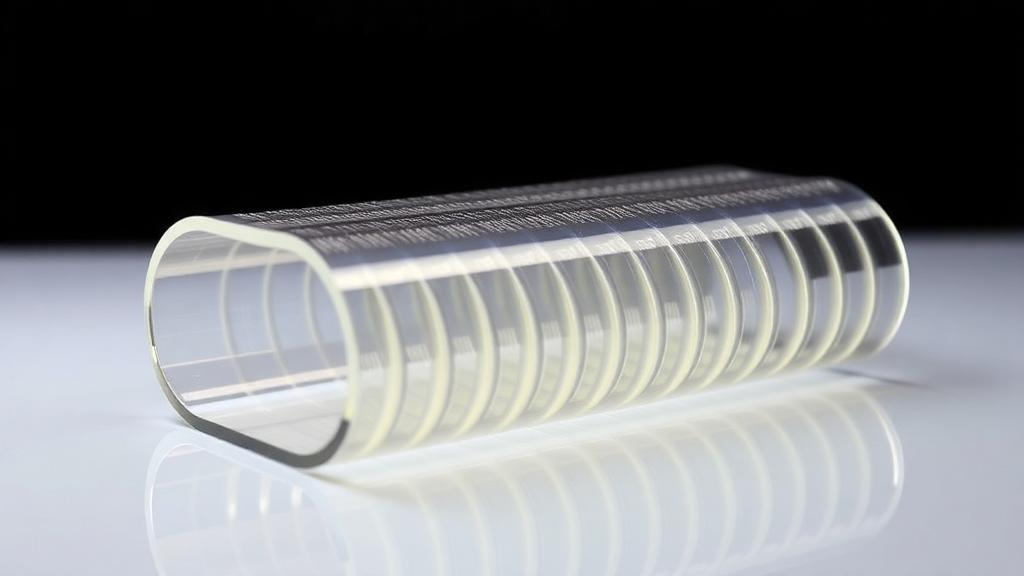
The significance of a fully polymeric vapor chamber becomes clearer when the physics of two-phase heat transfer is considered. In any vapor chamber, heat entering at the evaporator causes the working fluid to vaporize, the vapor then migrates across the low-pressure core toward cooler regions, condenses back to liquid, and the liquid must return to the evaporator through the wick. The rate-limiting step in thin, flexible devices is almost always this last stage, because capillary pressure generated by the wick must overcome viscous losses in the liquid channels while the vapor space remains unobstructed. A 250-micrometer total thickness leaves very little room for a conventional porous wick, which is why the researchers engineered superhydrophilic microchannels directly into the cyclic olefin copolymer walls. By treating these channels with oxygen plasma for nine minutes and subsequently coating them with polyethylene glycol, the internal surfaces achieve extreme wettability, meaning water spreads spontaneously and completely rather than forming droplets that would pin in place and starve the evaporator.
The choice of cyclic olefin copolymer deserves particular attention. Unlike polyimide or silicone, this class of polymer combines optical clarity, very low water absorption, excellent moisture barrier properties, and a high glass transition temperature, all of which matter for a sealed device charged with water. Gas permeability is a chronic weakness of polymeric heat pipes because non-condensable gases that diffuse through the walls accumulate in the condenser and progressively degrade performance over the device lifetime. A wall material with low permeability extends operational life and preserves the vacuum or low-saturation-pressure internal environment on which the phase-change cycle depends. The material is also inherently an electrical insulator, eliminating the risk of short circuits that metallic spreaders pose when placed directly over dense circuitry in wearables or conformal electronics.
The asymmetric architecture referenced in the work refers to an intentional imbalance between the evaporator and condenser sides of the chamber. Asymmetric vapor chambers allow the evaporation area, vapor space depth, and condensation region to be tailored independently rather than mirrored, which is valuable in flexible electronics where heat sources and heat sinks rarely align symmetrically. Combined with the patterned wettability, this geometry helps maintain a stable liquid-vapor interface even when the entire device is curved, since the capillary-driven return path remains anchored within the superhydrophilic microchannels regardless of the external bend radius.
The systematic evaluation of filling ratios reflects a well-known sensitivity in miniaturized two-phase devices. At low charge, such as the 28 percent condition tested, insufficient liquid inventory leads to dry-out of the evaporator, a runaway condition in which the wick can no longer supply fluid fast enough and the local surface temperature climbs steeply. At excessive charge, such as 70 percent, liquid pools within or beneath the vapor space, throttling vapor transport and adding parasitic thermal mass that slows startup. The intermediate filling condition, 42 percent, represents the compromise where enough working fluid saturates the microchannels while leaving the vapor lane clear. This underfilling and overfilling sensitivity mirrors observations in ultra-thin copper foam-mesh hybrid devices reported in the literature, suggesting the phenomenon is generic to thin two-phase spreaders rather than an artifact of polymeric construction.
The bending experiments provide a window into a failure mode unique to flexible thermal devices. Bending to 45 degrees can locally compress the vapor space, pinch capillary channels on the inner radius of curvature, and stretch them on the outer radius, altering both the hydraulic resistance of the liquid return path and the effective evaporation area. The finding that thermal resistance remains low and stable between 0 and 20 degrees of bending for the plasma-treated devices indicates that within this range the wettability-enhanced microchannels preserve continuous liquid feeding. The reported 20 percent reduction in thermal resistance relative to untreated microchannels quantifies the direct benefit of surface functionalization, effectively demonstrating that wettability engineering can substitute for the metallic wick structures that flexible devices cannot accommodate.
It is worth contextualizing the thermal resistance values against prior art. Flexible polymer heat pipes fabricated from laminated films with sintered mesh wicks have historically shown resistances between roughly 1 and 3 kelvin per watt under bending, while hybrid copper-silicone devices have fared somewhat better at moderate bend angles. Achieving stable low resistance across a 0 to 20 degree deformation range in a device with no metallic components at all represents meaningful progress, since hybrid designs carry penalties in weight, stiffness, and electrical conductivity that undermine the rationale for a flexible spreader in the first place. The comparison to ultra-thin copper mesh devices with effective conductivities in the thousands of watts per meter-kelvin is less about raw performance and more about the performance-per-thickness and performance-per-flexibility trade space, where two-phase devices vastly outperform any solid conductor of equal thickness, polymeric or metallic.
The oxygen plasma treatment itself is a mature technique in polymer microfabrication. Plasma exposure breaks polymer chains and introduces oxygen-containing polar groups at the surface, raising the surface energy and driving the water contact angle toward zero. Over-treatment, however, can roughen or weaken the surface and generate low-molecular-weight oxidized material, so the nine-minute optimization reflects a practical balance between wettability enhancement and preservation of channel integrity. The subsequent polyethylene glycol coating serves to stabilize the hydrophilic state. Untreated plasma surfaces on many polymers gradually recover their hydrophobicity as polar groups reorient into the bulk, a process known as hydrophobic recovery, and a hydrophilic polymer overlay retards this aging, extending the functional lifetime of the wick.
From a manufacturing standpoint, the emphasis on a complete microfabrication process in cyclic olefin copolymer matters as much as the measured performance. Polymers are compatible with replication techniques such as hot embossing, injection molding, and roll-to-roll lamination, which scale to large areas at low unit cost in a way that sintered copper wicks cannot. A fully polymeric, 250-micrometer-thick cooler that survives repeated bending could plausibly be laminated directly onto flexible printed circuit boards, integrated into textile-based wearable systems, or wrapped around robotic joints in soft actuators where rigid copper spreaders would concentrate mechanical stress. The electrical insulation of the casing further simplifies design by removing the need for intermediate dielectric layers between the spreader and exposed conductors.
The work also fits into a broader biomimetic trend in thermal engineering. Recent designs inspired by leaf venation use hierarchical, asymmetric branching networks to balance capillary pressure against permeability, since narrow channels generate strong capillarity but high flow resistance while wide channels do the opposite. Graded microchannel networks approximate this optimum. The superhydrophilic channels described here can be viewed as one ingredient in such architectures, providing the wetting limit that natural transport systems exploit, while the channel geometry governs the hydraulic side of the capillary balance.
Finally, the framing of the approach as sustainable passive cooling is substantively accurate. Two-phase spreading requires no pumps, no fans, and no electrical input, moving heat by the latent heat of vaporization of water, which is the highest of any common working fluid. Eliminating metal reduces embodied energy and material cost and removes corrosion as a lifetime-limiting mechanism. For the growing class of flexible, wearable, and soft robotic systems where every gram and every millimeter of bending compliance counts, a thin polymeric vapor chamber with engineered wettability offers a credible route to heat spreading that neither solid polymers, with their thermal conductivities below one watt per meter-kelvin, nor rigid metallic spreaders can provide.
Subject of Research: …
Article Title: Flexible polymeric asymmetric vapor chambers incorporating microchannels of extreme wettability for electronic device cooling
Article References: Tselepi, V., Nioras, D., Gogolides, E., & Ellinas, K. (2026). Flexible polymeric asymmetric vapor chambers incorporating microchannels of extreme wettability for electronic device cooling. Frontiers in Thermal Engineering, 6, Article 1850683. https://doi.org/10.3389/fther.2026.1850683
Image Credits: AI Generated
DOI: 10.3389/fther.2026.1850683
Keywords: Flexible, polymeric, asymmetric, vapor, chambers, incorporating, microchannels, extreme, wettability, electronic, device, cooling
Cite Scienmag News
Neil Sanderson. (October 16, 2026). Flexible Polymer Vapor Chambers With Superhydrophilic Microchannels Bend Cooling Rules. Scienmag. https://scienmag.com/flexible-polymer-vapor-chambers-with-superhydrophilic-microchannels-bend-cooling-rules/
Neil Sanderson. "Flexible Polymer Vapor Chambers With Superhydrophilic Microchannels Bend Cooling Rules." Scienmag, 16 October 2026, https://scienmag.com/flexible-polymer-vapor-chambers-with-superhydrophilic-microchannels-bend-cooling-rules/. Accessed 16 October 2026.
Neil Sanderson. "Flexible Polymer Vapor Chambers With Superhydrophilic Microchannels Bend Cooling Rules." Scienmag. October 16, 2026. https://scienmag.com/flexible-polymer-vapor-chambers-with-superhydrophilic-microchannels-bend-cooling-rules/


