


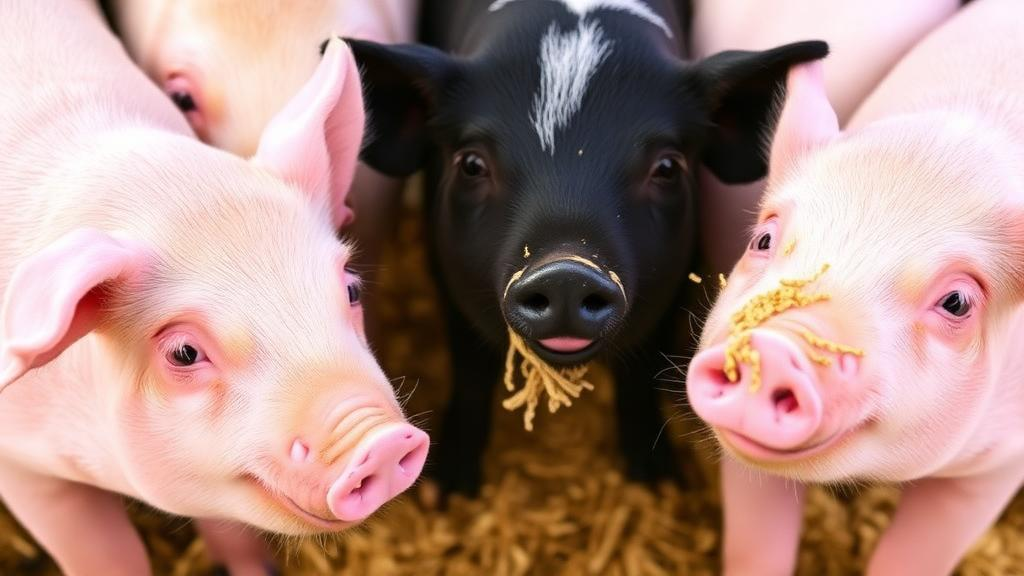
Every pig has a signature way of eating. Some animals charge into the feeder and wolf down large portions in rapid bursts, while others nibble frequently and slowly throughout the day. A new study from Spain shows that these individual feeding styles are remarkably stable over time and, more importantly, that a handful of simple feeding metrics recorded by electronic feeders can explain a large share of the variation in how fast pigs grow and how heavy they become. The findings, published in Frontiers in Animal Science, suggest that the humble feeder visit record may be one of the most underused tools for monitoring performance in commercial swine production.
The research team, led by Aitor Arrazola, Juan Pablo Sánchez, and Raquel Quintanilla of the Institute of Agrifood Research and Technology (IRTA), tracked 620 commercial crossbred pigs from eight distinct genetic backgrounds across four successive batches between April 2022 and September 2023. The animals were raised at the IRTA experimental pig farm in Monells, in the province of Girona, from 80 days of age until they reached market weight at around 170 days. Each pen of 12 to 14 pigs was equipped with a single NEDAP electronic feeder that logged the start time, duration, and feed intake of every visit by every animal, generating an extraordinarily detailed behavioral dataset of more than 261,000 feeder visits.
The eight genetic groups were three-way commercial crosses built from Duroc, Pietrain, Landrace, and Large White lines supplied by five breeding companies, with sires drawn from different Pietrain or Duroc lines and dams mostly from Landrace × Large White crosses. This design matters because most previous studies of pig feeding behavior relied on pure lines kept in breeding facilities, conditions that poorly reflect the commercial barns where three-way crossbreds are actually raised for meat. By working with commercial-type animals under commercial-like housing, the researchers aimed to establish reference values that would be directly relevant to the industry.
To make sense of the raw feeder logs, the team distinguished between two levels of analysis. A feeder visit is a single entry into the feeding station, whereas a meal is a cluster of visits grouped together using an individually calculated meal criterion, which averaged about 33 minutes during the growing phase and 30 minutes during fattening. From these records the researchers derived a rich set of metrics: feed intake per visit and per meal, feeding rate (grams consumed per minute), occupation time, daily number of visits and meals, intervals between meals, and the proportion of feed eaten at night. Performance traits, including body weight, average daily gain, backfat thickness measured by ultrasound, feed conversion ratio, and calorie and protein efficiency, were interpolated at fixed ages of 105, 125, 145, and 165 days so that all animals could be compared on the same footing.
The daily rhythm of feeding followed a classic bimodal pattern, with peaks at dawn and dusk and a trough during the night. But the amplitude of those peaks depended strongly on genetics. Pigs sired by Pietrain boars showed sharp, pronounced peaks and ate significantly less during midday and midnight than Duroc-sired crossbreds, which displayed flatter feeding curves and consistently higher night feed intake. During the fattening period, Pietrain-sired pigs ate 15.1 percent more than Duroc-sired pigs during the morning peak and 22.9 percent more during the afternoon peak. One Pietrain-sired group even approached 90 percent feeder occupancy at the pen level during the evening rush, a finding with clear practical implications for feeder space allocation, since competition at the trough can suppress intake in subordinate animals.
Genetic background also shaped the overall feeding pattern. The three Duroc-sired crossbreds consistently recorded the highest average daily feed intake in both periods, while the Pietrain-sired group with the lowest intake compensated with the highest visit frequency and the slowest feeding rate. Notably, the Pietrain-sired crossbred with the sharpest feeding peaks and the fastest feeding rate overtook the Duroc-sired groups in daily intake during fattening, grew the fastest, and was the heaviest and most protein-efficient of its cluster. Small differences in feeding behavior between groups translated into large differences in feed intake, particularly as the animals matured.
Perhaps the most striking statistical result concerned repeatability. When the researchers calculated intraclass correlation coefficients, a measure of how consistently the same animal behaves from day to day, feeder visit metrics scored remarkably high, ranging from 0.51 to 0.76 across both periods. Feeding rate per visit was the most repeatable trait of all. In contrast, meal-level metrics such as meal size, meal duration, and interval between meals showed poor repeatability, with correlations below 0.25. This asymmetry suggests that visit-level records capture a stable, individual behavioral signature, while meal-level aggregates are more sensitive to daily fluctuations such as stress, environmental disturbance, or the early stages of disease, which could make them useful welfare sentinels in their own right.
The correlation and multivariate analyses then connected behavior to biology. Feeding rate and feed intake per feeding bout correlated positively with average daily feed intake, body weight, average daily gain, and backfat thickness, but negatively with feed efficiency traits. In other words, eager eaters grow faster and heavier but tend to convert feed into body mass less efficiently, a trade-off well known from selection experiments on residual feed intake. Partial least-squares regression, a multivariate technique suited to many correlated predictors, quantified this explanatory power. Three eating intensity metrics, namely daily feed intake, feeding rate per visit, and feed intake per visit, together explained more than 60 percent of the variability in body weight and more than 50 percent in average daily gain during both rearing periods. Backfat thickness was moderately explained, with R-squared values between 25 and 35 percent, while feed efficiency traits were only weakly captured, at values below 20 percent. Adding the remaining feeding metrics to the models improved the fit only marginally, confirming that these three variables carry most of the predictive signal.
The weak link with feed efficiency is itself informative. Improving efficiency requires a multifactorial approach that integrates feeding patterns with digestibility, nutrient utilization, and genetic potential for lean growth, and selection programs focused solely on efficiency often produce animals with low intake that take longer to reach market weight. The authors argue that feeding patterns, particularly feeding rate and intake per visit, should be considered jointly with efficiency metrics rather than in isolation, so that breeding and management decisions do not sacrifice growth for marginal gains in conversion.
The practical payoff is straightforward. Farms that already run electronic feeders can compute feeding rate and intake per visit in real time, flag individuals whose eating intensity falls behind the group, and intervene with customized care before growth targets are missed, whether for market requirements or for the development of replacement gilts and boars. The researchers caution that their study used small, single-sex pens with one feeder each, and that validation in larger commercial groups with more feeders and greater social complexity is advisable. They also pose a forward-looking question: whether feeding patterns observed early in development can predict performance at the end of fattening. If the answer is yes, the feeder visit, a data point generated millions of times a day in modern swine barns, could become a cornerstone of precision livestock farming.
Subject of Research: Feeding behavior metrics as proxies for production performance and feed efficiency in growing pigs of different commercial genetic backgrounds
Article Title: Feeding patterns as proxies of production performance and feed efficiency in growing pigs from different genetic backgrounds
Article References: Arrazola, A., Sánchez, J. P., & Quintanilla, R. (2026). Feeding patterns as proxies of production performance and feed efficiency in growing pigs from different genetic backgrounds. Frontiers in Animal Science, 7, Article 1938801. https://doi.org/10.3389/fanim.2026.1938801
Image Credits: AI Generated
DOI: 10.3389/fanim.2026.1938801
Keywords: feeding behavior, growing pigs, feed efficiency, electronic feeders, swine genetics, crossbred pigs, precision livestock farming, feeding rate, feed intake, body weight, average daily gain, Duroc
Cite Scienmag News
Juliet Wilcox. (October 16, 2026). How Pigs Eat, Not Just How Much, Predicts Their Growth and Feed Efficiency. Scienmag. https://scienmag.com/how-pigs-eat-not-just-how-much-predicts-their-growth-and-feed-efficiency/
Juliet Wilcox. "How Pigs Eat, Not Just How Much, Predicts Their Growth and Feed Efficiency." Scienmag, 16 October 2026, https://scienmag.com/how-pigs-eat-not-just-how-much-predicts-their-growth-and-feed-efficiency/. Accessed 16 October 2026.
Juliet Wilcox. "How Pigs Eat, Not Just How Much, Predicts Their Growth and Feed Efficiency." Scienmag. October 16, 2026. https://scienmag.com/how-pigs-eat-not-just-how-much-predicts-their-growth-and-feed-efficiency/


