


…
The editorial’s framing of a paradigm shift in museum digitisation invites closer examination of what actually changed between earlier waves of digital heritage work and the current moment. When museums first began experimenting with multimedia guides, touchscreen kiosks, and early web archives in the 1990s and 2000s, the digital layer was largely supplementary: it delivered fixed content that curators had authored in advance, and visitors consumed it in a largely uniform way regardless of who they were or how they behaved in the gallery. The technologies of change that Parry described operated primarily as new channels for established interpretive practice. By contrast, the systems discussed in this Research Topic do not merely distribute content; they make decisions about it. An AI Director that adjusts pacing based on inferred visitor profiles, or an affective computing pipeline that reads emotional state through cameras and biosensors and reshapes an augmented reality overlay accordingly, is performing a form of interpretation that was previously the exclusive province of the curator, the educator, and the exhibition designer. This is the substantive difference that justifies talk of a new era rather than incremental improvement.
The ontological argument offered by Song and Evans deserves particular attention because it provides a vocabulary for a problem that is often discussed only in practical terms. Heidegger’s distinction between objects that merely stand at our disposal and things that gather a world of relations around themselves maps onto a genuine dilemma in virtual museology. A high-resolution 3D scan of a vessel, a manuscript, or an architectural fragment can be reproduced endlessly, transmitted instantly, and rendered in any environment a developer chooses, yet none of these operations automatically preserve the web of provenance, ritual use, historical circumstance, and scholarly interpretation that gives the original its significance. The claim that artefacts acquire meaning through gathered relations rather than intrinsic physical properties implies that the digital replica is not inherently impoverished; it is impoverished only if the relations are not carried across. This reframes the curator’s task: the question is no longer whether a digital surrogate can substitute for the original, but whether the curatorial apparatus that assembles meaning around the object can be extended into the virtual environment without being dissolved by it.
The empirical findings from Furusawa and colleagues on embodiment and aesthetic response add an important corrective to a common assumption in personalisation research. Much of the literature on adaptive museum systems treats the visitor as a bundle of preferences to be inferred: prior knowledge, dwell time, interaction history, stated interests. The finding that aesthetic and emotional response varies substantially with embodied locomotion and the physical scale of artworks, independently of where visitors direct their gaze, suggests that preference-based models capture only part of what shapes the experience. Two visitors may attend to precisely the same visual features of a painting yet undergo markedly different affective experiences because one approached it slowly across a large gallery while the other encountered it as a small reproduction during rapid movement. For AI-driven personalisation this implies that the sensor suite and the underlying model must extend beyond attention tracking into the domain of the body: gait, posture, proximity, and the kinesthetics of movement through space. It also implies that the design of the virtual environment itself, including room dimensions and the scale at which artworks are presented, is not a neutral container for personalisation but an active variable in the emotional outcome the system is trying to modulate.
The Museu XYZ case study raises questions that extend well beyond blockchain technology into the political economy of virtual museums. Decentralised curatorial models, in which authority is distributed among artists and communities rather than vested in a single institution, align naturally with the accessibility promises of the Metaverse: anyone with a connection can visit, contribute, and in principle shape the collection. Yet the dependence on cryptoart and NFT market logics means that the economic infrastructure of such museums is tied to speculative markets whose volatility and environmental costs have been extensively debated. A community-curated virtual museum whose exhibits are minted as tokens inherits the incentive structures of those tokens, including the possibility that curatorial decisions become entangled with asset valuation. This does not invalidate the model, but it illustrates the editorial’s central worry: commercial and infrastructural interests can encroach on curatorial judgement not through a dramatic takeover but through the quiet adoption of platforms and market mechanisms whose logics were designed for other purposes.
It is worth situating the AI Director concept of Çakmak and Çekmiş within the longer history of adaptive systems in cultural settings. Early adaptive hypermedia research in the 1990s explored personalised tour paths through digital collections, and subsequent decades produced increasingly sophisticated visitor models, from stereotype-based user profiles to machine-learned predictions of interest. What distinguishes the current generation is the coupling of these models with real-time control of the experience itself: not merely recommending which artefact to view next, but adjusting narrative pacing, feedback timing, and interaction modality on the fly. The finding that this works best when artefact identity and narrative structure are fixed by design is a genuinely useful design principle. It suggests that the appropriate division of labour between human and machine is not a question of how much authority to delegate in the abstract, but of identifying which layers of the experience are load-bearing for meaning and must therefore remain invariant, and which layers can safely vary in response to inferred visitor states. Personalisation, on this view, is not the opposite of curatorial intent but operates within a space that curatorial intent defines.
The question of affective computing in museums also merits careful treatment. Systems that infer emotion from facial expression, voice, posture, or physiological signals promise a form of responsiveness that no human docent could scale to thousands of visitors, and there is genuine evidence that emotionally adaptive experiences can increase engagement and recall. But the inference of inner states from external signals remains scientifically contested, with documented biases across cultures, ages, and individual differences in expressiveness. A system that misreads a visitor’s contemplative stillness as boredom, or their culturally specific expression of reverence as confusion, may adapt the experience in ways that distort rather than support the encounter with heritage. The ethical stakes are heightened in cultural settings, where the emotional register of an encounter with sacred objects, traumatic histories, or ancestral artefacts is not incidental but constitutive of their meaning. Institutions deploying such systems will need not only technical validation but also transparency about what is being sensed, what is being inferred, and what the visitor can control.
The editorial’s call for comparative studies across curatorial models deserves elaboration, because the field’s evidence base remains thin in characteristic ways. Most published evaluations of XR heritage experiences are single-site, short-duration studies with small samples, often conducted with visitors who are already technologically enthusiastic. Non-adaptive baselines are frequently absent, making it difficult to attribute observed benefits to the AI component rather than to novelty effects or the general appeal of immersive media. Longitudinal evaluation across repeated visits is especially rare, yet the value of a museum experience may lie less in a single memorable session than in whether it motivates return visits, sustained learning, or changed attitudes toward heritage. Comparative designs that hold content constant while varying the curatorial model, from centralised institutional control to decentralised community authorship, would begin to answer whether the ontological and political questions raised here have measurable experiential consequences.
The regulatory and economic dimension flagged in the editorial is likely to grow in importance as AI-driven curation matures. Cultural institutions increasingly depend on commercial platforms for the delivery of immersive experiences, and these platforms accumulate data about visitor behaviour that has value far beyond the museum’s own evaluative purposes. Questions of data governance, algorithmic transparency, and the terms under which cultural institutions delegate interpretive authority to third-party systems are not peripheral technicalities; they bear directly on the editorial’s question of whether AI assumes responsibility for curatorial intent in ways that serve the public or serve the infrastructure. Professional bodies in museology and digital heritage are only beginning to develop guidance for these arrangements, and the Research Topic’s insistence on sustained critical attention to economic structures provides a timely prompt for that work.
Finally, the vision of digital artefacts as first-class objects of curatorial, educational, and social interaction represents a significant reorientation for the field. Under the older surrogate model, the digital copy was judged by its fidelity to the original and its usefulness in lieu of a visit. Under the emerging model, a born-digital artwork, a procedurally reconstructed lost building, or a community-authored virtual exhibit may have no original at all, and its significance is established through the relations it gathers: the narratives it supports, the communities that curate it, the interactions it affords. This does not diminish the value of physical collections, but it does mean that the discipline’s theories, evaluation methods, and professional practices, developed largely around the primacy of the original object, will need continued adaptation. The contributions gathered in this Research Topic, spanning ontological theory, constrained implementation, decentralised experimentation, and embodied empirical study, offer a coherent starting point for that adaptation, and the questions they converge upon, about where meaning resides and who has authority over it, will remain live as the technologies mature.
Subject of Research: …
Article Title: Editorial: AI-driven XR applications in cultural heritage: a new era of interactive museums
Article References: Nofal, E., Hammady, R., & De Marco, R. (2026). Editorial: AI-driven XR applications in cultural heritage: a new era of interactive museums. Frontiers in Virtual Reality, 7, Article 1990419. https://doi.org/10.3389/frvir.2026.1990419
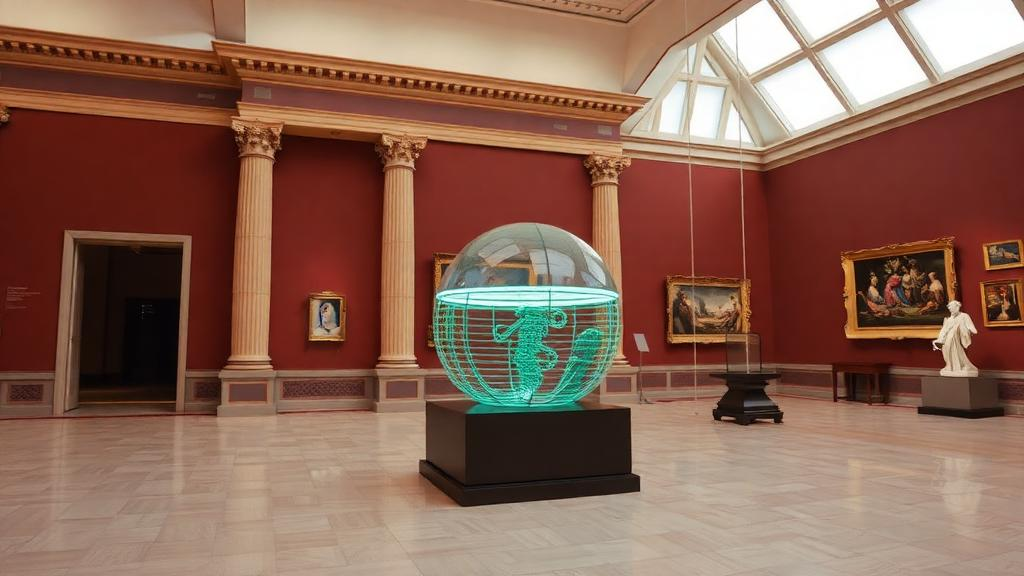
Image Credits: AI Generated
DOI: 10.3389/frvir.2026.1990419
Keywords: Editorial, AI-driven, applications, cultural, heritage, interactive, museums, scientific research
Cite Scienmag News
Courtney Benton. (October 16, 2026). When AI Curates the Museum: XR and the New Rules of Cultural Heritage. Scienmag. https://scienmag.com/when-ai-curates-the-museum-xr-and-the-new-rules-of-cultural-heritage/
Courtney Benton. "When AI Curates the Museum: XR and the New Rules of Cultural Heritage." Scienmag, 16 October 2026, https://scienmag.com/when-ai-curates-the-museum-xr-and-the-new-rules-of-cultural-heritage/. Accessed 16 October 2026.
Courtney Benton. "When AI Curates the Museum: XR and the New Rules of Cultural Heritage." Scienmag. October 16, 2026. https://scienmag.com/when-ai-curates-the-museum-xr-and-the-new-rules-of-cultural-heritage/


