


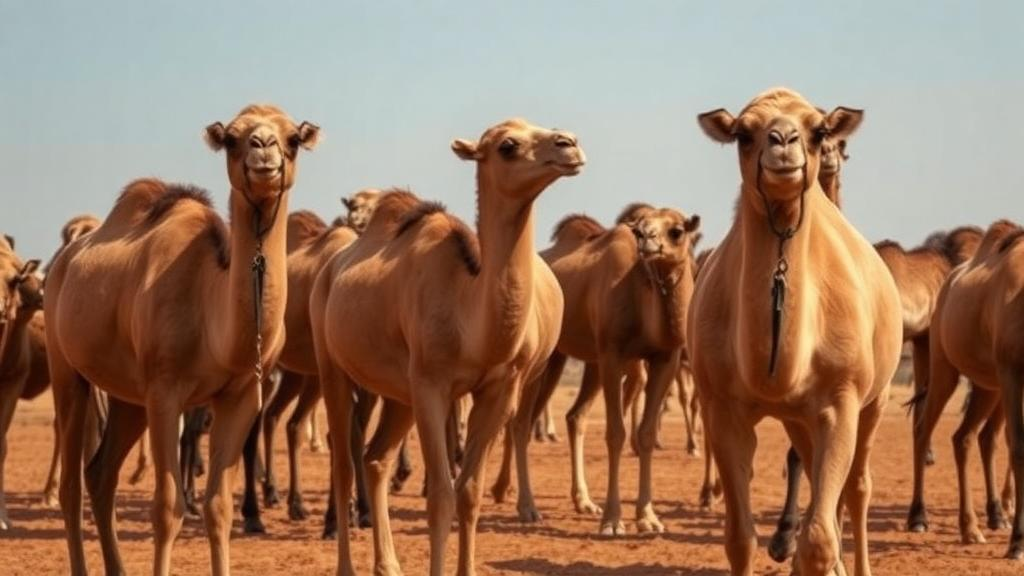
Nearly half of Somalia’s camel-owning households lost animals to drought in a single year, according to a new nationally representative study that maps, with unprecedented precision, where and why the iconic animals are dying. Drawing on data from 5,925 camel-owning households surveyed in the 2020 Somalia Demographic and Health Survey, researchers found that 45.91 percent of households reported losing at least one camel to drought within the preceding twelve months. The finding is striking because camels are famously the most drought-hardy of all livestock, engineered by evolution to endure weeks without water and to thrive on sparse desert vegetation. If even the ship of the desert is perishing at this scale, the authors argue, the droughts now striking the Horn of Africa have crossed a threshold that traditional pastoral systems were never designed to withstand.
The study, published in the journal Pastoralism: Research, Policy and Practice, was led by Mohamed Abdirahim Omar of Salaam University in Mogadishu, together with Mohamed Ahmed Hassan of the University of Burao and Abdisalam Hassan Muse of Amoud University. Pastoralism sustains more than 60 percent of Somalia’s population, and camels sit at the center of that economy, supplying milk, meat, transport, and a form of living savings account that families draw on in hard times. Because livestock production anchors the national economy, the stability of pastoral herds is inseparable from national food security. Yet until now, the researchers note, evidence on drought-related camel mortality has been fragmented, regional, or anecdotal, leaving policymakers without the species-specific, household-level data needed to target interventions where they matter most.
The team’s analytical approach was deliberately rigorous. They used the household-level dataset of the 2020 SDHS, a nationally representative cross-sectional survey implemented by the Somali National Bureau of Statistics with technical support from ICF’s DHS Program. The survey employed a two-stage stratified sampling design: first, 556 enumeration areas were selected with probability proportional to size, and then 28 households were systematically chosen within each area. From all surveyed households, 5,925 reported owning camels and formed the analytical sample. The outcome variable was binary and self-reported: whether the household had lost any camels to drought in the previous year. The researchers then fitted a multivariable logistic regression model, adjusting for a battery of socio-demographic, economic, and environmental confounders, including region of residence, settlement type, household head age and sex, household size, wealth index, asset ownership, water source, and sanitation. A variance inflation factor diagnostic confirmed multicollinearity was not a problem, with all values below 1.7 and a mean of 1.22.
The geography of loss turned out to be the single most powerful predictor. Compared with households in the northwestern reference region of Awdal, those in Sool faced 7.74 times the adjusted odds of drought-related camel mortality, Nugaal 4.12 times, and Sanaag 4.07 times, all highly statistically significant. The raw regional prevalence figures are even more dramatic: 72.86 percent of camel-owning households in Sool reported drought deaths, followed by Sanaag at 60.88 percent, Nugaal at 60.73 percent, and Mudug at 55.62 percent. At the other extreme, Middle Shabelle reported just 3.05 percent, with Gedo at 17.40 percent and Banadir at 21.30 percent. The pattern maps almost perfectly onto the climate record of the survey window. The late 2019 Deyr short rains and the 2020 Gu long rains were marked by severe moisture deficits across northern and central Somalia, decimating pastures in exactly the regions where mortality peaked, while southern areas such as Gedo and Lower Juba received comparatively better rainfall and benefited from riverine microclimates along the Juba and Shabelle rivers.
Just as revealing is what did not predict mortality. In the crude, unadjusted analysis, wealth looked protective: rich households had 45 percent lower odds of reporting camel losses than poor ones. But once geography, livelihood, and household head age were accounted for, that protection evaporated entirely, with the adjusted odds ratio for rich households falling to a statistically insignificant 0.83. The same fate befell household head sex and access to improved sanitation, both of which lost significance after adjustment. The interpretation is sobering: drought is what researchers call a covariate shock, one that strikes entire communities simultaneously rather than individual households one by one. When a whole region’s pastures fail, private wealth cannot buy water that does not exist or forage that has vanished. Resilience, the authors conclude, is less a function of individual capital than of the stability of broader socio-ecological and governance systems.
Livelihood type produced one of the study’s most paradoxical findings. Nomadic households, which made up 55.71 percent of the sample, faced 2.87 times the adjusted odds of drought-related camel mortality compared with urban households. This inverts a core assumption of pastoral ecology, in which mobility is the classic adaptive strategy: herders follow seasonal pastures and ephemeral water points, a tactic refined over millennia. The authors suggest that mobility itself is being curtailed across the Horn of Africa by biophysical barriers, shifting land-use patterns, and resource-based conflicts, transforming a traditional strength into a liability. When herders can no longer navigate out of a drought-stricken zone, animals exhaust their physical reserves on extended migrations, immunity weakens, and susceptibility to disease rises, while households become isolated from adaptive services and emergency relief.
Age emerged as the other key socio-demographic driver. Households headed by people aged 41 to 54 had 1.52 times the adjusted odds of camel loss relative to those headed by someone under 30, and the figure rose to 1.59 for households headed by people over 54. The authors point to a possible disjunction between traditional ecological knowledge, accumulated over decades of herding, and the unprecedented severity of modern climate extremes, compounded by the reduced physical capacity of older herders to perform the intensive labor a crisis demands, from hauling water to driving animals over long distances to new grazing grounds.
The policy implications are as geographically specific as the findings. The authors argue that conventional risk-sharing mechanisms, which work well for idiosyncratic losses affecting scattered households, are structurally incapable of absorbing covariate shocks like drought. Instead, they advocate for Index-Based Livestock Insurance, or IBLI, a system that uses satellite-derived vegetation indices such as NDVI to trigger automatic payouts to pastoralists when forage conditions deteriorate, sidestepping the high transaction costs and verification problems of conventional insurance. Crucially, they insist that such schemes must be culturally adapted for Somalia: anchored in Takaful, the Islamic cooperative insurance model, delivered through the country’s robust mobile money platforms such as EVC Plus and Sahal, and co-designed with trusted local governance structures, including customary clan-based Xeer systems, to verify herders’ status and resolve disputes.
Beyond insurance, the study points to community-based recovery mechanisms and proactive market interventions. Camel leasing, a culturally embedded Somali practice in which poorer households borrow nursing camels from wealthier relatives to rebuild herds and maintain milk nutrition, could be formalized to supplement formal safety nets after a shock. The authors also call for strengthened market infrastructure that enables early destocking, allowing pastoralists to sell animals at fair prices at the onset of drought and preserve their economic value as cash rather than losing it to animal death, supported by tailored climate forecasts that inform decisions before prices collapse. The study has limitations the authors acknowledge: the outcome is self-reported and cross-sectional, ruling out causal inference, and survey data lack granular variables such as access to specific pastures or local conflict events. Still, the core message stands. Drought-related camel mortality in Somalia is a systemic, geographically concentrated crisis, not a string of individual misfortunes, and responding to it will require structural, proactive interventions rather than reactive emergency aid for the households and regions that the numbers show are being hit hardest.
Subject of Research: Geographic and socio-demographic drivers of drought-related camel mortality among pastoral households in Somalia
Article Title: Pastoral vulnerability to drought: geographic and socio-demographic drivers of drought-related camel mortality in Somalia
Article References: Omar, M. A., Hassan, M. A., & Muse, A. H. (2026). Pastoral vulnerability to drought: geographic and socio-demographic drivers of drought-related camel mortality in Somalia. Pastoralism: Research, Policy and Practice, 16, Article 16714. https://doi.org/10.3389/past.2026.16714
Image Credits: AI Generated
Keywords: camel mortality, drought, pastoralism, Somalia, climate change, livestock, logistic regression, Demographic and Health Survey, Index-Based Livestock Insurance, resilience, nomadic households, Horn of Africa
Cite Scienmag News
Sloane Callahan. (October 16, 2026). Drought Is Killing Somalia’s Camels at Alarming Rates, National Survey Reveals. Scienmag. https://scienmag.com/drought-is-killing-somalias-camels-at-alarming-rates-national-survey-reveals/
Sloane Callahan. "Drought Is Killing Somalia’s Camels at Alarming Rates, National Survey Reveals." Scienmag, 16 October 2026, https://scienmag.com/drought-is-killing-somalias-camels-at-alarming-rates-national-survey-reveals/. Accessed 16 October 2026.
Sloane Callahan. "Drought Is Killing Somalia’s Camels at Alarming Rates, National Survey Reveals." Scienmag. October 16, 2026. https://scienmag.com/drought-is-killing-somalias-camels-at-alarming-rates-national-survey-reveals/


