


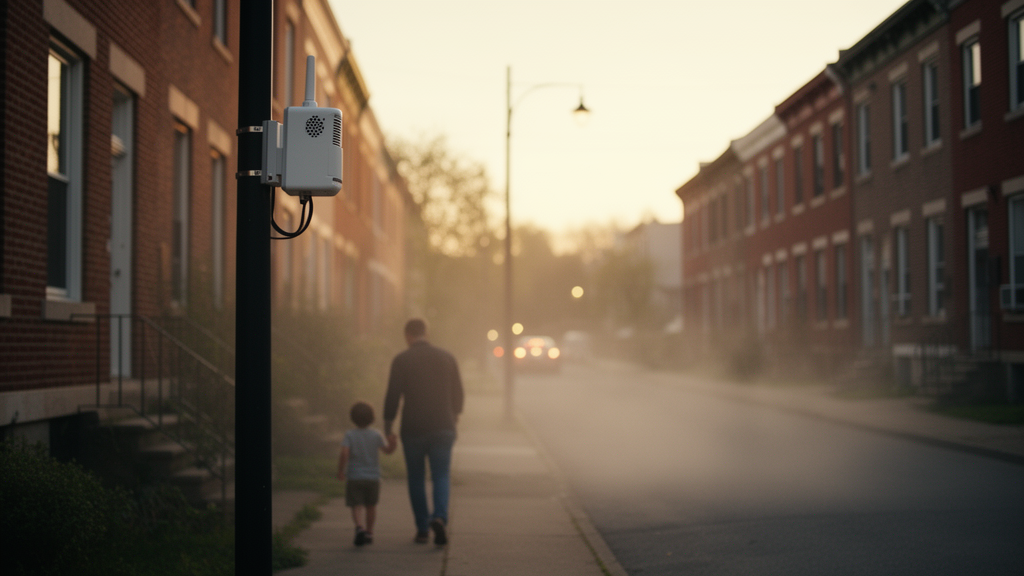
In the dense city of Chelsea, Massachusetts, two children walking to school from opposite ends of the same neighborhood can inhale meaningfully different amounts of air pollution, and the biggest differences may come not from where pollution is emitted but from how the buildings around them breathe. A new study from Northeastern University researchers, published in the Journal of Exposure Science & Environmental Epidemiology, has mapped daily inhaled doses of fine particulate matter (PM2.5) and ozone for school-aged children at the level of individual homes, uncovering neighborhood-scale disparities that conventional exposure studies routinely miss.
The research team, led by Emma K. Walter with Matthew J. Eckelman and Julia R. Varshavsky, combined two data streams that are rarely joined with such precision: a hyperlocal network of 84 air quality sensors scattered across the city, and parcel-level housing records for every residential building. From these, they estimated air exchange rates, the speed at which outdoor air infiltrates into homes, and calculated the body-weight-normalized daily dose of pollution that a hypothetical elementary school student would inhale while at home, at school, and in transit. The approach, built on the Lawrence Berkeley National Laboratory (LBNL) infiltration model and concepts from the EPA’s TracMyAir tool, delivers a resolution of one household, far finer than the sparse regulatory monitoring networks that most exposure studies rely upon.
Chelsea was a deliberate choice. Located just two miles north of Boston and squeezed between the city center, northern suburbs, and Logan Airport, the community of 40,000 handles an extraordinary logistics load: roughly 63,000 vehicles pass through daily, and the city stores 100 percent of the region’s jet fuel, 70 percent of its gasoline, and 80 percent of its home heating fuel. Around 46 percent of residents are immigrants, 70 percent rent their homes, and 92 percent live in multifamily units. Every census block meets at least one Massachusetts environmental justice criterion, and residents suffer cardiovascular disease rates 15 percent above and asthma hospitalization rates 90 percent above the state average. Yet until now, no one had quantified how pollution exposure varies from block to block within this heavily burdened city.
The sensor network, known as iSUPER, uses QuantAQ MODULAIR monitors that record PM1, PM2.5, PM10, carbon monoxide, nitric oxide, nitrogen dioxide, and ozone at five-minute intervals, operating continuously on solar power since 2023. The team converted these readings into hourly and seasonal averages, and estimated concentrations at each address using an inverse distance-weighted average of up to four sensors within half a kilometer. They then simulated school-year weekday schedules for children living at each parcel, calculating distinct walking or driving routes to the city’s consolidated elementary school complex and weighting pollution exposure along each segment of the journey using Thiessen polygons drawn around the sensors.
The findings on air exchange rates are among the most striking. Multifamily homes, which make up 86 percent of Chelsea’s modeled buildings, showed higher air exchange rates across all seasons, with a median of 1.0 air changes per hour compared with 0.88 for single-family homes, driven by their smaller unit areas and taller building heights. More troubling was the socioeconomic pattern: average air exchange rates rose in block groups with larger Hispanic and Latino populations (a Pearson correlation coefficient of 0.57) and higher rent burdens (a Spearman coefficient of 0.51). In other words, the children most likely to be living in leakier buildings, where outdoor pollution penetrates most readily, are concentrated in the communities already facing economic and environmental stress.
For PM2.5, inhaled doses were relatively uniform, ranging from 0.52 to 1.4 micrograms per kilogram per day, with a median of 1.0. But that apparent uniformity conceals real spatial differences in ambient concentrations, which varied by up to 4.4 micrograms per cubic meter across the city, peaking in the southwest corner where homes sit beside a major industrial area, a highway, a bridge under restoration, and a busy port. The authors emphasize that even differences of this magnitude matter: prior research links each 1 microgram per cubic meter increase in PM2.5 to a 0.41 percent rise in asthma hospitalizations, and a 4.16 microgram per cubic meter increase to an additional 32 deaths per 100,000 people. Because children breathe more air per unit of body weight and have developing respiratory systems, these modest but persistent disparities may be sufficient to shape health outcomes over time.
Ozone told a different story. Daily inhaled doses ranged from 1.4 to 5.0 micrograms per kilogram, with ambient concentrations varying by as much as 39 to 47 micrograms per cubic meter between addresses within a single season. Doses clustered highest in the central and eastern parts of the city, particularly near the school complex, where walking contributed a median of 10 percent of total daily ozone dose, compared with just 5 percent for PM2.5. The authors flag an important caveat here: the low-cost ozone sensors may be cross-sensitive to nitrogen dioxide, which typically shows an inverse spatial pattern to ozone near traffic sources, so the sharp spatial heterogeneity in ozone readings should be treated as provisional until validated.
One of the study’s clearest practical insights concerns microenvironments. For PM2.5, home accounted for a median 61 percent of daily inhaled dose and school 37 percent, with driving contributing less than 1 percent. For ozone, home contributed a median 59 percent and school 38 percent. These proportions give Chelsea’s advocates concrete leverage: the school microenvironment alone justifies investment in classroom air filtration, an intervention shown to reduce PM2.5 concentrations in other districts, while low-cost do-it-yourself air filters offer families a practical tool for the home. The study also notes that school bus exposure, which was not modeled, would likely exceed the personal vehicle estimates, since diesel buses have longer routes, lower airtightness, and their own emissions, adding another potential layer of disparity that the state’s transition to electric school buses could address.
The technical approach has limits the authors candidly acknowledge. The LBNL infiltration model was designed primarily for single-family homes, and its parameters come from a national database of 70,000 homes dominated by Ohio properties, only 177 of them in Massachusetts, though the older, smaller Ohio homes resemble Chelsea’s housing stock. The model cannot capture indoor sources like gas stoves, which release PM2.5, carbon monoxide, nitrogen oxides, and carbon dioxide into kitchens, and it assumes uniform body weight and activity levels across the 6-to-10 age range, potentially underestimating dose for the youngest children. None of these caveats undermines the central comparative finding, however, because the same assumptions were applied consistently across every address in the city.
The broader message is methodological as much as it is local. Sparse regulatory monitors, the workhorse of exposure science, average away exactly the block-scale variation that determines who breathes the most pollution. By fusing high-resolution sensing with building-level data, this study demonstrates that within-city disparities in concentration, infiltration, and inhaled dose can be quantified, mapped, and targeted. As low-cost sensors proliferate, the authors argue, exposure assessments should routinely incorporate hyperlocal monitoring and housing characteristics, enabling interventions such as green infrastructure, traffic management, filtration programs, and zero-emission school buses to be aimed precisely at the neighborhoods and buildings where children’s lungs bear the heaviest burden. For Chelsea, the map is now drawn; the task ahead is turning its dark corners green.
Subject of Research: Neighborhood-scale disparities in air pollution exposure and inhaled dose among school-aged children
Article Title: Neighborhood-scale disparities in air exchange rates and inhaled pollution dose among school-aged children
Article References: Walter, E. K., Eckelman, M. J., & Varshavsky, J. R. (2026). Neighborhood-scale disparities in air exchange rates and inhaled pollution dose among school-aged children. Journal of Exposure Science & Environmental Epidemiology. https://doi.org/10.1038/s41370-026-00989-x
Image Credits: AI Generated
DOI: 10.1038/s41370-026-00989-x
Keywords: air pollution, PM2.5, ozone, air exchange rate, environmental justice, children's health, hyperlocal monitoring, exposure science, infiltration modeling, Chelsea Massachusetts, asthma, low-cost sensors
Cite Scienmag News
Russell Cooper. (October 16, 2026). Hyperlocal sensors reveal block-by-block gaps in children’s pollution exposure. Scienmag. https://scienmag.com/hyperlocal-sensors-reveal-block-by-block-gaps-in-childrens-pollution-exposure/
Russell Cooper. "Hyperlocal sensors reveal block-by-block gaps in children’s pollution exposure." Scienmag, 16 October 2026, https://scienmag.com/hyperlocal-sensors-reveal-block-by-block-gaps-in-childrens-pollution-exposure/. Accessed 16 October 2026.
Russell Cooper. "Hyperlocal sensors reveal block-by-block gaps in children’s pollution exposure." Scienmag. October 16, 2026. https://scienmag.com/hyperlocal-sensors-reveal-block-by-block-gaps-in-childrens-pollution-exposure/


