


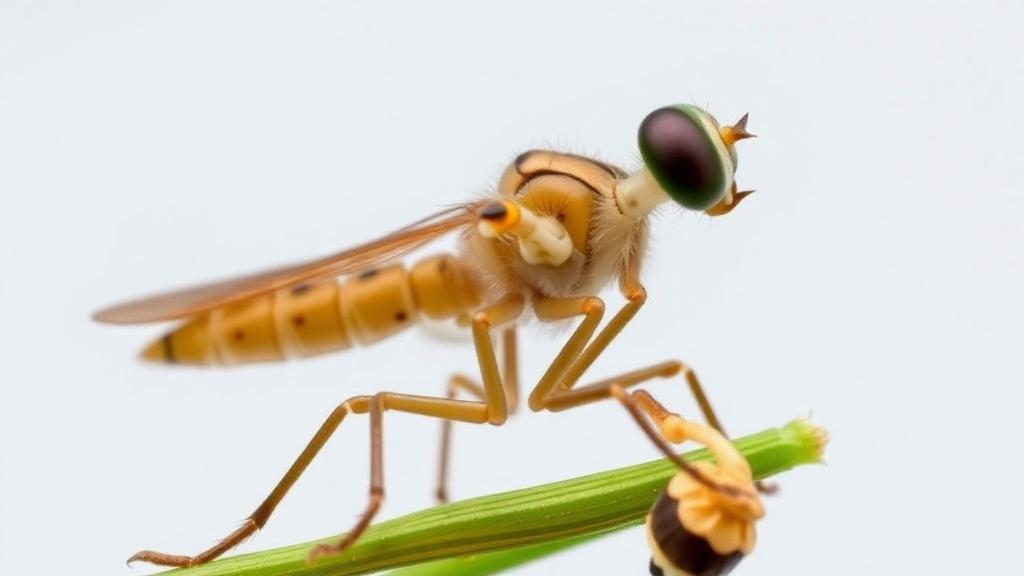
In the mountain streams of Yunnan Province, south-western China, a tiny mayfly has been keeping one of entomology’s more stubborn secrets. Potamanthellus unicutibius, a species first described in 2003 from nymphs collected in Vietnam, was known only from its juvenile stage — and an odd one at that. Its larvae possess filtering mouthparts and brush-like setae on their fore-legs, features otherwise unknown in the family Neoephemeridae. Now, more than two decades after its original description, researchers have finally captured, reared and described the adult stage of this enigmatic insect, and the findings are reshaping how scientists understand the evolution of mayfly genitalia.
The new study, published in the Biodiversity Data Journal, documents the collection of dozens of nymphs from a narrow mountain creek in Yinjiang county, Yunnan, during a spring 2026 expedition. Through careful laboratory rearing, the team obtained more than ten adults, including male and female imagos and subimagos, providing the first complete look at the species across its entire life cycle. The specimens were preserved in high-concentration ethanol and deposited in the Mayfly Collection at Nanjing Normal University, establishing a permanent reference for future research on this rare lineage.
The rearing process itself was a meticulous undertaking. Mature nymphs were placed in trays containing natural stream water, along with small stones, twigs and leaves that mimicked their native habitat. Each tray was covered with a small tent made of mosquito netting to capture emerging adults, while a small aerator continuously supplied oxygen to the water. This combination of field collection and indoor rearing proved essential, as adult mayflies are notoriously ephemeral — many species live only days, and some are known exclusively from brief light-trap encounters.
What the researchers found when they examined the adults was striking. The male imago, measuring 8.0 to 10.0 millimetres in body length with fore-legs reaching 11.0 to 12.0 millimetres, displays a reddish-brown body with heavily pigmented wings marked by reddish-brown crossveins and surrounding clouds. Its hind-wings carry various reddish to chocolate dots and markings, and its cerci — the paired tail filaments — extend an extraordinary 40.0 to 42.0 millimetres, roughly four times the body length. The female is slightly larger, at 11.0 to 12.0 millimetres, with proportionally shorter fore-legs and longer fore-wings.
But the most significant discovery lies in the male genitalia. Unlike all other known members of the genus Potamanthellus, whose males lack distinct penes and show only forceps and a dorsal plate, P. unicutibius males possess clearly developed, membranous penes that extend slightly beyond the subgenital plate. The gonopore opens at the posterolateral corner of the penis, and a dorsal plate with two distinct posterolateral processes sits between the penes and the subanal plate. This combination of features is unique not only within the genus but across the entire family Neoephemeridae.
The significance of this genital morphology extends far beyond taxonomy. In most mayflies, the gonopores open at the apex of three-dimensional penes, but in Potamanthellus the penes are membranous and plate-like. The researchers now interpret structures previously regarded as the penes of other Potamanthellus species as actually being the dorsal plate of the penes — a reinterpretation made possible only by the discovery of the adult P. unicutibius. This finding suggests that the reduction of male genitalia in neoephemerid mayflies follows a discernible evolutionary trajectory, with P. unicutibius representing an intermediate or transitional stage.
The broader evolutionary picture that emerges is one of gradual reduction across the family. The researchers propose a three-stage model: initially, as seen in related genera such as Ephemera or Potamanthodes, the forceps and penes are relatively well developed; subsequently, as observed in Pulchephemera or Ochernova, the penes undergo reduction; and finally, as in P. unicutibius, the forceps become diminished and the penes become membranous. This sequence provides what the authors describe as the original clue to understanding vestigial penes in several other lineages of the order Ephemeroptera, including species in Leptophlebiidae and Baetidae where similar reductions have been documented independently.
The nymphal biology of P. unicutibius is equally remarkable. Its fore-tibiae bear two rows of long hair-like setae, and its fore-tarsi carry filtering hairs — adaptations that allow the nymph to strain particulate matter from flowing water. This filtering morphology, typically seen in the families Isonychiidae and Oligoneuriidae, is entirely absent from all other neoephemerid genera, which instead possess robust chewing or cutting mouthparts and bodies lacking elongate setae. The nymphs were collected from a narrow creek roughly one to two metres wide with a flow velocity of about one metre per second, an environment where such filtering adaptations would confer a clear advantage.
This ecological divergence suggests that P. unicutibius and its congeners have followed fundamentally different evolutionary paths. While other Potamanthellus species appear adapted for swimming and likely feed by chewing on fallen leaves or aquatic macrophytes, P. unicutibius has specialised for filter-feeding in flowing water. The smooth body surface, operculate gills and swimming-adapted caudal filaments of the genus indicate a degree of active locomotion, but the filtering apparatus of P. unicutibius represents a further specialisation within this clade, potentially opening a new ecological niche unavailable to its relatives.
With the family Neoephemeridae currently comprising five extant genera and 17 described species, the confirmation of P. unicutibius as a distinct lineage within the Potamanthellus-like group — the smaller of the family’s two major morphological divisions — underscores how much remains to be discovered in this understudied branch of mayfly evolution. The species is now known from Yunnan Province in China and Lao Cai Province in Vietnam, and its distinctive combination of filtering nymphal morphology and reduced adult genitalia makes it a critical reference point for understanding both the diversity and the evolutionary history of Neoephemeridae. As researchers continue to explore the freshwater ecosystems of south-east Asia, further discoveries in this lineage may yet reveal additional chapters in the story of how these ancient insects have adapted to life in the world’s flowing waters.
Subject of Research: Adult stage description and evolutionary significance of the filter-feeding mayfly Potamanthellus unicutibius from China
Article Title: Reared adults of Potamanthellus unicutibius Nguyen & Bae, 2003 from China ( Ephemeroptera , Neoephemeridae )
Article References: Gong, D., & Zhou, C. (2026). Reared adults of Potamanthellus unicutibius Nguyen & Bae, 2003 from China (Ephemeroptera, Neoephemeridae). Biodiversity Data Journal, 14, Article e211811. https://doi.org/10.3897/bdj.14.e211811
Image Credits: AI Generated
Keywords: Potamanthellus unicutibius, Ephemeroptera, Neoephemeridae, mayflies, filter-feeding, male genitalia, Yunnan China, taxonomic description, evolutionary reduction, freshwater entomology, nymphal morphology, biodiversity
Cite Scienmag News
Gavin Prescott. (October 16, 2026). Unknown Adult of a Filter-Feeding Mayfly Finally Revealed After Two Decades. Scienmag. https://scienmag.com/unknown-adult-of-a-filter-feeding-mayfly-finally-revealed-after-two-decades/
Gavin Prescott. "Unknown Adult of a Filter-Feeding Mayfly Finally Revealed After Two Decades." Scienmag, 16 October 2026, https://scienmag.com/unknown-adult-of-a-filter-feeding-mayfly-finally-revealed-after-two-decades/. Accessed 16 October 2026.
Gavin Prescott. "Unknown Adult of a Filter-Feeding Mayfly Finally Revealed After Two Decades." Scienmag. October 16, 2026. https://scienmag.com/unknown-adult-of-a-filter-feeding-mayfly-finally-revealed-after-two-decades/


