


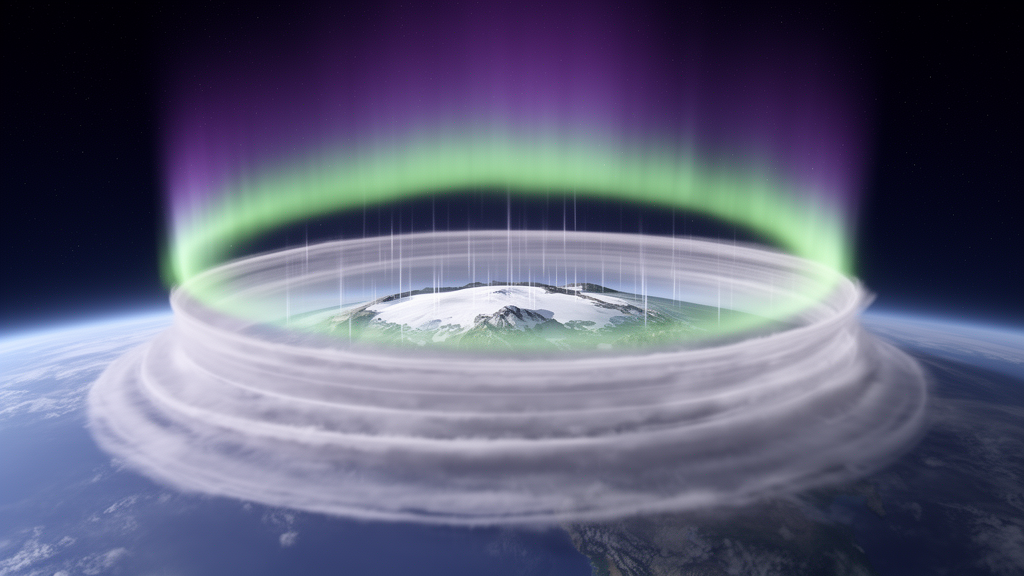
A violent burst of solar activity in mid-January 2026 gave atmospheric scientists an unusually clear view of how space weather can eat away at Earth’s protective ozone layer. According to a research team at Saint Petersburg State University, a powerful X1.9-class solar flare on January 18 launched a fast coronal mass ejection toward Earth, triggering a severe geomagnetic storm that reached NOAA G4 level. In its wake, satellite observations revealed ozone losses of up to 70 percent in the high-latitude upper atmosphere, with the depleted layer failing to recover before the end of the month.
The storm, described in the journal Frontiers in Astronomy and Space Sciences, was remarkable not because it was the most extreme on record, but because of its rare combination of characteristics. On January 19, the north-south component of the interplanetary magnetic field turned sharply southward, opening an efficient channel for solar wind energy to pour into Earth’s magnetosphere. The auroral electrojet index, or AE, surged to 2,597 nanotesla, while the planetary Kp index climbed to 8-minus, marking severe global disturbance. The storm persisted through January 20, driving the Dst index down to minus 236 nanotesla, a signature of an intense event.
What followed was a deluge of energetic particles. The solar energetic particle event accompanying the January 18 coronal mass ejection persisted through January 19, and the flux of protons with energies above 10 megaelectronvolts, measured by the GOES satellites, peaked near 37,000 particle flux units on January 19. That figure ranks third in the recorded history of 10 MeV proton fluxes, exceeded only by the March 1991 event at 43,000 pfu and the October 1989 event at 40,000 pfu. Meanwhile, magnetospheric electrons rained down into the polar atmosphere throughout the storm’s main and recovery phases.
When these energetic particles slam into the upper atmosphere, they ionize air molecules and set off a cascade of chemistry that ultimately destroys ozone. The ionization produces odd hydrogen compounds, collectively known as HOx, which include the hydrogen atom, the hydroxyl radical, and the hydroperoxyl radical HO2. It also generates odd nitrogen compounds, or NOx, which are more stable and can be carried by winds far from where they were born. Both families act as catalysts: in two-step reaction cycles, each molecule converts ozone and atomic oxygen into two ordinary oxygen molecules without being consumed itself, allowing a single catalyst to destroy thousands of ozone molecules.
The HOx cycle dominates in the mesosphere, at altitudes of roughly 65 to 85 kilometers, where the pressure ranges from about 0.01 to 0.1 hectopascals. There, the hydroxyl radical reacts with ozone to form water and oxygen, and a subsequent reaction regenerates the radical while destroying another ozone molecule. NOx chemistry, by contrast, becomes more important in the stratosphere, where nitric oxide reacts with ozone to produce nitrogen dioxide, which in turn reacts with atomic oxygen to release NO again. Because NOx survives in the darkness of polar night, its influence can linger for weeks and be transported across vast distances by atmospheric circulation.
To track this chemistry in action, the researchers turned to the Microwave Limb Sounder on NASA’s Aura spacecraft, which has been scanning the atmosphere since 2004 from a quasi-polar orbit 705 kilometers up. By measuring thermal emission at millimeter and submillimeter wavelengths along the atmospheric limb, MLS provides daily near-global coverage with vertical resolution of about 3 to 6 kilometers, from the upper troposphere to the mesosphere. Crucially, it measures multiple species simultaneously, including ozone, HO2, and nitric acid, allowing scientists to link the appearance of ozone-destroying catalysts directly to the ozone loss itself.
The observations showed a striking hemispheric asymmetry. In the Northern Hemisphere, HO2 concentrations, which hovered near 0.1 parts per billion before the storm, jumped to between 1.3 and 1.6 ppb at pressures between 0.3 and 0.5 hPa on January 18, and exceeded 1.5 ppb near 0.4 to 0.5 hPa on January 19 and 20, more than an order of magnitude above background. In the Southern Hemisphere, the response was similar in character but weaker in magnitude, with values reaching about 0.8 to 0.9 ppb. After January 20, HO2 in both hemispheres rapidly returned to background levels, confirming that the enhancement was short-lived and tied directly to the particle precipitation.
Nitric acid, a reservoir species for reactive nitrogen, also responded. In the Northern Hemisphere, where wintertime background values are low, HNO3 rose from about 0.3 to 0.5 ppb to 1.1 to 1.2 ppb between January 19 and 20, centered near 0.05 hPa. In the Southern Hemisphere, background levels were already high, between 1.8 and 2.3 ppb, so the storm-driven increase to 2.5 to 2.7 ppb was harder to distinguish from natural variability. Nitric acid matters because it sequesters odd nitrogen and, in the cold polar winter, feeds polar stratospheric clouds whose surfaces activate chlorine compounds that destroy ozone, while its gravitational settling contributes to denitrification that prolongs springtime depletion.
The ozone consequences were dramatic. Following the onset of particle precipitation on January 18, Northern Hemisphere ozone in the 0.01 to 0.1 hPa range fell to roughly 70 percent of its pre-event average, reaching its lowest point on January 20. The Southern Hemisphere saw a milder decline of about 20 percent, peaking on January 19. The altitude of maximum ozone loss coincided precisely with the layer of enhanced HO2, strong evidence that catalytic hydrogen oxide chemistry, ignited by the particle influx, was the primary destruction mechanism. Notably, ozone in the affected layer had not recovered by the end of January, suggesting the storm may also have perturbed the dynamical circulation that transports ozone and its precursors at high latitudes.
Comparing the January 2026 event with earlier storms observed by the same instrument reveals a clear pattern. The January 2005 solar proton event depleted Northern Hemisphere mesospheric ozone by about 60 percent, the January 2012 event by roughly 50 percent, and the January 2026 event by approximately 70 percent, tracking the increasing intensity of the associated particle fluxes. The researchers conclude that the January 2026 storm, with its historically high proton flux and prolonged recovery, ranks among the most powerful space weather events of the satellite era, and that its impact on mesospheric chemistry was correspondingly the most severe of the three events studied.
Subject of Research: Energetic particle precipitation during the January 2026 geomagnetic storm and its impact on high-latitude ozone
Article Title: Ozone depletion in January 2026: impact of energetic particle precipitation
Article References: Ozone depletion in January 2026: impact of energetic particle precipitation. (n.d.). https://doi.org/10.3389/fspas.2026.1924724
Image Credits: AI Generated
DOI: 10.3389/fspas.2026.1924724
Keywords: ozone depletion, energetic particle precipitation, geomagnetic storm, solar proton event, coronal mass ejection, mesosphere, HO2, nitric acid, Aura MLS, space weather, polar atmosphere, NOx chemistry
Cite Scienmag News
Cameron Wolfe. (October 16, 2026). Record January 2026 Solar Storm Stripped Up to 70% of Polar Mesospheric Ozone. Scienmag. https://scienmag.com/record-january-2026-solar-storm-stripped-up-to-70-of-polar-mesospheric-ozone/
Cameron Wolfe. "Record January 2026 Solar Storm Stripped Up to 70% of Polar Mesospheric Ozone." Scienmag, 16 October 2026, https://scienmag.com/record-january-2026-solar-storm-stripped-up-to-70-of-polar-mesospheric-ozone/. Accessed 16 October 2026.
Cameron Wolfe. "Record January 2026 Solar Storm Stripped Up to 70% of Polar Mesospheric Ozone." Scienmag. October 16, 2026. https://scienmag.com/record-january-2026-solar-storm-stripped-up-to-70-of-polar-mesospheric-ozone/


