


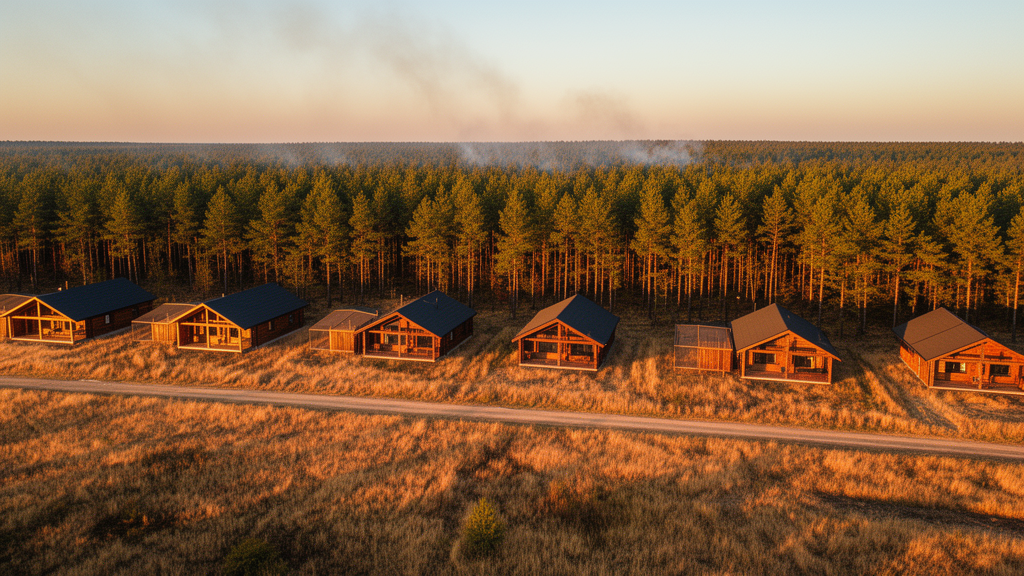
The wildland-urban interface, the razor-thin zone where houses press against forests and grasslands, has become one of the fastest-growing fire danger hotspots on Earth. Since 2000 the global interface area has expanded by more than one-third, and by 2020 it covered roughly 1.93 million square kilometers, about 1.44 percent of the planet’s land surface, while sheltering nearly 1.2 billion residents. A team of Chinese researchers argues that the mathematical tools currently used to rank which of these communities are most at risk are ill-suited to the messy, incomplete information that real assessments actually provide, and they have built a new framework to fix that problem.
In a study published in Frontiers in Forests and Global Change, Yusheng Hu and colleagues at Beijing Information Science and Technology University, the Beijing Academy of Science and Technology, and China University of Mining and Technology-Beijing introduce a fire risk assessment method based on what they call gray linguistic 2-tuple relational analysis. The approach is designed to fuse crisp numbers, interval values, and fuzzy linguistic judgments, such as an expert describing a fuel condition as high or moderate, into a single mathematical representation. Crucially, the method also encodes how incomplete or uncertain each piece of information is, a quantity the authors call the information gray degree.
The physical stakes are laid out starkly in the paper. Interface fires burn through a double-layered fuel bed: natural vegetation such as shrubs, herbs, and litter below, and man-made structures including wooden buildings, furniture, and fuel storage above. When flames jump from vegetation to buildings, the heat release rate climbs sharply, pushing temperatures past the fire resistance limits of standard construction materials. Wind-driven spotting, in which burning embers travel up to 20 kilometers and ignite new fires, has become the dominant spread mechanism, rendering traditional linear firebreaks ineffective. Under extreme conditions, a single burning residence can ignite 30 percent of neighboring buildings within a 500-meter radius.
The costs of these fires are multidimensional and long-lasting. The 2019-2020 Australian bushfire season consumed over 10 million hectares, killed 33 people directly, destroyed more than 3,000 homes, and generated economic losses estimated by Westpac Bank at AUD 5 billion. The fires released 430 million tons of carbon dioxide as carbon sink function declined, and weakened water conservation affected drinking water safety for 12 million people. Biodiversity recovery may take 50 to 100 years, and post-disaster reconstruction typically costs 2.5 to 3.5 times the direct losses.
Against this backdrop, the researchers built a multidimensional indicator system of 15 indicators across four categories: fuel conditions, surrounding environment, meteorological conditions, and topographic characteristics. The fuel dimension includes fuel load measured in tons per hectare, moisture content, and the spatial continuity of fuels, which determines whether fires can ladder vertically from surface vegetation into canopies and structures. The environmental dimension captures uncontrolled agricultural and forestry burning, domestic fire use, population density, and road network density, the last treated as a cost-type indicator because denser roads improve firefighting access and evacuation routes.
The meteorological and topographic indicators follow standard fire science logic. Precipitation governs longer-term moisture in deep fuel layers, while relative humidity controls the immediate ignitability of fine surface fuels like dead grass. Temperature accelerates fuel desiccation, and wind velocity tilts flames, boosts convective oxygen supply, and carries firebrands across defensive barriers. Slope gradient intensifies radiative and convective preheating of uphill fuels, slope aspect regulates solar drying, topographic position identifies canyon chimney effects and ridge-top ember launch points, and elevation shapes vegetation type and fire season length. Notably, the team deliberately retained correlated indicators, such as precipitation and humidity, because they represent distinct physical mechanisms, and the gray relational framework they use does not require strict statistical independence among variables.
The core mathematical innovation lies in the gray linguistic 2-tuple. A conventional linguistic 2-tuple pairs a linguistic label from a seven-term risk scale, ranging from extremely low to extremely high, with a symbolic translation value capturing how far an evaluation deviates from the nearest label. The authors extend this pairing with a gray degree between 0 and 1, quantified across seven levels of information sufficiency from extremely sufficient to extremely incomplete. Crisp measurements, interval-valued data, and fuzzy linguistic variables are all transformed into this unified representation, so an expert who says fuel spatial distribution is high risk but admits the supporting information is incomplete produces an entry that carries both the judgment and its uncertainty explicitly.
Multi-expert inputs are then merged using a gray linguistic 2-tuple weighted averaging operator, which the authors prove satisfies the standard algebraic properties of permutation invariance, idempotency, monotonicity, and boundedness. Each evaluated area is subsequently compared against a positive ideal reference sequence, constructed as the state with the highest assessed risk and the lowest information gray degree, using a gray 2-tuple relational degree that generalizes classical gray relational analysis. A larger relational degree means an area sits closer to the worst-case reference and therefore carries higher risk. To translate the output into operational terms, the framework maps relational degrees onto the seven-level risk classification and adopts a deliberately conservative rule: values falling between two adjacent levels are always assigned to the higher risk category.
To demonstrate the method, the team ran a scenario-based numerical experiment with a controlled synthetic dataset and simulated expert profiles, covering five contrasting interface prototypes: an urban edge zone with dense development and low fuel load, an interlaced suburban transition zone, a continuous mountainous forest zone with heavy fuels, steep terrain, and strong winds, a scenic recreational area, and an agriculture-forest edge where seasonal straw burning is common. The ranking placed the mountainous forest zone at highest risk, followed by the agriculture-forest edge, the interlaced transition zone, the recreational area, and finally the urban edge zone. Under the conservative classification rule, the mountainous area rated high risk, the second and third areas slightly high risk, and the remaining two moderate risk.
The robustness tests delivered the study’s most encouraging results. When information gray degrees were perturbed upward across three scenarios, the numerical relational degrees shifted, with the mountainous area’s value ranging from 0.7107 to 0.7909, but the ranking never changed, and Spearman rank correlation with the baseline was a perfect 1.00 in every case. Five weight-perturbation scenarios, each shifting 10 percent of one indicator’s weight to another, likewise left the order intact. The authors also report that the algorithm’s asymptotic time complexity is O(r times m times n plus m log m), meaning that when the numbers of indicators and experts are fixed, computational cost scales approximately linearly with the number of areas assessed, and the method requires no iterative model training or large labeled datasets. The team is candid about limitations: the experiment is synthetic, some information loss is unavoidable when intervals and linguistic terms are transformed, and weight and gray degree initialization retain subjective elements. Empirical validation against real interface landscapes, using remote sensing, high-resolution geographic information systems, meteorological observations, and historical fire records, remains the necessary next step before the framework can guide resource allocation in the communities where homes and wildfire meet.
Subject of Research: A gray linguistic 2-tuple decision framework for assessing and ranking wildfire risk in wildland-urban interface areas under incomplete information
Article Title: Wildland-urban interface fire risk assessment based on gray linguistic 2-tuple relational analysis
Article References: Wildland-urban interface fire risk assessment based on gray linguistic 2-tuple relational analysis. (n.d.). https://doi.org/10.3389/ffgc.2026.1794027
Image Credits: AI Generated
DOI: 10.3389/ffgc.2026.1794027
Keywords: wildland-urban interface, wildfire risk assessment, gray relational analysis, linguistic 2-tuple, gray system theory, multi-criteria decision making, fuzzy linguistic variables, information uncertainty, fire behavior, sensitivity analysis, computational complexity, disaster risk
Cite Scienmag News
Margaret Porter. (October 16, 2026). New Gray Math Framework Ranks Wildfire Risk Where Homes Meet Forests. Scienmag. https://scienmag.com/new-gray-math-framework-ranks-wildfire-risk-where-homes-meet-forests/
Margaret Porter. "New Gray Math Framework Ranks Wildfire Risk Where Homes Meet Forests." Scienmag, 16 October 2026, https://scienmag.com/new-gray-math-framework-ranks-wildfire-risk-where-homes-meet-forests/. Accessed 16 October 2026.
Margaret Porter. "New Gray Math Framework Ranks Wildfire Risk Where Homes Meet Forests." Scienmag. October 16, 2026. https://scienmag.com/new-gray-math-framework-ranks-wildfire-risk-where-homes-meet-forests/


