


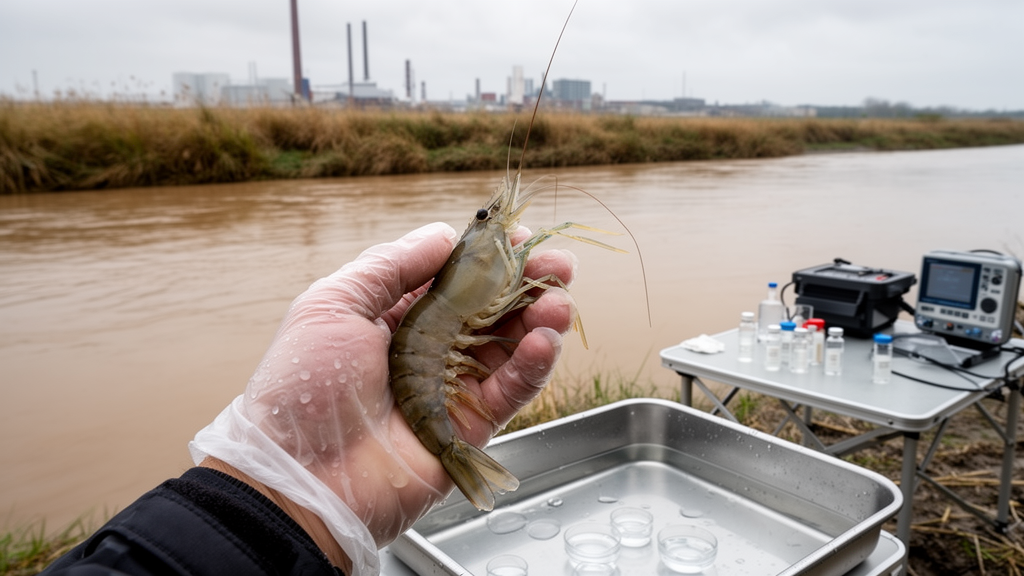
In the brackish lagoons, reservoirs and delta channels of southwestern Ukraine, an inconspicuous invasive crustacean is quietly recording the chemical history of the waters it inhabits. The Oriental river prawn, Macrobrachium nipponense, a Far-Eastern species that first established itself in Ukrainian waters in the 1980s, has become the subject of a new study measuring how four notorious trace metals—mercury, lead, cadmium and copper—accumulate in its tissues. The findings, published in Estuarine Management and Technologies, offer both reassurance and a warning: prawn tissue contamination currently stays within Ukrainian and international food-safety limits, yet the surrounding waters and especially the bottom sediments carry a burden of metals that could be re-released at any time.
The research team sampled prawns, water and bottom sediments from four sites across three distinct water bodies: Sukhyi Lyman, an estuary of the Akkarzhanka and Dalnyk rivers; the Cuciurgan Reservoir in the Dniester River drainage; and two locations in the Ukrainian sector of the Danube Delta, a canal in the city of Vylkove and the Ochakiv Branch. All sampling took place in the warm season of May and June 2024, at depths of one to 1.5 metres. At each site the researchers collected one litre of water and samples of bottom sediment in sterile containers, and captured prawns using six-millimetre-mesh fyke nets. Five individuals were analysed per locality, with the Danube Delta contributing two sets of five prawns so that metal loads could be compared between two hydrologically different delta channels.
The analytical work was carried out in the certified Water Hygiene and Ecology laboratory of the Ukrainian Research Institute of Transport Medicine using atomic absorption spectrophotometry. Prawn abdominal muscle tissue was digested in concentrated nitric acid at 135 degrees Celsius for four hours, followed by the addition of hydrogen peroxide and perchloric acid until the solution cleared. Every measurement was performed in five analytical replicates, and all glassware was acid-washed to avoid contamination. Calculations of metal concentrations relied on wet weight, and results were benchmarked against maximum permissible concentrations set by Ukraine’s Ministry of Health and by the Food and Agriculture Organisation for crustacean products destined for human consumption.
The water itself told a story of uneven and sometimes dramatic pollution. Mercury in surface water was roughly twice the permissible level of 0.01 micrograms per litre at both Sukhyi Lyman and the Cuciurgan Reservoir. Cadmium at Sukhyi Lyman reached 24.5 micrograms per litre, nearly five times the fish-farm quality standard of five micrograms per litre, while at the Cuciurgan Reservoir and in the Danube Delta cadmium remained below the regulatory limit. Copper exceeded the fisheries limit more than threefold in the Cuciurgan Reservoir, reaching 3.6 micrograms per litre, and lead stayed within permissible bounds everywhere, though it was highest at Sukhyi Lyman and the reservoir. A clear salinity gradient ran from nearly fresh water in the Danube Delta to brackish conditions in the estuary and reservoir, and dissolved oxygen remained above four milligrams per litre throughout, indicating that the pollution signal was chemical rather than a symptom of oxygen collapse.
Bottom sediments proved to be the real reservoirs of contamination. At Sukhyi Lyman, mercury in the black silt reached 8.35 micrograms per kilogram, an order of magnitude above levels in the overlying water. Lead in the same sediments climbed to 7,260 micrograms per kilogram, and copper to 5,709 micrograms per kilogram. In the Danube Delta, copper in the sediment reached an extraordinary 18,189.5 micrograms per kilogram, the highest sediment value recorded in the study. The authors attribute this persistent copper loading in the delta catchment to the long-term use of copper compounds as plant-protection products on the region’s extensive vineyards. Because sediments accumulate and store metals, they can act as long-term secondary sources, releasing stored pollutants back into the water column when storms, floods, dredging or construction disturb the silt.
To quantify how metals move from the environment into living tissue, the researchers calculated two key indicators. The bottom concentration factor, or BCF, compares metal levels in sediment with those in water and captures the sediment’s capacity to concentrate pollutants. The bioaccumulation factor, or BAF, compares metal levels in prawn tissue with those in water and therefore reflects the total real-world exposure of the animal, including uptake from its surroundings and diet. BCF values generally exceeded BAF values across the sites, confirming that trace metals accumulate far more intensively in the sediments than in the biota. For copper and lead in particular, the team obtained some of the highest BCF figures, with copper in the Danube channels at Vylkove reaching a BCF of 12,126 and a BAF of 7,172.
Inside the prawns themselves, copper dominated the metal burden, consistently and greatly exceeding the concentrations of the other three metals and often far surpassing the levels found dissolved in the water. The highest tissue copper occurred in prawns from the Cuciurgan Reservoir, at roughly 18,282 micrograms per kilogram. This pattern has a biological logic: copper is an essential element for crustaceans, forming the oxygen-binding centre of the respiratory protein haemocyanin in their haemolymph and supporting metabolism, enzyme synthesis and antioxidant defence. Mercury, by contrast, was consistently the lowest of the four metals in prawn tissue, although one striking exception emerged in the Ochakiv Branch of the Danube, where prawns carried 10.2 micrograms per kilogram of mercury, far above the 0.04 to 0.47 micrograms per kilogram measured elsewhere.
Crucially for food safety, none of the measured tissue concentrations crossed the regulatory thresholds. Under FAO and World Health Organisation guidelines, and under Ukraine’s national regulations on contaminants in food, lead, cadmium and mercury in edible crustacean meat must each remain below 0.5 milligrams per kilogram, and the prawns fell comfortably short of those limits. The measured values were also lower than those reported for related decapods elsewhere, including the green tiger prawn of the Persian Gulf, and broadly comparable to or below figures recorded for the species within its native Chinese range. The study’s results support a simple underlying premise: the absorption of trace quantities of metals from water by aquatic organisms depends primarily on the relative dissolved concentration of each element, so the more of a metal that is dissolved, the more the prawn absorbs.
Yet the authors urge strong caution rather than celebration. Each of the sampled water bodies bears a distinctive anthropogenic fingerprint. Sukhyi Lyman has been transformed into a large maritime complex, with trade and fishing ports and a railway junction, a transformation accelerated by the Russia-Ukraine War, and its waters now show very high technogenic cadmium pollution. The Cuciurgan Reservoir serves as the cooling pond for the Moldovan State District Power Plant, whose discharges of warm water and acid reagents drive hypoxia, acidification, eutrophication and hydrogen sulphide accumulation, processes that promote the reverse diffusion of metals from the benthic sludge back into the water. The Danube Delta, meanwhile, integrates pollutants arriving from an enormous international catchment, with complex exchanges that appear to be intensifying under wartime conditions. The war also restricts scientists’ access to many critical sites, leaving gaps in the monitoring record.
The commercial stakes are considerable. In 2025 the commercial stock of the Oriental river prawn in the Ukrainian sector of the Danube was estimated at 650 tonnes and is predicted to grow, and the species is prized both as wild-caught food and as a candidate for aquaculture in pens or flow-through systems using locally adapted brood stock. The study concludes that, for now, all four water areas meet present-day Ukrainian and international guidelines for prawn aquaculture or commercial harvesting. But given the current levels of contamination, the ongoing potential for new pollutant inputs, the unassessed interactions among chemicals, biology and ecosystems, and the unpredictable pressures of an ongoing war, the researchers recommend extreme caution and continued, expanded monitoring of trace metals and other regulated pollutants in Ukraine’s waters for decades to come.
Subject of Research: Bioaccumulation of trace metals in the invasive Oriental river prawn in southwestern Ukrainian waters
Article Title: Accumulation of trace metals in tissues of the Oriental river prawn Macrobrachium nipponense ( Arthropoda , Crustacea , Decapoda , Palaemonidae ) from polluted waters in southwestern Ukraine
Article References: Accumulation of trace metals in tissues of the Oriental river prawn Macrobrachium nipponense ( Arthropoda , Crustacea , Decapoda , Palaemonidae ) from polluted waters in southwestern Ukraine. (n.d.). https://doi.org/10.3897/emt.2.176866
Image Credits: AI Generated
DOI: 10.3897/emt.2.176866
Keywords: Macrobrachium nipponense, trace metals, bioaccumulation, heavy metal pollution, invasive species, Ukraine, Danube Delta, aquaculture, bottom sediments, food safety, mercury, copper
Cite Scienmag News
Denise Maddox. (October 16, 2026). Invasive river prawn becomes a living gauge of heavy metal pollution in Ukraine’s war-stressed waters. Scienmag. https://scienmag.com/invasive-river-prawn-becomes-a-living-gauge-of-heavy-metal-pollution-in-ukraines-war-stressed-waters/
Denise Maddox. "Invasive river prawn becomes a living gauge of heavy metal pollution in Ukraine’s war-stressed waters." Scienmag, 16 October 2026, https://scienmag.com/invasive-river-prawn-becomes-a-living-gauge-of-heavy-metal-pollution-in-ukraines-war-stressed-waters/. Accessed 16 October 2026.
Denise Maddox. "Invasive river prawn becomes a living gauge of heavy metal pollution in Ukraine’s war-stressed waters." Scienmag. October 16, 2026. https://scienmag.com/invasive-river-prawn-becomes-a-living-gauge-of-heavy-metal-pollution-in-ukraines-war-stressed-waters/


