


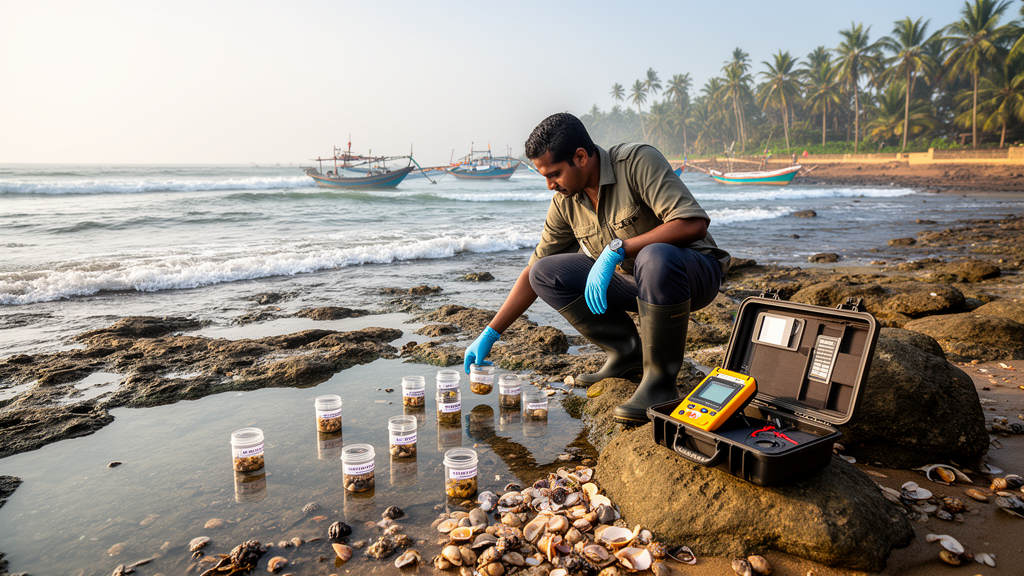
On a stretch of the Indian coast where the sand itself is radioactive, scientists have now traced exactly how much natural radiation creeps into the sea snails that people eat. A new study from the heavy mineral-rich Kollam coast of Kerala, in south-west India, measured four naturally occurring radionuclides in fifteen commercially and ecologically important marine gastropod species, and the results reveal a striking hierarchy of contamination led by one isotope in particular: polonium-210. The research, published in Archives of Environmental Contamination and Toxicology by Yaseen Nawaz Shareef and Mohan Feroz Khan, offers one of the most detailed portraits yet of how primordial radioactivity moves through intertidal food webs in a high background natural radiation area, or HBNRA.
Kollam is no ordinary shoreline. The Chavara-Neendakara placer deposits along this coast are among the most naturally radioactive beaches on Earth, enriched over geological time with monazite sands bearing thorium and uranium. Waves and longshore currents have concentrated these heavy minerals for millennia, and the background gamma radiation here can far exceed global averages. What Shareef and Khan wanted to know was whether that terrestrial legacy translates into measurable internal doses for the molluscs grazing the rocks and mudflats, and ultimately for the coastal communities who harvest them. Gastropods matter because many are eaten locally, sold in regional trade, and occupy key positions as grazers and scavengers in the intertidal ecosystem.
The team collected fifteen gastropod species across multiple stations along the Kollam coast and analysed their soft tissues for four radionuclides spanning the uranium and thorium decay series: uranium-238, thorium-232, polonium-210, and lead-210. The analytical picture that emerged was highly asymmetric. Activity concentrations ranged from below detection limits up to 1.8 becquerels per kilogram for uranium-238, from 0.62 to 4.1 becquerels per kilogram for thorium-232, from 14.7 to 76.4 becquerels per kilogram for lead-210, and from 3.2 to 56.4 becquerels per kilogram for lead-210. Overall accumulation followed a clear sequence: polonium-210 far exceeded lead-210, which in turn exceeded thorium-232, with uranium-238 trailing behind at the lowest levels.
That dominance of polonium-210 is chemically telling rather than surprising to radioecologists. Polonium is a chalcophile element, meaning it binds strongly with sulfur-rich biomolecules, and it partitions aggressively into the organic fraction of living tissue. Marine organisms routinely concentrate polonium-210 from seawater and food by factors of thousands, making it the single largest contributor to internal radiation dose from natural radionuclides in most seafood. Lead-210, the grandparent isotope in the same decay chain, behaves more conservatively, and its close coupling with polonium in these snails reflects their shared origin in the decay of radon-222 and its progeny deposited from the atmosphere and regenerated in sediments.
The statistical architecture of the data sharpened this interpretation. Using Kruskal-Wallis non-parametric tests, the researchers found significant differences among species, taxonomic groups, feeding guilds, and sampling stations for polonium-210 and lead-210, with p-values below 0.01. In plain terms, what a snail eats and where it lives strongly determine how much of these two isotopes it carries. Grazers scraping periphyton from rocks, scavengers consuming detritus, and predators attacking prey each accumulate distinct isotopic signatures, and stations closer to the mineral-enriched zones showed elevated burdens. By contrast, uranium-238 and thorium-232 showed limited biological variability across the dataset, suggesting their uptake is controlled more by ambient seawater and sediment chemistry than by species-specific physiology.
One of the most technically significant findings involved the relationship between polonium-210 and lead-210 themselves. The two isotopes showed strong positive correlations, with r-values exceeding 0.80 and p-values below 0.001, indicating they enter and move through these organisms in tandem. Yet the polonium-210 to lead-210 activity ratios ranged from 1.09 to 4.59, well above the secular equilibrium value of 1.0 expected if the pair were simply inherited together from the environment. Ratios above unity demonstrate preferential enrichment and retention of polonium within the snails, a hallmark of its sulfur-seeking chemistry and its efficient biological recycling through marine food chains.
From these tissue concentrations, the team computed the radiological consequence for human consumers. The annual committed effective dose, a standard metric expressing the lifetime dose commitment from ingesting contaminated food in a given year, varied between 62.5 and 229.5 microsieverts per year, with an average of 178 microsieverts per year. For context, the global average natural background dose from all sources is roughly 2,400 microsieverts per year, so even the highest gastropod-derived dose represents a modest fraction of total natural exposure. The estimated carcinogenic risk to the general public from eating these snails was judged minimal under standard dose-risk frameworks.
Minimal risk does not mean no relevance, however, and the authors are careful on this point. Dose estimates depend on consumption patterns, and heavy local consumers who eat gastropods frequently, particularly species at the high end of the concentration range, could approach doses that warrant attention over a lifetime. Moreover, the strong species-specific and station-specific variability means that blanket consumption guidelines would be crude instruments. The study argues instead for tailored, species-specific ecological monitoring, consumption guidelines calibrated to local harvest practices, and sustainable management strategies that account for the natural radioactivity of this coast rather than treating it as uniform background noise.
The Kollam findings also slot into a broader global picture that radioecologists have been assembling for decades. Studies from the Persian Gulf, the northern Gulf, the Irish Sea, the Adriatic, the Aegean, Ha Long Bay in Vietnam, and the Bay of Bengal have repeatedly identified polonium-210 as the dominant internal dose contributor in molluscs and crustaceans, with concentrations and ratios varying by species, tissue, and season. Recent work on Asian green mussels in titanium placer zones of Vietnam, on cephalopod communities in the Bay of Biscay, and on dried fish from the Kanyakumari coast of Tamil Nadu has reinforced the same pattern. What the Kerala study adds is a systematic baseline for gastropods specifically in one of the world’s most naturally radioactive coastal settings, filling a gap between the better-studied bivalves and finfishes.
There is also a subtle climate dimension lurking in this research agenda. Polonium-210 and lead-210 enter the marine environment partly through atmospheric deposition, and shifting monsoon patterns, changing dust fluxes, and altered coastal hydrodynamics could modulate how much of these isotopes reaches intertidal organisms. Some researchers have begun exploring how climate-mediated atmospheric redistribution of polonium might affect inhalation doses as well as ingestion pathways. For a coast like Kollam, where heavy mineral sands supply a continuous natural source of the parent isotopes, any change in the balance between atmospheric input, sediment regeneration, and biological uptake could ripple through the food web in ways that current monitoring programmes are only beginning to appreciate.
For now, the practical message from the Kollam coast is measured rather than alarming. The sea snails of Kerala carry a measurable natural radioactive burden, dominated by polonium-210, shaped by what they eat and where they live, and translating into doses that are real but small relative to total natural background. The study’s value lies less in sounding a health alarm than in demonstrating how a rigorous, species-resolved radioecological survey can convert a vague sense of natural radioactivity into precise, actionable numbers. As coastal populations grow and seafood consumption patterns shift, that kind of precision will be the foundation for guidelines that protect consumers without undermining the livelihoods and food cultures that depend on this harvest.
Subject of Research: Environmental Science
Article Title: Mapping Radionuclide Exposure Through Marine Gastropods in Coastal Waters of Kerala, South-West India
Article References: Shareef, Y. N., & Khan, M. F. (2026). Mapping Radionuclide Exposure Through Marine Gastropods in Coastal Waters of Kerala, South-West India. Archives of Environmental Contamination and Toxicology, 91(3), Article 26. https://doi.org/10.1007/s00244-026-01215-3
Image Credits: AI Generated
DOI: 10.1007/s00244-026-01215-3
Keywords: marine gastropods, radionuclides, polonium-210, lead-210, Kerala coast, high background natural radiation area, radioecology, seafood safety, uranium-238, thorium-232, Mapping, Radionuclide
Cite Scienmag News
Sloane Callahan. (October 16, 2026). Mapping Radionuclide Exposure Through Marine Gastropods in Coastal Waters of Kerala, South-West India. Scienmag. https://scienmag.com/mapping-radionuclide-exposure-through-marine-gastropods-in-coastal-waters-of-kerala-south-west-india/
Sloane Callahan. "Mapping Radionuclide Exposure Through Marine Gastropods in Coastal Waters of Kerala, South-West India." Scienmag, 16 October 2026, https://scienmag.com/mapping-radionuclide-exposure-through-marine-gastropods-in-coastal-waters-of-kerala-south-west-india/. Accessed 16 October 2026.
Sloane Callahan. "Mapping Radionuclide Exposure Through Marine Gastropods in Coastal Waters of Kerala, South-West India." Scienmag. October 16, 2026. https://scienmag.com/mapping-radionuclide-exposure-through-marine-gastropods-in-coastal-waters-of-kerala-south-west-india/


