


Environmental DNA has promised a revolution in the way scientists watch over the world’s shrinking freshwater life: instead of hauling nets through murky water for nights on end, researchers can simply sample the water itself and read the genetic traces that fish leave behind. But a new study from a small, turbid lake in Aotearoa New Zealand delivers a sobering reality check. When researchers set out to detect two culturally and ecologically vital eel species using eDNA, they found that the answer to the deceptively simple question
The findings carry particular weight because of what is at stake for the two species involved. The longfin eel, found nowhere else in the world, has been assessed as Endangered, and its decline reflects a broader pattern across Aotearoa New Zealand’s lowland waterways. Decades of wetland drainage, river channelling, irrigation schemes and hydroelectric dam construction have fragmented the migration routes that both eel species depend on to complete their life cycles. Because eels are apex predators in many freshwater systems, their loss reverberates through entire food webs. For Indigenous Māori, tuna hold deep cultural significance as guardians of waterways and as a traditional food source, adding a dimension of cultural responsibility to any monitoring programme. A tool that can reliably confirm whether eels occupy a given lake, river or wetland is therefore not merely a technical convenience but a foundation for conservation decisions and for honouring treaty obligations to indigenous communities.
Environmental DNA works, in principle, because every organism continually sheds genetic material into its surroundings through skin cells, mucus, faeces and gametes. Once released, this DNA diffuses through the water column, but it does not persist indefinitely. Ultraviolet radiation, enzymatic breakdown and microbial assimilation all degrade eDNA over time, and the pace of degradation varies with temperature, turbidity, hydrology and transport processes. This ephemerality is both a strength and a weakness: it means a positive detection usually indicates a recent and relatively local presence, yet it also means that sampling design can make or break a survey. A species may be present at a site but go undetected simply because too little of its DNA found its way into the sample, producing the false negatives that continue to challenge the field despite increasingly sensitive laboratory methods.
Lakes present their own distinctive complications. Unlike rivers, where flow tends to mix and transport DNA downstream in a predictable direction, lakes are relatively still systems in which eDNA accumulates in uneven patches shaped by wind, currents, thermal stratification and the behaviour of the animals themselves. More than 99 percent of the world’s lakes are smaller than one square kilometre, so small water bodies like the study lake are not an edge case; they are the global norm. Such lakes are frequently enriched by nutrients from surrounding land, producing high concentrations of suspended solids and the turbidity that complicates conventional water filtration. Filters clog quickly when sediment loads are high, which is precisely why the study’s lake, a hypertrophic lowland system rich in nitrogen and phosphorus, offered such a demanding and informative test of the four collection methods.
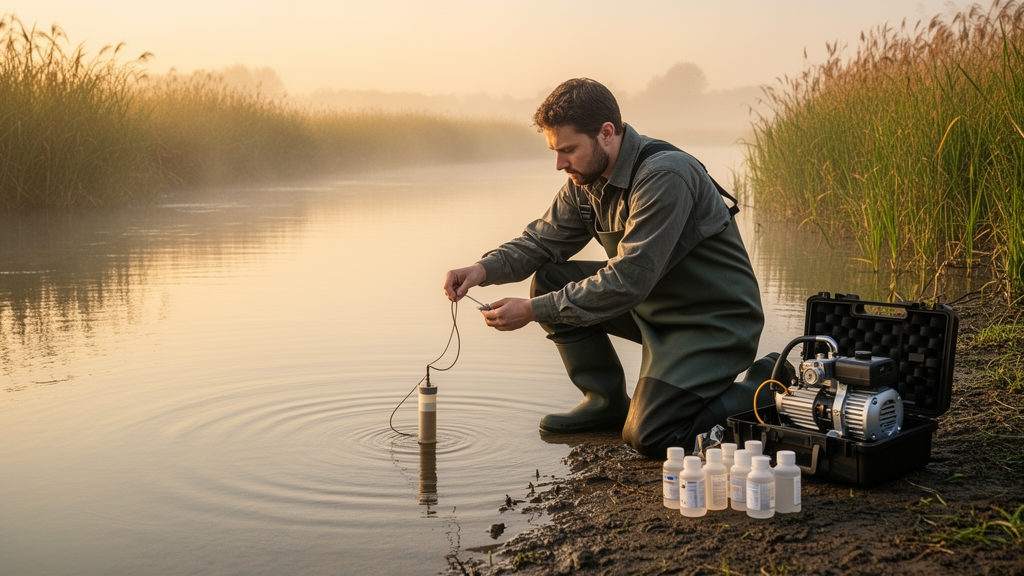
The parallel comparison of methods is what gives the results their practical value. Active pump filtration, in which a battery-powered pump draws a measured volume of water through a fine filter, has long been the default approach in freshwater eDNA work because it standardises exactly how much water is sampled. The study’s three-litre pump samples produced the most consistent detections across sites, confirming that this method remains a dependable benchmark. Yet pump filtration is labour-intensive, requires equipment in the field, and, as the turbid conditions demonstrated, can be vulnerable to clogging. Each liter filtered in heavy sediment demands care, and the volume that can realistically be processed limits the amount of DNA captured in a single sample.
Passive samplers offer an appealing alternative. Rather than filtering water on-site, researchers deploy filter membranes on stationary poles or suspended buoys and let DNA accumulate onto them over hours or days. Because nothing is actively drawn through the membrane, turbidity matters far less, and the approach avoids hauling large water volumes. In this study, passive samplers left submerged for thirteen hours yielded the highest eel DNA concentrations of any method, suggesting that extended in situ accumulation can concentrate genetic signal effectively. The caveat, however, was high variability between replicate filters at the same site, meaning some passive samplers captured abundant DNA while their immediate neighbours captured little. Short two-hour deployments performed poorly by comparison, indicating that passive sampling needs sufficient time to gather meaningful quantities of eel DNA, particularly for species whose DNA is distributed unevenly through the water.
The other two methods fared worse. Sediment samples, which some studies have found to hold higher fish DNA concentrations than water and to preserve historical signals over longer periods, performed poorly in this turbid lake and appear to be spatially patchy, so a sediment sample may miss DNA present nearby. Tow-net sampling, in which a fine-mesh net is towed behind a boat so that water filters through inserts as the vessel moves, was abandoned partway through the study because clogged filters and trapped water in the filter device made consistent sample collection impossible. These practical failures are instructive in themselves: a method that cannot be executed reliably in the intended environment will produce inconsistent data no matter how sound its underlying theory, and pilot testing under realistic field conditions remains essential before committing to a protocol.
Perhaps the most striking result was spatial. Eel DNA was not uniformly distributed through the lake but was significantly more concentrated near the shoreline, and especially near the lake’s outflow, a pattern the authors attribute plausibly to eel activity in those zones. Eels are active foragers that hunt along lake margins, so the DNA they shed is deposited preferentially where they spend their time. This has a direct consequence for monitoring design: surveys that sample only from the middle of a lake, perhaps because open water is easier to access by boat, risk underestimating or entirely missing species that concentrate their activity near shore. The difference was especially consequential for the longfin eel, for which location influenced detection probability independently of sampling method, meaning that even the best collection technique could not compensate for sampling in the wrong part of the lake.
Occupancy modelling provided the analytical backbone for translating these raw detections into practical guidance. This statistical framework explicitly separates two quantities that conventional analyses conflate: whether a species truly occupies a site, and whether the sampling process detects it when it does. By modelling detection probability as a function of method, location and sampling effort, the researchers could ask how many replicates are needed for reliable detection under each combination. The answer was encouragingly modest. Three replicate samples per site proved sufficient for dependable detection of both species, provided samples were collected with the right method and, in the case of the longfin eel, from nearshore habitats. That a small number of well-placed replicates can achieve reliable detection is good news for monitoring budgets, since replication multiplies field effort and cost.
The species-level difference in detectability is also telling. Detections of the shortfin eel were consistently more frequent than those of the longfin eel, and detection probability for the shortfin eel was driven primarily by sampling method alone. The most likely explanation lies in differences in abundance, distribution and eDNA dynamics between the two species: a more abundant or more widely dispersed animal sheds more DNA into more of the lake, effectively raising the baseline signal available to any sampling method. This implies that eDNA monitoring results should not be interpreted as a simple census of relative abundance across species without careful calibration, because detectability is species-specific and method-specific. A survey optimised for one target may systematically under-detect another sharing the same water.
The implications extend well beyond single-species eel surveys to the rapidly growing practice of metabarcoding, in which the same DNA samples are used to characterise entire communities rather than individual targets. Because sampling method biases which taxa are captured and in what quantities, choices made in the field propagate through every downstream analysis of community composition. Standardising protocols, or at least documenting method effects rigorously, is therefore critical if results from different studies and regions are to be compared. This study’s finding that method and location jointly shape detection outcomes offers a template for the kind of side-by-side method evaluation that should ideally precede any large-scale monitoring programme, particularly in the small, turbid, nutrient-rich lakes that dominate the global landscape and that have historically been the most difficult environments for eDNA work to deliver on its promise.
Subject of Research: Environmental DNA sampling methods for detecting freshwater eels in a turbid lowland lake
Article Title: Species, sampling method and location affect eel eDNA detection in a turbid lowland lake
Article References: Thomson-Laing, G., Robson, C., Steiner, K., Schallenberg, L., Zaiko, A., & Wood, S. A. (2026). Species, sampling method and location affect eel eDNA detection in a turbid lowland lake. Metabarcoding and Metagenomics, 10, Article e185622. https://doi.org/10.3897/mbmg.10.185622
Image Credits: AI Generated
Keywords: environmental DNA, eDNA, freshwater eels, Anguilla australis, Anguilla dieffenbachii, occupancy modelling, Lake Moāwhitu, New Zealand, ddPCR, aquatic monitoring, passive sampling, turbid lakes
Cite Scienmag News
Margaret Porter. (October 16, 2026). Pumps, Passive Samplers and Patchy DNA: How Eel eDNA Detection Hinges on Method and Place. Scienmag. https://scienmag.com/pumps-passive-samplers-and-patchy-dna-how-eel-edna-detection-hinges-on-method-and-place/
Margaret Porter. "Pumps, Passive Samplers and Patchy DNA: How Eel eDNA Detection Hinges on Method and Place." Scienmag, 16 October 2026, https://scienmag.com/pumps-passive-samplers-and-patchy-dna-how-eel-edna-detection-hinges-on-method-and-place/. Accessed 16 October 2026.
Margaret Porter. "Pumps, Passive Samplers and Patchy DNA: How Eel eDNA Detection Hinges on Method and Place." Scienmag. October 16, 2026. https://scienmag.com/pumps-passive-samplers-and-patchy-dna-how-eel-edna-detection-hinges-on-method-and-place/


