


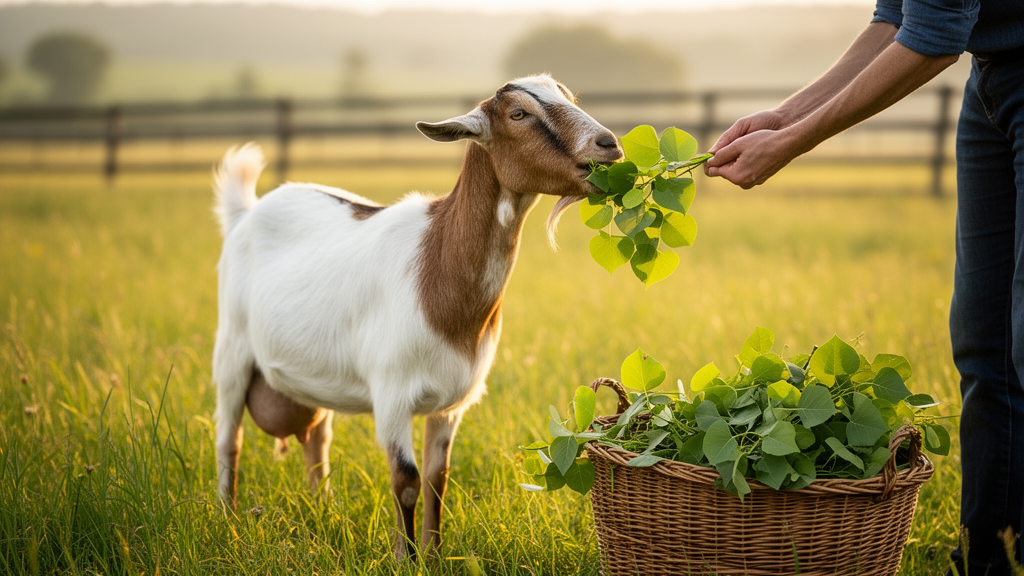
Tree leaves that most farmers mulch, chip, or burn could become a serious feed for goats, according to a new study from German researchers, but the findings come with a sharp caveat that matters for every dairy herd: the same leaves that nourish non-lactating animals can quietly sabotage calcium metabolism in freshly lambed does. The work, conducted at the Research Institute for Farm Animal Biology in Dummerstorf together with partners in Berlin, Pulawy, and Leipzig, is among the first to rigorously quantify how fast-growing poplar and willow foliage performs in goat nutrition, and its results are a striking mix of promise and caution for the growing agroforestry movement.
The premise is deceptively simple. Goats are evolutionary intermediates between browsers and grazers, and studies show they can satisfy up to 60 percent of their nutritional needs from foliage when given the choice. Yet European husbandry guidelines recommend pasture access without requiring access to trees and shrubs. Fast-growing poplars and willows, cultivated widely in alley-cropping and short-rotation plantations across temperate latitudes, already serve as feed for sheep and cattle in New Zealand, China, North America, and parts of Europe. In Germany alone, roughly 6,600 hectares of short-rotation poplar and willow plantations yield about nine tonnes of woody dry mass per hectare annually, along with up to three tonnes of foliage per hectare in the second year after planting. Whether that foliage actually delivers usable nutrition to goats, however, had never been thoroughly tested.
The researchers ran two linked experiments. In the first, four castrated Saanen goat wethers, each about 1.5 years old, were rotated through four diets in a 4-by-4 Latin square design: meadow hay alone, or hay supplemented with 650 grams per day of dried foliage from one of three hybrids, black poplar (Populus nigra × deltoides), balsam poplar (P. nigra × maximowiczii), or willow (Salix triandra × viminalis). During the third week of each feeding block, the animals were moved into respiration chambers where oxygen consumption, carbon dioxide production, and methane emissions were measured at six-minute intervals, while feces and urine were collected for complete nutrient, energy, and mineral balance calculations.
The chemical analysis alone was enough to turn heads. Compared with hay, the tree leaves contained up to ten times higher concentrations of crude protein, minerals, phenols, and measurable antioxidant capacity. Black poplar leaves were particularly rich in calcium at 21.6 grams per kilogram of dry matter, roughly five times the hay content, along with markedly higher zinc, copper, iron, magnesium, and selenium. Willow leaves carried the highest manganese levels and, remarkably, showed antioxidant capacity six to ten times greater than hay in standard ABTS and FRAP assays. The foliage also packed condensed tannins and phenolic compounds at two to three times the hay concentrations, a double-edged property that would prove consequential later in the study.
Digestibility results favored the poplars. Balsam poplar diets achieved the highest organic matter digestibility at 64 percent, compared with 59 percent for hay and just 56.1 percent for willow. Willow fared worst across the board, posting the lowest crude protein digestibility at 52.9 percent and the lowest fiber digestibility, a deficit the researchers attribute to its extraordinary condensed tannin content of 116.6 grams per kilogram of dry matter, some 22-fold higher than the poplar leaves. Tannins bind proteins and nutrients in the rumen, forming complexes that resist digestion and inflate fecal nitrogen losses. Despite this, microbial protein production in the rumen, estimated from urinary purine derivatives, was unaffected by any of the foliage diets.
Perhaps the most climate-relevant finding was what came out of the animals as gas. Methane emitted per kilogram of dry matter intake was significantly lower on all three foliage diets than on hay, with willow delivering the largest reduction at 17.2 grams per kilogram versus 22.4 for hay. Tannins suppress methanogenic archaea in the rumen, and the bacteriostatic effect appears to translate directly into reduced enteric methane, the potent greenhouse gas that accounts for a substantial share of livestock agriculture’s climate footprint. Notably, foliage feeding raised no red flags for food safety: despite leaves accumulating more zinc, manganese, nickel, and lead than hay, plasma concentrations of these heavy metals in the goats remained indistinguishable from hay-fed controls.
Selenium told a subtler story. Although balsam poplar leaves contained the most selenium, wethers fed the black poplar diet showed the highest plasma selenium at 72.6 micrograms per liter, significantly above both the balsam poplar and hay groups. Because selenium intake differed only marginally between the two poplar diets, the authors conclude that selenium from black poplar is more bioavailable, possibly reflecting differences between inorganic and organic selenium species in the leaves. This bioavailability advantage carried into the second experiment, where lactating does supplemented with black poplar foliage consumed 2.7 times more selenium and maintained significantly higher plasma selenium concentrations by the fifth week of lactation, hinting that tree foliage could partly substitute inorganic selenium supplements derived from fossil sources.
That second experiment put the most promising candidate to a real-world test. Sixteen pregnant, year-old Saanen goats were split after lambing: half received 700 grams per day of black poplar foliage alongside hay and wheat during the first five weeks of lactation, while the control group received hay and wheat only. The hypothesis was logical, even elegant. The periparturient period imposes crushing energy and calcium demands for fetal growth, colostrum, and milk production, driving negative mineral balances, body fat mobilization, and oxidative stress. Poplar leaves are loaded with calcium, selenium, and polyphenolic antioxidants, precisely the profile that might buffer these stresses.
The results dismantled that hope. Poplar-supplemented does showed no improvement in glutathione peroxidase activity or any other antioxidant marker, despite the leaves’ impressive laboratory antioxidant capacity, suggesting the phenolic compounds were poorly absorbed in vivo. Worse, in the second week after lambing the poplar group exhibited significantly lower serum calcium concentrations and a lower ratio of osteocalcin to CTX, the molecular signatures of bone formation and resorption, indicating intensified bone mobilization. The likely culprit is tannin chemistry: condensed tannins are known to hinder intestinal calcium absorption, and calcium actually enhances the binding between tannins and proteins, compounding the interference. The poplar does were losing more calcium from skeleton despite consuming nearly two and a half times more dietary calcium than controls.
The study’s authors draw a cleanly practical conclusion. Black poplar foliage is a genuinely valuable feed for non-lactating goats, offering improved protein digestibility, selenium status, and reduced methane yield, but it should not be fed to goats in early lactation, when calcium homeostasis is already stretched to its limit. The team acknowledges limitations, including small animal numbers that limited statistical power for mineral balances and methane measurements, and the well-documented sensitivity of leaf composition to harvest time, leaf age, soil, and climate. Still, in an era when agriculture urgently seeks feed resources that cut emissions without competing for cropland, the image of a goat stripping leaves from a poplar row has gained real scientific weight, provided farmers know exactly when in the reproductive calendar to open the gate.
Subject of Research: Nutritional value of poplar and willow foliage in goat diets and its effects on digestibility, selenium status, methane emission, and calcium metabolism around lambing
Article Title: Nutrient and energy digestibility, mineral status and antioxidant defense in goat wethers and periparturient does supplemented with poplar and willow leaves
Article References: Helffenstein, K., Schwerdtfeger, J., Görs, S., Durkalec, M., Kowalczyk, J., Eggert, A., Wilkens, M. R., & Kuhla, B. (2026). Nutrient and energy digestibility, mineral status and antioxidant defense in goat wethers and periparturient does supplemented with poplar and willow leaves. Frontiers in Animal Science, 7, Article 1861647. https://doi.org/10.3389/fanim.2026.1861647
Image Credits: AI Generated
DOI: 10.3389/fanim.2026.1861647
Keywords: goats, poplar foliage, willow, agroforestry, selenium, methane emissions, tannins, calcium metabolism, antioxidants, animal nutrition, early lactation, digestibility
Cite Scienmag News
Daisy Hatcher. (October 16, 2026). Poplar Leaves Boost Selenium and Cut Methane in Goats but Backfire in Early Lactation. Scienmag. https://scienmag.com/poplar-leaves-boost-selenium-and-cut-methane-in-goats-but-backfire-in-early-lactation/
Daisy Hatcher. "Poplar Leaves Boost Selenium and Cut Methane in Goats but Backfire in Early Lactation." Scienmag, 16 October 2026, https://scienmag.com/poplar-leaves-boost-selenium-and-cut-methane-in-goats-but-backfire-in-early-lactation/. Accessed 16 October 2026.
Daisy Hatcher. "Poplar Leaves Boost Selenium and Cut Methane in Goats but Backfire in Early Lactation." Scienmag. October 16, 2026. https://scienmag.com/poplar-leaves-boost-selenium-and-cut-methane-in-goats-but-backfire-in-early-lactation/


