


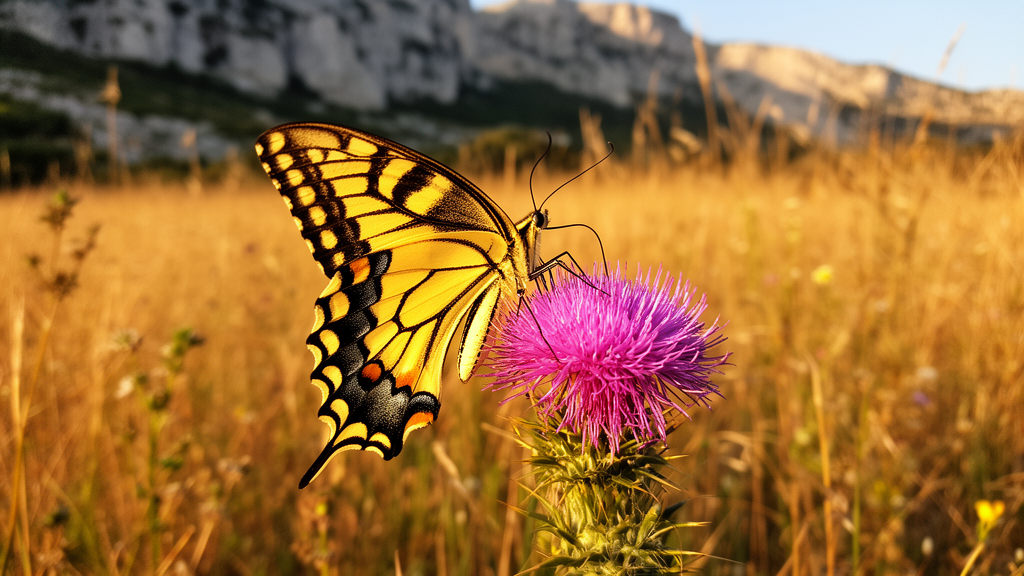
The Southern Swallowtail Papilio alexanor Esper, 1800 is one of Europe’s most strictly protected butterflies, listed under Annex IV of the Habitats Directive and Appendix II of the Bern Convention. Until now, its known Italian range was confined to Liguria and Piedmont in the northwest of the country, with only scattered historical records from the far south. A new study published in Nota Lepidopterologica documents the first confirmed evidence of stable reproducing populations in southern Italy, discovered along the border between the regions of Campania and Basilicata. The finding, based on field surveys conducted in April and May of 2025 and 2026, reshapes understanding of the species’ biogeography and has direct implications for its conservation status under both European and Italian frameworks.
The species inhabits the southern portion of the western Palaearctic region, with a highly fragmented distribution stretching from southern France eastward to Kyrgyzstan and northern Afghanistan. In Europe, established populations were known from south-eastern France, the westernmost part of Liguria, some valleys in south-western and north-western Piedmont, and the southern Balkan Peninsula, particularly Greece. Historical records from Calabria and Sicily, spanning from 1918 to 1985, had never been followed by confirmation of a stable population. The last documented evidence of a female ovipositing in southern Italy dated to 1985, near Morano Calabro, and was not confirmed by subsequent surveys at the same locality. Researchers had therefore speculated that no established populations existed in this region.
The new discovery began with a single record from the citizen science platform iNaturalist: an individual apparently engaged in oviposition behaviour on a yellow-flowered umbellifer in Basilicata in 2023. Subsequent prospecting of sites presenting habitat characteristics consistent with the known ecology of the species led to the identification of two main presence sites along the Campania-Basilicata border. Field surveys were coordinated in collaboration with the University of Turin and the Italian Lepidopterological Association. Precise locality data are withheld in the publication to protect the populations from disturbance and illegal collection, though information is available to conservation authorities and qualified researchers upon request.
The first site, spanning the Provinces of Salerno and Potenza at elevations of 50 to 200 metres, supports an occupied habitat estimated at not less than 0.6 square kilometres. The second site, in the Province of Potenza at 450 to 500 metres, covers at least 0.4 square kilometres. Both sites fall within the Mediterranean Bio-geographical Region, aligning with the species’ priority status under the Habitats Directive. The geology belongs to the Tyrrhenian margin of the Southern Apennines, a fold-and-thrust belt characterised by Upper Cretaceous and Paleocene-Eocene limestone formations. Due to the high permeability of this bedrock, the resulting landscape is typically rugged, rocky, and arid, providing the steep cliff habitats favoured by the adults.
Field observations across both years confirmed active reproduction through direct observation of ovipositing females, larvae at multiple developmental stages, and the presence of a pupa at the base of a host plant. At the first site, surveys in late April 2025 recorded approximately ten adults of both sexes in flight and feeding on Valeriana rubra. By mid-May 2025, roughly 100 larvae at various developmental stages were found on the Campania side and approximately 30 on the Basilicata side. In April 2026, between 20 and 30 fresh adults were observed, with numerous individuals foraging on V. rubra flowers and females ovipositing on the host plant. By mid-May 2026, at least 20 caterpillars from the second to fourth larval stages were found, actively feeding on leaves after having entirely consumed the floral stems and maturing seeds of the host plant.
A central finding of the study is the documentation of Ferula glauca L. as a larval host plant of P. alexanor in Italy for the first time. Prior to this record, the host plants documented for Italian populations belonged to other ecologically and morphologically distinct Apiaceae genera, specifically Ptychotis saxifraga and Opopanax chironius. Use of Ferula species had previously been reported only for Balkan and Central Asian populations. Within the monitored areas, F. glauca is clearly the most widespread Ferula species present, and all observed ovipositions and larvae were exclusively found on it. The species is a robust Mediterranean large perennial herb widely distributed across Southern Italy, thriving in arid, uncultivated garrigues and rocky calcareous soils, with a flowering period concentrated between April and June.
The flight period recorded at both sites, from early April to the end of May, is markedly earlier than that of known northern Italian populations, which are more tightly coupled to the later phenology of their respective host plants. This early phenology is broadly consistent with Peloponnesian Greek populations recently observed laying on F. glauca. The species is univoltine and oligophagous, with larvae feeding exclusively on Apiaceae. Univoltinism is a direct consequence of the larval diet: caterpillars feed solely on the flowers and developing seeds of the host plant, closely linking adult emergence to the host plant’s phenology in each area. The early and relatively brief flight window, combined with the difficult access to rocky cliff habitats, may explain why these southern Italian populations remained undetected for decades.
The populations discovered have been confirmed as reproducing for at least two years, from 2025 to 2026, and the 2023 iNaturalist record suggests that a reproducing population may have been present for at least four years. The extent of occupied habitat at the two sites suggests that conditions may be sufficient to support viable reproducing populations, though dedicated demographic surveys will be needed to confirm this. Historical records from southern Italy had always been interpreted as vagrant individuals or ephemeral occurrences; the present data suggest that this interpretation should be reconsidered, at least for this part of the peninsula. However, the origin of these populations, whether long-established, the result of recent natural range expansion, or anthropogenic introduction, cannot be determined from the available data and warrants further investigation.
The discovery carries significant conservation implications. One of the two sites falls within a Natura 2000 area, but as the species is not currently listed among its protected elements, the associated conservation measures do not yet apply to it, a gap that should be urgently addressed. According to the most recent Article 17 reporting cycle, the conservation status of the species in Italy is inadequate in the Alpine biogeographical region, while it is still not considered present in the Mediterranean Region. The European Red List of Butterflies assesses the species as Near Threatened, while in Italy it is listed as Endangered. Both the national Red List assessment and the Habitats Directive conservation status should be revised in light of the data reported here. The high desirability of the species among collectors makes both adults and larvae particularly vulnerable to poaching.
The findings call for a number of urgent research and conservation actions. Long-term population monitoring at both sites should be initiated in compliance with Habitats Directive requirements. Systematic surveys of adjacent areas in Campania, Basilicata, and Calabria are needed to assess the true extent of the species’ presence in southern Italy, guided by the distribution of calcareous cliff habitats and F. glauca. Historical localities should be re-surveyed during the phenological window documented here, which differs substantially from that of northern Italian populations. The possibility of additional larval host plants at higher elevations also warrants investigation. Genetic characterisation of these populations in relation to other European populations would be essential to clarify their origin and phylogeographic affinities, while assessment of ecological connectivity between the newly discovered sites and known populations would contribute to understanding the broader metapopulation structure of this species in Italy.
Subject of Research: First documented record of a reproducing population of Papilio alexanor in Southern Italy
Article Title: First documented record of a reproducing population of Papilio alexanor Esper, 1800 ( Lepidoptera , Papilionidae ) in Southern Italy, with ecological notes
Article References: Meraglia, S., Baruzzi, A., Mazzei, P., Valeri, L., & Zerunian, Z. (2026). First documented record of a reproducing population of Papilio alexanor Esper, 1800 (Lepidoptera, Papilionidae) in Southern Italy, with ecological notes. Nota Lepidopterologica, 49, 157-170. https://doi.org/10.3897/nl.49.206084
Image Credits: AI Generated
DOI: 10.3897/nl.49.206084
Keywords: Papilio alexanor, Southern Swallowtail, butterflies, Lepidoptera, Italy, conservation, Habitats Directive, Ferula glauca, First, documented, record, reproducing
Cite Scienmag News
Margaret Porter. (October 16, 2026). Southern Swallowtail Butterfly Found Breeding in Southern Italy After Decades of Absence. Scienmag. https://scienmag.com/southern-swallowtail-butterfly-found-breeding-in-southern-italy-after-decades-of-absence/
Margaret Porter. "Southern Swallowtail Butterfly Found Breeding in Southern Italy After Decades of Absence." Scienmag, 16 October 2026, https://scienmag.com/southern-swallowtail-butterfly-found-breeding-in-southern-italy-after-decades-of-absence/. Accessed 16 October 2026.
Margaret Porter. "Southern Swallowtail Butterfly Found Breeding in Southern Italy After Decades of Absence." Scienmag. October 16, 2026. https://scienmag.com/southern-swallowtail-butterfly-found-breeding-in-southern-italy-after-decades-of-absence/


