


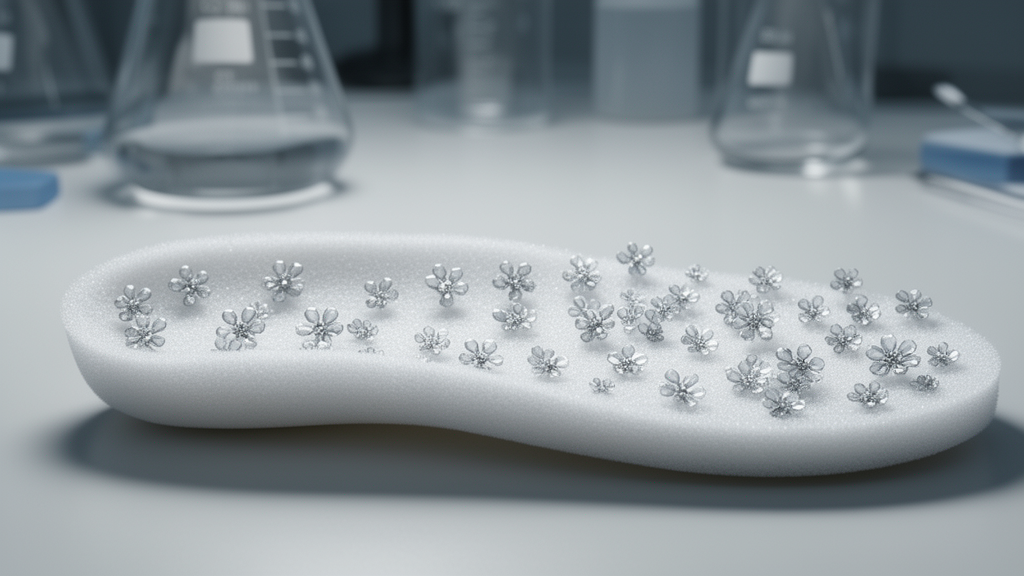
Inside a warm, damp shoe, an invisible ecosystem thrives. Hours of wear raise humidity and temperature to levels that bacteria and fungi find irresistible, and the leather lining of a shoe—being an organic material—serves as both a home and a food source for a long list of unwanted guests, including Bacillus, Staphylococcus, Penicillium, Aspergillus and Candida species. The result can be anything from unpleasant odor to genuine bacterial and fungal infections of the foot. A team of researchers in Bulgaria has now reported a way to fight back at the nanoscale: by growing zinc oxide nanoparticles directly inside a gelatin coating applied to shoe lining leather, they created a finish film that measurably suppresses both bacterial and fungal growth.
The study, published in the Spanish Journal of Soil Science by Darina Zheleva and Desislava Angelova of the University of Chemical Technology and Metallurgy together with Ekaterina Krumova, Lyudmila Yovchevska and Yana Gocheva of the Stephan Angeloff Institute of Microbiology at the Bulgarian Academy of Sciences, addresses a gap in leather nanotechnology. Most work on antimicrobial leather has focused on the pre-tanning stage, where nanomaterials are added to the tanning solution itself. Far fewer investigations have explored the very last step of leather processing—the finishing stage—where a thin protective film is laid on top of the material. It is precisely here that the Bulgarian team chose to intervene, synthesizing and depositing zinc oxide nanoparticles in situ rather than simply mixing a pre-made powder into a coating.
The choice of zinc oxide is deliberate. Among metal oxide nanomaterials such as titanium dioxide, copper oxide, silver and copper, ZnO stands out for its strong antimicrobial properties, its biocompatibility, its relatively low toxicity and its cost-effectiveness. Positively charged zinc-containing particles can interact electrostatically with the negatively charged surfaces of bacterial cell walls, and the nanoparticles are known to generate reactive oxygen species—hydrogen peroxide, superoxide anions and hydroxyl radicals—that inflict oxidative stress on microbial cells. Released zinc ions additionally interfere with bacterial metabolism and enzyme function, and the particles’ small size allows them to penetrate membranes and damage intracellular components, including DNA.
To anchor the nanoparticles to the leather, the researchers used a cleverly matched scaffold: a cross-linked gelatin hydrogel, chemically similar in structure to the collagen that constitutes natural leather itself. Gelatin and collagen carry abundant amino, amide and carboxyl groups in their side chains, and these polar groups can bind metal atoms. The amino and carboxyl functional groups act as binding sites for zinc ions, seeding localized nucleation of ZnO crystals on and within the coating. In effect, the organic matrix becomes a template that guides the growth of the inorganic particles.
The team prepared chrome-tanned pig leather samples, each 50 by 50 millimeters and 0.89 millimeters thick, and treated them with three different methods that varied the sequence of steps. In the first method, gelatin was cross-linked with glutaraldehyde before leather impregnation, followed by the addition of zinc nitrate solution and sodium hydroxide. The second method immersed the leather in gelatin first and introduced the crosslinking agent later. The third method, performed in an ultrasonic bath, pre-mixed the zinc nitrate and sodium hydroxide solutions before impregnation and crosslinking. In all cases, sodium hydroxide was added in tenfold excess relative to zinc ions, driving the precipitation of zinc hydroxide and its conversion to zinc oxide during thermal treatment and drying.
Scanning electron microscopy revealed what happened next: the spherical nanoparticles morphed into striking flower-like structures, a sign that nucleation of ZnO crystal architecture had begun on the leather surface. Individual particles measured between 50 and 200 nanometers, but clusters and agglomerations swelled to more than 500 nanometers and beyond one micrometer. The team attributes the flower-like morphology to heterogeneous nucleation on the gelatin matrix: supersaturation after the addition of sodium hydroxide drives crystal growth along specific crystallographic planes of the wurtzite structure, while the surrounding organic network restricts orientation and promotes radial, petal-like assembly. Elemental analysis added a dramatic quantitative contrast. In the first sample type, the coating contained roughly 11.6 percent zinc oxide by weight within the probed cubic-micrometer region; in the second, where the particles sat atop the hydrogel surface, the figure jumped to approximately 64.6 percent—suggesting heavy agglomeration and, critically, higher surface activity exactly where it matters for microbial contact.
Spectroscopy confirmed the chemistry underneath. Fourier-transform infrared spectra showed the expected absorption peaks for amide and amine groups from collagen and gelatin, and demonstrated that positively charged zinc species can bind electrostatically to negatively charged carboxylate residues or to the lone electron pairs on amino acid nitrogen atoms. A characteristic peak at 852 wavenumbers confirmed the formation of tetrahedrally coordinated zinc oxide, most clearly expressed in the ultrasonically treated sample. Ultraviolet-visible spectroscopy sealed the case with a low absorption peak at 363 nanometers—the unambiguous optical fingerprint of nanostructured zinc oxide.
Then came the biological tests, conducted with the Kirby–Bauer disc diffusion method against four bacterial strains: Pseudomonas aeruginosa and Escherichia coli, both Gram-negative, and Bacillus subtilis and Erysipelothrix rhusiopathiae, both Gram-positive. The results revealed a clear selectivity. Only the ultrasonically prepared sample produced a measurable zone of inhibition, and only against Bacillus subtilis, with a modest inhibition zone of about 4 millimeters—small compared with the 18-millimeter zones produced by a reference antibiotic. The Gram-negative bacteria proved entirely resistant to all the modified samples. This pattern matches earlier findings that Gram-positive bacteria are generally more vulnerable to ZnO nanoparticles than their Gram-negative counterparts, possibly owing to differences in cell wall architecture, surface charge, membrane composition and cellular physiology. The researchers also note that the relatively weak antibacterial effect may stem from limited diffusion of active zinc species out of the cross-linked gelatin matrix, which restricts the particles’ availability at the bacterial interface—a trade-off inherent in immobilizing nanoparticles for durability.
Against fungi, the story was considerably more impressive. The untreated leather showed no antifungal activity whatsoever, but all three ZnO-modified variants strongly protected against Aspergillus niger and Candida albicans. Growth of Candida albicans was inhibited for the first 24 hours before the yeast resumed growth, while Aspergillus niger growth was suppressed for 24 hours, followed by long-lasting inhibition of sporulation that persisted through 72 hours of observation. The mechanism likely combines physical effects—disruption of ion transport, membrane integrity and protein function by the particles—with chemical attack through reactive oxygen species generation, zinc ion release and direct membrane interaction. When treated with the nanoparticles, fungal hyphae developed compact vacuole-like structures, lost cytoplasmic volume and became coated with electron-dense particle layers, consistent with nanoparticle adsorption and subsequent cellular damage.
The authors conclude that these ZnO-containing finish films can serve as effective protective antibacterial and antifungal coatings for shoe leather, helping shield the human foot from microbial exposure. Because zinc oxide holds Generally Recognized As Safe status for certain uses and has shown limited dermal penetration and low acute toxicity in most studies, the approach looks promising relative to the hazardous biocides traditionally used to prevent leather biodegradation. Still, the researchers urge caution: the long-term effects of chronic skin contact with zinc ion release remain insufficiently understood, and nanomaterials fall under the EU’s REACH regulatory framework, demanding careful toxicological evaluation. There is also an unsolved sustainability problem at the end of the product’s life. No current technology can extract or regenerate nanoparticles embedded in footwear materials, which limits both the reuse of the embedded metal and the technology’s overall environmental credentials. For now, the work stands as a vivid demonstration that the final finishing step—the one the industry has long overlooked—may be the best place to build infection-fighting power directly into the shoes on our feet.
Subject of Research: Antimicrobial zinc oxide nanoparticle coatings for shoe lining leather
Article Title: Investigation of ZnO Antimicrobial Surface Treatment of Shoe Lining Materials
Article References: Zheleva, D., Angelova, D. S., Krumova, E., Yovchevska, L., & Gocheva, Y. (2026). Investigation of ZnO Antimicrobial Surface Treatment of Shoe Lining Materials. Spanish Journal of Soil Science, 15, Article 14992. https://doi.org/10.3389/sjss.2025.14992
Image Credits: AI Generated
Keywords: zinc oxide nanoparticles, antimicrobial coating, shoe lining leather, gelatin hydrogel, footwear hygiene, reactive oxygen species, Aspergillus niger, Candida albicans, nanotechnology, leather finishing, collagen, antifungal activity
Cite Scienmag News
Violet Maxwell. (October 16, 2026). Flower-Shaped Zinc Oxide Nanoparticles Turn Shoe Linings Into Microbe-Killing Shields. Scienmag. https://scienmag.com/flower-shaped-zinc-oxide-nanoparticles-turn-shoe-linings-into-microbe-killing-shields/
Violet Maxwell. "Flower-Shaped Zinc Oxide Nanoparticles Turn Shoe Linings Into Microbe-Killing Shields." Scienmag, 16 October 2026, https://scienmag.com/flower-shaped-zinc-oxide-nanoparticles-turn-shoe-linings-into-microbe-killing-shields/. Accessed 16 October 2026.
Violet Maxwell. "Flower-Shaped Zinc Oxide Nanoparticles Turn Shoe Linings Into Microbe-Killing Shields." Scienmag. October 16, 2026. https://scienmag.com/flower-shaped-zinc-oxide-nanoparticles-turn-shoe-linings-into-microbe-killing-shields/


