


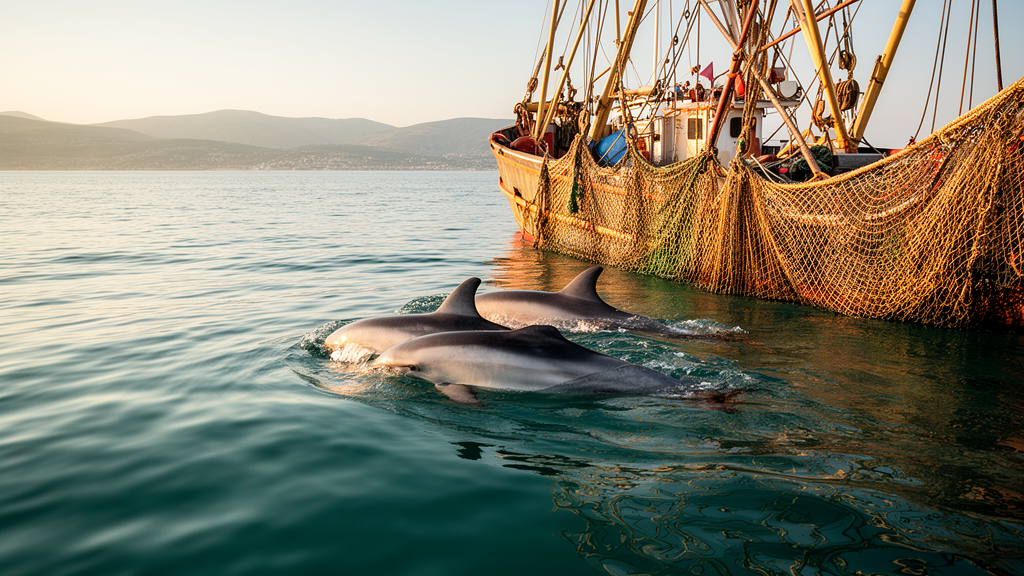
Off the Italian coast, bottlenose dolphins are shadowing fishing trawlers at rates so high that scientists now describe the animals as strikingly reliant on trawl gear. A new eight-year study, published in Frontiers in Mammal Science, reveals that dolphins followed nearly one in four trawlers inspected—and in one region, they trailed three out of every four bottom otter trawlers. The finding suggests that in parts of the Adriatic Sea, one of the most intensively trawled areas on Earth, dolphins may have little choice but to treat fishing vessels as dependable food sources.
The research, led by Giovanni Bearzi of Dolphin Biology and Conservation and OceanCare, together with Silvia Bonizzoni, Nathan B. Furey of the University of New Hampshire, and Randall R. Reeves, combined survey data collected between 2018 and 2025 with 17,755 kilometers of navigation effort from independent research boats. The team covered two study areas off the Italian regions of Veneto and Marche, spanning roughly 5,000 square kilometers of shallow coastal waters. Over 148 days of trawling activity, the researchers inspected 859 trawlers for dolphin presence or absence, photographing vessels and cataloguing gear types with high-resolution cameras and 20-megapixel digital equipment.
The results were stark. Dolphins were observed in the wake of 24.7 percent of all trawlers checked. But the proportion varied dramatically depending on the type of gear being towed. Bottom otter trawlers, which drag a single net kept open by two large boards across the seabed, were followed by dolphins 41.3 percent of the time. Midwater pair trawlers, in which two vessels tow a single net together, attracted dolphins 35.1 percent of the time. Beam trawlers, which tow narrow metal dredges fitted with teeth along the leading edge, were followed only 1.5 percent of the time—essentially ignored by the animals.
The regional contrast was even more surprising. Off Veneto, dolphins followed 25.9 percent of otter trawlers inspected. Off Marche, roughly 150 kilometers to the south, they trailed 75.9 percent of the same gear type. The difference was statistically significant, and the researchers note it is unlikely to be a sampling artifact given the robust number of inspections in both areas. Why dolphins in Marche associate with trawlers at triple the rate seen in Veneto remains difficult to explain, particularly since the two regions are so close together and share similar shallow, heavily fished waters.
Photo-identification data reinforce the picture of widespread reliance. The team compiled 47,261 high-quality photographs of individual dolphins, matching animals based on conspicuous dorsal fin markings. Of 490 marked adult individuals identified in Veneto, 85.9 percent were photographed at least once behind trawlers. In Marche, the figure rose to 90.3 percent of 308 marked adults. These numbers suggest that the large majority of bottlenose dolphins in both study areas forage regularly behind operating trawl gear, not merely as occasional opportunists but as consistent specialists targeting considerable proportions of the local trawl fleets.
The behaviour itself is technically sophisticated. Dolphins foraging behind towing trawlers normally surface between 20 and 200 meters behind the vessel’s stern, often splitting into subgroups: one cluster near the vessel, possibly feeding on organisms discarded from the deck; a second surfacing above the towed net; and a third behind the codend, the closed end of the net where catch accumulates. Dives typically last two to three minutes, with the longest recorded at about five minutes. During hauling, when trawlers are motionless or moving slowly backward, dolphins can approach the stern as the net is retrieved, surfacing as close as one to two meters from the vessel. The researchers tracked dolphin movements behind trawlers for a total of 86 hours and 1 minute, covering 525 kilometers of following.
Group sizes behind trawlers averaged 9.0 individuals, ranging from 1 to 70. Adults were present in all 212 groups followed, while juveniles appeared in 51.4 percent, calves in 29.2 percent, and newborns in 7.1 percent. Critically, dependent newborns and small calves were routinely observed surfacing and diving in synchrony with adults above towed nets, performing dives as long as those of the adults. The youngest animals did not approach vessels as closely as adults, but by observing the behaviour of mature foragers, immature dolphins are likely to learn this specialised tactic and become trawler-followers themselves as they mature—a pattern consistent with cultural transmission of foraging behaviour documented in other odontocete populations worldwide.
The researchers frame this adaptation against a backdrop of severe ecological degradation. The Adriatic Sea has one of the world’s highest regional intensities of bottom trawling and, by far, the poorest seabed condition compared to 23 other trawled regions worldwide. Trawling has helped drive a major regime shift in the basin, flattening rich three-dimensional habitats into sedimentary plains and depleting natural prey for apex predators. Elasmobranchs declined by more than 94 percent between 1948 and 2005. Short-beaked common dolphins, once abundant throughout the Adriatic, have virtually disappeared. In this context, the dolphins’ turn to trawlers may simply reflect exploitation of the resources that remain available to them—a pattern paralleled in terrestrial carnivores such as polar bears, which become reliant on human food sources when natural prey is scarce.
Whether this reliance ultimately helps or harms the dolphins is unknown. Foraging behind trawlers could augment food intake in the short term, and in other species, association with fishing gear has been linked to higher survival and calving rates. But any advantages may be offset by chronic exposure to vessel noise, trawl-related pollutants, occasional injury or death in trawl gear, and the continued deterioration of the ecosystems on which the animals depend. Culture-driven foraging specialisation can also fragment populations into separate social clusters, making them more vulnerable to further environmental change. When the targeted niche depletes, the behavioural trait becomes maladaptive—an evolutionary trap in which short-term benefits mask long-term costs.
The authors argue that promoting the continued use of trawlers is inadvisable, not only to protect dolphins but to conserve Adriatic marine biodiversity more broadly. They point to spatial restrictions on trawl fisheries and the adoption of less destructive fishing methods as sensible approaches consistent with obligations under the Convention on Biological Diversity, the Convention on Migratory Species, and the Barcelona Convention. The Jabuka/Pomo Pit Fisheries Restricted Area, established in 2017 in the Adriatic, offers a compelling example of how spatial management can benefit both the marine environment and fisheries. Yet compliance there was high while fishers maintained similar overall effort by trawling elsewhere. The northern Adriatic has been classified as an Important Marine Mammal Area for bottlenose dolphins, and appropriately large no-take zones would allow researchers to investigate whether dolphins, over time, reduce their dependence on trawlers and return to catching prey the natural way—potentially opening the door for common dolphins to return to waters they once dominated.
Subject of Research: Bottlenose dolphin reliance on trawlers in the prey-depleted Adriatic Sea
Article Title: Bottlenose dolphin reliance on trawlers in prey-depleted Adriatic Sea regions
Article References: Bearzi, G., Bonizzoni, S., Furey, N. B., & Reeves, R. R. (2026). Bottlenose dolphin reliance on trawlers in prey-depleted Adriatic Sea regions. Frontiers in Mammal Science, 5, Article 1855890. https://doi.org/10.3389/fmamm.2026.1855890
Image Credits: AI Generated
DOI: 10.3389/fmamm.2026.1855890
Keywords: bottlenose dolphins, Adriatic Sea, trawling, prey depletion, cultural transmission, marine conservation, Frontiers in Mammal Science, Bottlenose, dolphin, reliance, trawlers, prey-depleted
Cite Scienmag News
Margaret Porter. (October 16, 2026). Bottlenose Dolphins in the Adriatic Sea Are Hooked on Trawlers—and That Should Worry Us. Scienmag. https://scienmag.com/bottlenose-dolphins-in-the-adriatic-sea-are-hooked-on-trawlers-and-that-should-worry-us/
Margaret Porter. "Bottlenose Dolphins in the Adriatic Sea Are Hooked on Trawlers—and That Should Worry Us." Scienmag, 16 October 2026, https://scienmag.com/bottlenose-dolphins-in-the-adriatic-sea-are-hooked-on-trawlers-and-that-should-worry-us/. Accessed 16 October 2026.
Margaret Porter. "Bottlenose Dolphins in the Adriatic Sea Are Hooked on Trawlers—and That Should Worry Us." Scienmag. October 16, 2026. https://scienmag.com/bottlenose-dolphins-in-the-adriatic-sea-are-hooked-on-trawlers-and-that-should-worry-us/


