


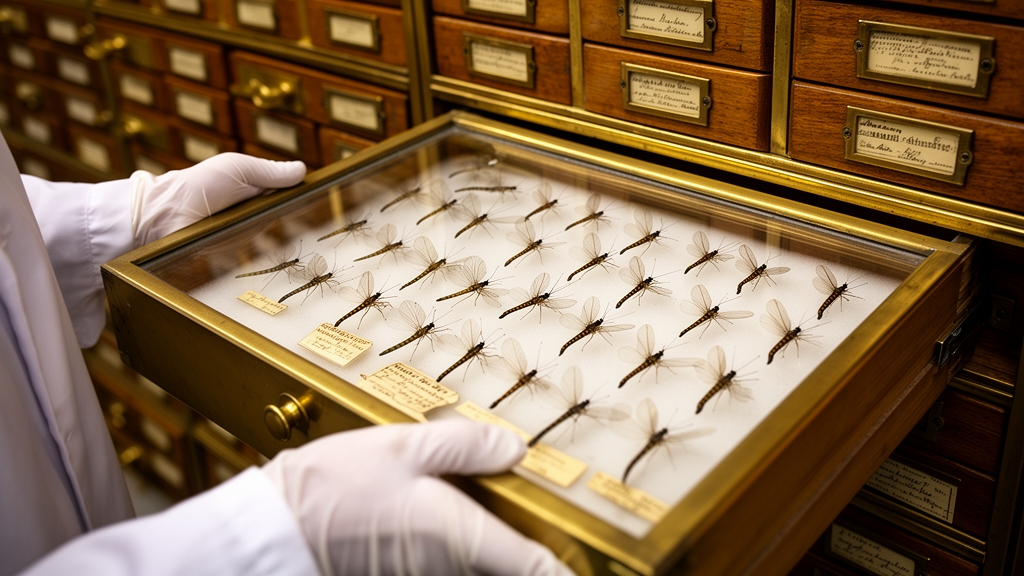
Deep beneath the grand halls of the Natural History Museum Vienna, in drawers lined with pinned insects and handwritten labels, lies one of the most remarkable scientific archives of its kind. A newly published catalogue has confirmed that the museum holds 1,282 type specimens representing 75 species and subspecies of snakeflies, the enigmatic insects whose elongated prothorax and predatory habits have earned them the common name of Raphidioptera. The work, appearing in the Annals of the Natural History Museum Vienna, represents the first comprehensive documentation of the museum’s Neuropterida type material and offers a rare window into how modern taxonomy was built, specimen by specimen, over more than a century.
Snakeflies are, in many ways, the quiet underdogs of the insect world. With only 252 valid species currently recognized worldwide, Raphidioptera is the smallest order of the Holometabola, the vast group of insects that undergo complete metamorphosis and includes butterflies, beetles, bees, and flies. Of those 252 species, 206 belong to the family Raphidiidae and 46 to the family Inocelliidae. Despite their modest diversity, snakeflies hold a special place in evolutionary studies because they retain many primitive features, including a long, flexible neck-like prothorax that allows the head to be raised in a striking, snake-like posture. Adults are agile predators, and larvae develop under tree bark, feeding on small arthropods in the crevices of forest ecosystems.
The scientific value of the Vienna collection lies not merely in its size but in its composition. Of the 75 species and subspecies represented by type specimens, 68 belong to the family Raphidiidae and seven to the family Inocelliidae. The overwhelming majority of these species were described by Horst Aspöck, Ulrike Aspöck, and Hubert Rausch, three Austrian researchers whose decades of close cooperation with the museum transformed the study of snakeflies. Ulrike Aspöck served as curator of the collection from 1986 to 2006, a period during which the museum’s holdings grew substantially. The catalogue records that the museum’s entire Raphidioptera collection contains 168 species and subspecies, meaning that nearly half are anchored by type material, the physical specimens upon which the original scientific descriptions of those species were based.
Type specimens are the bedrock of biological nomenclature. When a scientist formally describes a new species, the law of priority requires that a single physical specimen, the holotype, be designated as the definitive reference for that name. Additional specimens used in the original description, known as paratypes, allotypes, and paratypoids, provide supporting evidence and often represent the opposite sex or geographic variants. Without these specimens, species names become ambiguous, and taxonomists cannot reliably determine which organisms a name applies to. The Vienna catalogue meticulously documents each type specimen, recording the original description’s page number, the type locality, and the current taxonomic status of every species, information that is essential for future researchers attempting to resolve nomenclatural disputes.
The catalogue’s technical rigor is evident in its treatment of individual specimens. Each entry documents the precise labels attached to the specimen, distinguishing between printed labels, handwritten text, and remarks by the original authors. Many specimens carry macerated genital segments stored in glycerine in small glass vials pinned to the corresponding insect, a preparation technique that allows researchers to examine the taxonomically critical reproductive structures without destroying the specimen. The catalogue also notes whether material is dried and pinned or preserved in 75 percent ethanol, and whether specimens belong to the main collection or to the collection of Herbert Hölzel, which came to the museum in 2010.
Among the most historically significant specimens in the collection are those with provenance stretching back to the nineteenth century. The lectotype of Raphidia ratzeburgi, described by Brauer in 1876, carries labels indicating its origin in Austria, with the original description later specifying Styria as the more precise type locality. The holotype of Raphidia phoenicia, described in 1964, bears a label reading Led. Cyp. b. 854, suggesting a possible origin on Cyprus, though the authors note that the provenance remains unresolved. The holotype of Raphidia exul, also described in 1964, carries no type locality at all, a situation the original authors acknowledged with regret, noting that they had initially believed the specimen came from Parnassus in Greece based on its label, but that the later discovery of a female in the same handwriting suggested a possible origin near the Taurus mountains, a question that must remain undecided.
The catalogue also reveals the geographic breadth of the research that produced these types. Type localities span from Morocco’s High Atlas mountains, where the holotype of Africoraphidia spilonota was collected in 1933, to Mexico’s Sierra de Miahuatlán, where the holotype of Alena (Aztekoraphidia) infundibulata was found in 1991. Kyrgyzstan emerges as a particularly rich source, with numerous species described from the Talasskiy Alatau, the Chatkal range, and the Fergana range, reflecting intensive field expeditions conducted by the Aspöck team in the 1990s. Greece, Türkiye, and Italy are also well represented, with type localities ranging from Crete’s Lefka Ori to Calabria’s Aspromonte. The catalogue documents specimens collected by dozens of different researchers over more than a century, including early expeditions by Krüper in Greece in the 1860s and by Mann in the Balkans in the 1860s and 1870s.
Not every entry in the catalogue is a success story. The type status of one specimen of Ophiopsis mediterranea, marked as a type in the collection, could not be confirmed, as the specimen is not listed in the original description. Two type specimens of Mongoloraphidia (Hissaroraphidia) karatauica, described in 1995, are missing from the museum, having been transferred to the Aspöck collection but not returned by the time the publication was completed. These gaps, while unfortunate, are themselves scientifically valuable, as they alert future researchers to the need for caution when citing these specimens and may prompt renewed efforts to locate the missing material.
The foundation for the present catalogue was laid in 2006 and 2007, when a diploma thesis by the first author of the publication recorded the type material of Neuropterida in the museum’s main collection for the first time. That preliminary work, combined with decades of cooperation between the museum and the Aspöck research group, has now culminated in a definitive reference that will serve taxonomists, evolutionary biologists, and conservation scientists for generations. As the smallest order of the Holometabola, snakeflies may never attract the popular attention given to butterflies or beetles, but the Vienna collection demonstrates that even the most modest insect groups can generate a scientific legacy of extraordinary depth, one pinned specimen at a time.
Subject of Research: Type catalogue of Raphidioptera specimens at the Natural History Museum Vienna
Article Title: Type specimens of Neuropterida ( Insecta ) in the Natural History Museum Vienna. I. Raphidioptera
Article References: Type specimens of Neuropterida ( Insecta ) in the Natural History Museum Vienna. I. Raphidioptera. (n.d.). https://doi.org/10.3897/anhmw.171465
Image Credits: AI Generated
DOI: 10.3897/anhmw.171465
Keywords: snakeflies, Raphidioptera, type specimens, Natural History Museum Vienna, taxonomy, Neuropterida, Type, specimens, Insecta, Natural, History, Museum
Cite Scienmag News
Gavin Prescott. (October 16, 2026). Inside Vienna’s Vault: 1,282 Snakefly Type Specimens Reveal a Century of Insect Discovery. Scienmag. https://scienmag.com/inside-viennas-vault-1282-snakefly-type-specimens-reveal-a-century-of-insect-discovery/
Gavin Prescott. "Inside Vienna’s Vault: 1,282 Snakefly Type Specimens Reveal a Century of Insect Discovery." Scienmag, 16 October 2026, https://scienmag.com/inside-viennas-vault-1282-snakefly-type-specimens-reveal-a-century-of-insect-discovery/. Accessed 16 October 2026.
Gavin Prescott. "Inside Vienna’s Vault: 1,282 Snakefly Type Specimens Reveal a Century of Insect Discovery." Scienmag. October 16, 2026. https://scienmag.com/inside-viennas-vault-1282-snakefly-type-specimens-reveal-a-century-of-insect-discovery/


