


…
The editorial’s emphasis on visibility as a pathway to inclusion reflects a broader principle in the sociology of science: representation in journals, conference programs, and editorial boards shapes who imagines themselves as future researchers. When early-career scientists see authors with similar backgrounds publishing on topics they care about, the perceived distance between themselves and the profession narrows. This is particularly relevant in melittology, where fieldwork traditions, mentorship lineages, and regional societies have historically influenced who participates. The Research Topic examined here spans four continents and multiple career stages, suggesting that editorial initiatives can function as both a record of existing contributions and an invitation to newcomers who might otherwise assume that bee science is a narrow or closed field.
The demographic statistics cited in the editorial deserve closer attention because they reveal a structural pattern often described as a leaky pipeline. Women earning roughly half of entomology doctoral degrees in North America while remaining underrepresented in permanent academic and government positions indicates that attrition occurs after training, not before it. The Brazilian case is especially instructive: when women receive the majority of bachelor’s and master’s degrees in a discipline yet occupy fewer permanent research posts, the bottleneck lies in hiring, promotion, and retention rather than in interest or preparation. Similar patterns have been documented across many scientific fields, and the consistency of the finding across countries with different academic systems suggests that the causes are systemic rather than local. Career-stage timing compounds the problem, since the years in which researchers typically establish independent laboratories often coincide with peak caregiving responsibilities, and institutions that fail to accommodate this reality lose trained scientists at precisely the moment their investment matures.
The scientific content assembled in the Research Topic also illustrates how methodological diversity strengthens inference in pollination science. Species distribution modeling, as applied by the authors studying Neotropical crops and Amazonian bumblebees, relies on occurrence records, environmental layers, and climate projections to estimate where species can persist under future conditions. Such models carry inherent uncertainties, including assumptions about dispersal ability, biotic interactions, and physiological tolerance, which is why the finding that one bumblebee species may lose more than forty percent of suitable climate area while a close relative faces milder projected losses is best interpreted as a call for species-specific field validation rather than a definitive forecast. The contrast between the two Bombus species underscores a recurring lesson in conservation biology: closely related taxa sharing a region can respond very differently to the same climatic pressures, so conservation planning must be grounded in the ecology of individual species rather than in group-level assumptions.
The treatment of neonicotinoid pesticides across the Research Topic similarly demonstrates the value of complementary approaches. A field-focused study of stingless bees in Brazilian coffee cultivation can capture real-world exposure scenarios in a tropical agroecosystem, while a systematic review of bumblebee studies across Europe and North America can synthesize patterns that no single experiment could reveal. The observation that behavioral and reproductive effects are better characterized than effects on pollination efficiency itself identifies a genuine gap: a bee may survive exposure yet deliver fewer or lower-quality pollination services, with consequences for crop yields that current risk assessments may not fully capture. Stingless bees add another dimension to this question because they are dominant pollinators in many Neotropical systems, manage colonies differently from honey bees, and may experience distinct exposure routes through their nesting materials and food storage practices.
The honey bee contributions in the collection connect laboratory-scale mechanisms to practical beekeeping decisions. Hygienic behavior, the removal of diseased or mite-infested brood from cells, has long been recognized as a heritable colony-level defense, and tools that allow breeders to identify resistant colonies without waiting for natural disease outbreaks can accelerate selection programs. Synthetic semiochemical-based assays are valuable precisely because they standardize a stimulus that varies unpredictably in nature, letting beekeepers compare colonies on equal footing. Resistance to the parasitic mite Varroa destructor matters not only for mite control itself but also for the viral complexes that mites vector, which is why a single behavioral trait can correlate with resilience against RNA viruses, microsporidian parasites, and fungal pathogens. At the same time, the study of competition between managed honey bees and cavity-nesting native bees at the urban-bushland interface in Australia addresses a different side of the same species: the same bee that supports crop pollination can, at high densities, compete with native assemblages for floral resources. Practical recommendations for colony placement and for planting pollen sources used by native bees represent the kind of actionable output that emerges when ecological research is designed with management questions in mind.
The waggle dance research highlights how new instrumentation revitalizes classical questions. Karl von Frisch’s decoding of the dance in the mid-twentieth century established that foragers communicate direction and distance, but modern video capture and network analysis allow researchers to follow individual dancers and followers over time, quantifying how recruitment actually propagates through a colony’s forager workforce. Viewing the dance as one node in a social network rather than as an isolated signal opens questions about which bees attend dances, how information spreads unevenly among colony members, and how collective foraging decisions emerge from many individual interactions. This shift from signal description to network dynamics exemplifies a broader trend in animal behavior research, enabled by affordable high-resolution recording and computational tools that were unavailable to earlier generations.
The historical figures invoked by the editors also merit reflection. Eva Crane’s founding of the International Bee Research Association in 1949 created an institutional home for apicultural science at a time when the field was scattered across national traditions, and her prolific career demonstrated that rigorous synthesis could itself be a scientific contribution. Anna Maurizio’s role in establishing the forerunner of the International Commission for Plant-Pollinator Relationships helped build the pollination biology community that now underpins much of the research described in this collection. These women worked in eras when formal recognition of female scientists was rarer, and their legacies illustrate how infrastructure-building, not only experimental discovery, shapes a discipline’s trajectory. Tracing such lineages matters for contemporary equity efforts because it corrects the perception that women are newcomers to bee science rather than long-standing contributors whose visibility in historical accounts has lagged behind their actual influence.
The international composition of the Research Topic carries its own significance. Bee science conducted in Brazil, Australia, North America, and Europe addresses ecosystems, pollinator faunas, and agricultural systems that differ profoundly, from stingless bee coffee pollination in the Neotropics to honey bee and native bee interactions in Australian bushland. Research agendas shaped primarily in a few wealthy countries risk overlooking questions critical to biodiversity hotspots where pollinator dependence of crops and wild plants is high and monitoring capacity is limited. Editorial platforms that deliberately gather work from multiple regions help distribute scientific attention more evenly and expose readers to study systems and bee taxa they might otherwise never encounter. They also create collaboration opportunities, since global challenges such as climate-driven range shifts and pesticide regulation cannot be resolved within any single country’s data.
Ultimately, the editorial frames a dual commitment that characterizes much of contemporary bee science: addressing urgent applied problems, including pollinator decline, crop pollination security, and sustainable pest management, while pursuing fundamental questions about behavior, genetics, and ecology. The two commitments are mutually reinforcing, because applied urgency attracts funding and public interest that sustain basic research, and mechanistic understanding provides the foundation on which practical tools are built. Whether the demographic gap in research positions narrows in the coming decades will depend on institutional choices in hiring, mentoring, and workload allocation, but initiatives that make contributions visible, document persistent inequities with transparent data, and connect researchers across regions and career stages represent concrete steps toward a community in which the full breadth of talent devoted to understanding and protecting bees can flourish.
Subject of Research: …
Article Title: Editorial: Women in bee science
Article References: Fahrbach, S. E., Imperatriz-Fonseca, V. L., Nunes-Silva, P., & Wallace, H. M. (2026). Editorial: Women in bee science. Frontiers in Bee Science, 4, Article 1781526. https://doi.org/10.3389/frbee.2026.1781526
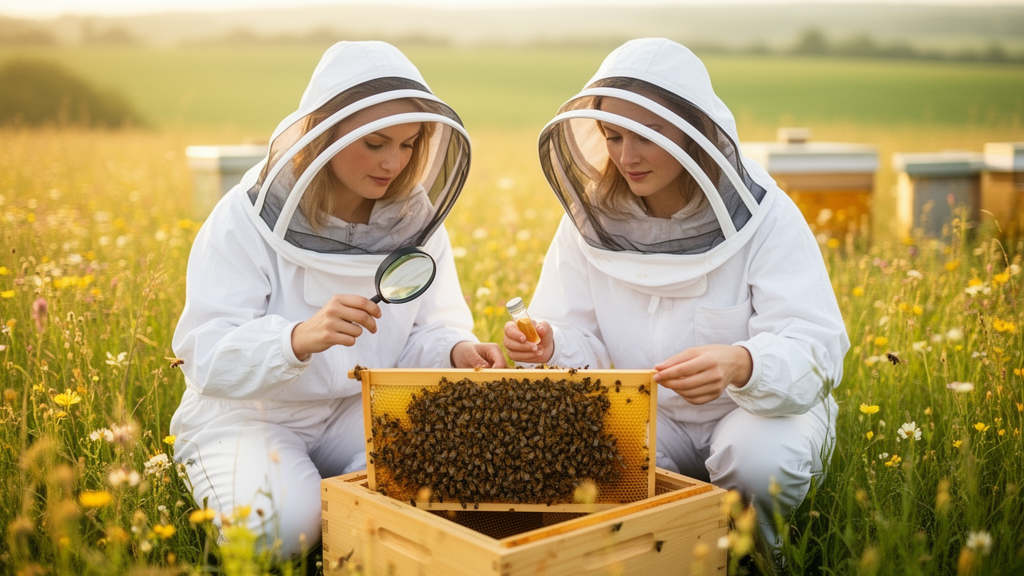
Image Credits: AI Generated
DOI: 10.3389/frbee.2026.1781526
Keywords: bee science, women in science, pollination, climate change, neonicotinoids, stingless bees, honey bees, bumblebees, Editorial, Women, science, scientific research
Cite Scienmag News
Sloane Callahan. (October 16, 2026). Women Redefine the Frontiers of Bee Science. Scienmag. https://scienmag.com/women-redefine-the-frontiers-of-bee-science/
Sloane Callahan. "Women Redefine the Frontiers of Bee Science." Scienmag, 16 October 2026, https://scienmag.com/women-redefine-the-frontiers-of-bee-science/. Accessed 16 October 2026.
Sloane Callahan. "Women Redefine the Frontiers of Bee Science." Scienmag. October 16, 2026. https://scienmag.com/women-redefine-the-frontiers-of-bee-science/


