


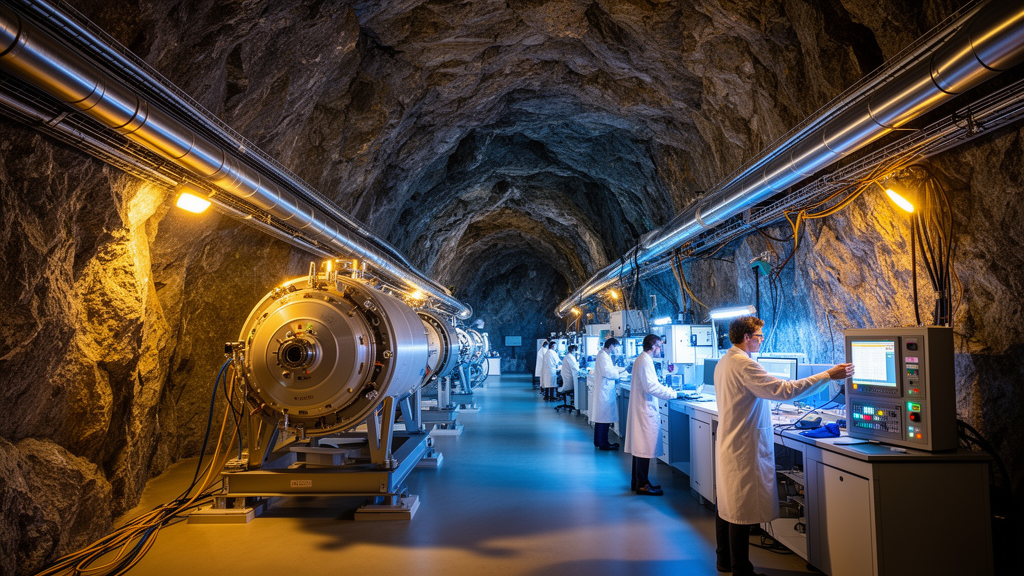
Deep beneath the Swiss Alps, inside two 800-meter vertical shafts drilled during construction of the Gotthard railway base tunnel, a team of European engineers and scientists sees the skeleton of something extraordinary: a next-generation microgravity research facility that could fly experiments — and eventually people — through weightlessness hundreds of times a day. The concept, unveiled in a perspective article in Frontiers in Space Technologies, proposes a facility called Alpine Low Gravity Exploration, or AlpGE, that would be built into vertical rock faces, dams, or mine shafts in the European Alps. If realized, it would be the first ground-based microgravity platform in the world certified for human participation, combining the accessibility of a laboratory with the physics of free fall.
The vision arrives at a pivotal moment for the space sector. What was once the exclusive domain of governmental agencies — launching astronauts, operating space stations, planning lunar bases — is rapidly shifting toward commercial players. At least four private consortia are currently developing commercial space stations, and two companies are competing to launch crewed capsules. Meanwhile, major agencies including NASA and the European Space Agency have committed to establishing permanently crewed bases on the Moon and, eventually, sending humans to Mars. These ambitions carry enormous biomedical and technological challenges, from bone loss and immune dysfunction to the behavior of lunar regolith under partial gravity. Addressing them demands research facilities that are faster, cheaper, and more flexible than anything currently available.
Europe today relies on a portfolio of microgravity platforms, each with distinct strengths and severe limitations. Drop towers, such as the 120-meter freestanding vacuum tube at the Center of Applied Space Technology and Microgravity (ZARM) in Bremen, Germany, offer the highest microgravity quality of any platform — between 10⁻⁵ and 10⁻⁶ g — but only for 4.7 seconds, or 9 seconds when using a hydraulic catapult. Establishing the vacuum before each drop takes up to two hours, limiting operations to two or three drops per day. The harsh deceleration of up to 50 g and the cramped experiment capsule, just 600 millimeters in diameter, further restrict what can be tested.
Parabolic flights, operated in Europe primarily by Novespace in Bordeaux using an Airbus A310, provide up to 22 seconds of weightlessness and are the only platform allowing untrained personnel on board after a short briefing. The aircraft flies a steep climb, then reduces thrust so it just compensates air drag, tracing a parabolic free-fall trajectory. Scientists can operate their own experiments directly, using standard lab equipment with minimal modification. But the microgravity quality is comparatively poor — around 10⁻² to 10⁻³ g due to fuselage vibrations and the aircraft’s turn rate — and campaigns require six to twelve months of preparation, strict safety assessments, and a rigid schedule that offers little room for iteration when hardware fails.
Sounding rockets, launched from the Esrange Space Center in Sweden, extend microgravity to five or six minutes at high quality, but subject payloads to accelerations of roughly 13 g, spinning at 3 Hz, and violent vibrations. Temperature swings from −30 °C to above 200 °C during flight add further stress. Orbiting platforms like the International Space Station offer the longest durations, but crew time is scarce and expensive, launch delays can ruin time-sensitive samples, and after the ISS is decommissioned — currently planned for the end of 2032 — European experiments will depend on commercial stations or return satellites still under development.
Against this backdrop, a new class of facility has emerged that the authors call guided actuated parabola, or GAP, systems. Unlike traditional drop towers, which simply release a capsule into free fall, GAP facilities actively drive a rail-guided capsule along a vertical parabola using a controlled feedback loop. Inside the outer capsule, an experiment capsule separates by a few millimeters during the microgravity phase, fully decoupled and in free fall, while the outer shell absorbs air drag and mechanical disturbances. Because no vacuum is required, repetition rates soar. The GraviTower Bremen Prototype, using hydraulic drives and steel cables, has performed over 10,000 parabolas since opening to science in 2022 — a milestone the ZARM drop tower needed 34 years to reach. The Einstein Elevator in Hannover, propelled by electrodynamic linear drives along a 40-meter tower, achieves 4 seconds of microgravity at 10⁻⁶ g and can fly up to 300 parabolas per day.
These systems have proven the technology works. The challenge now is scale. To match the roughly 20 seconds of microgravity offered by parabolic flights, a vertical free-fall distance of approximately 1,000 meters would be required. A 300-meter shaft would already deliver about 10 seconds of high-quality weightlessness. But constructing a freestanding tower of that height with sufficiently low lateral deflections is not feasible — which is precisely why the authors propose going underground, or rather into the mountains. The Alps offer abundant vertical structures: solid rock faces, dams, and shafts, many already built, with excellent road and rail access year-round. The team has identified six promising sites in Switzerland alone, including the two 800-meter Sedrun shafts and the Hagerbach Test Gallery near Flums.
The proposed AlpGE facility would combine the strengths of existing platforms into something genuinely new. A large cabin — roughly 12 square meters of experiment space with a payload capacity up to 1,000 kilograms — would be accelerated along a parabolic trajectory by an electrical drive in a controlled loop, carrying both automated experiments and untrained personnel. An advanced release-caging mechanism with full motion control in six degrees of freedom would suppress rotation rates and vibrations from structural eigenfrequencies. Because the drive system is fully programmable, the facility could generate not just microgravity but any arbitrary partial gravity condition — lunar gravity at 0.17 g, Martian gravity at 0.38 g, even asteroid-level fields — with precise repeatability. Hypergravity phases before and after each parabola would be adjustable between 1.1 and 5 g, allowing scientists to tailor the entire gravity profile to their experiment’s needs.
The human-rated aspect sets AlpGE apart from every other ground-based microgravity platform. Parabolic flights are the only current option for human subjects in weightlessness, but they require preventive medication for motion sickness, rigid scheduling, and strict safety restrictions on chemicals and biological samples. AlpGE’s design would allow rapid evacuation of human subjects experiencing discomfort, enabling experiments without medication. The flexible, science-centered operation — one experiment at a time, tailored entirely to the researcher’s needs — would permit day-by-day iterations of construction, testing, and hardware improvement. The authors also envision integrating large computer clusters for real-time simulations and immediate data evaluation, potentially allowing experiments to autonomously control the microgravity platform itself, a capability unique to ground-based facilities.
The concept remains early-stage, and scaling GAP technology from tens of meters to several hundred meters will be challenging, requiring significant development in drive systems, precision rails, and safety architecture. But the authors argue that Europe already possesses the key ingredients: two working GAP facilities demonstrating technical feasibility, Alpine geology offering rigid vertical structures, and infrastructure ensuring accessibility. As the new space race accelerates and the ISS era draws to a close, the ability to test technologies and countermeasures under realistic microgravity and partial gravity conditions — rapidly, repeatably, and with humans on board — could determine which nations and companies lead the next phase of space exploration. From the authors’ perspective, Europe is now well positioned to take that next step, one parabola at a time, deep inside the mountains.
Subject of Research: A concept for a European human rated microgravity and partial gravity research and testing facility
Article Title: A concept for a European human rated microgravity and partial gravity research and testing facility
Article References: Wuest, S. L., Braun-Badertscher, S., Gierse, A., Gotsch, M., & Schuster, K. (2026). A concept for a European human rated microgravity and partial gravity research and testing facility. Frontiers in Space Technologies, 7, Article 1822358. https://doi.org/10.3389/frspt.2026.1822358
Image Credits: AI Generated
DOI: 10.3389/frspt.2026.1822358
Keywords: concept, European, human, rated, microgravity, partial, gravity, research, testing, facility, scientific research
Cite Scienmag News
Denise Maddox. (October 16, 2026). Inside the Mountain: Europe’s Bold Plan to Build a Human-Rated Microgravity Lab in the Alps. Scienmag. https://scienmag.com/inside-the-mountain-europes-bold-plan-to-build-a-human-rated-microgravity-lab-in-the-alps/
Denise Maddox. "Inside the Mountain: Europe’s Bold Plan to Build a Human-Rated Microgravity Lab in the Alps." Scienmag, 16 October 2026, https://scienmag.com/inside-the-mountain-europes-bold-plan-to-build-a-human-rated-microgravity-lab-in-the-alps/. Accessed 16 October 2026.
Denise Maddox. "Inside the Mountain: Europe’s Bold Plan to Build a Human-Rated Microgravity Lab in the Alps." Scienmag. October 16, 2026. https://scienmag.com/inside-the-mountain-europes-bold-plan-to-build-a-human-rated-microgravity-lab-in-the-alps/


