


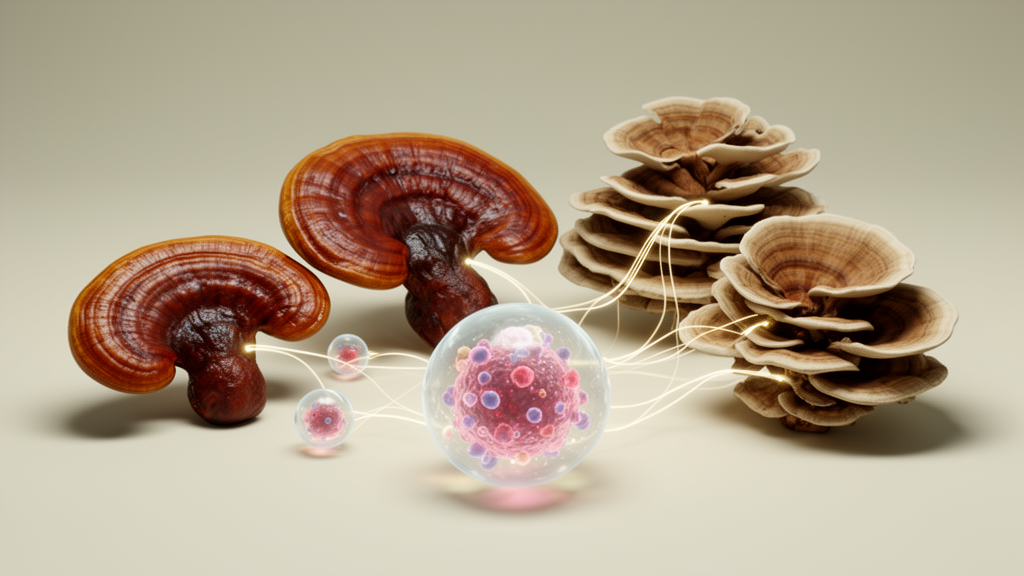
The idea that a mushroom could help fight cancer sounds like folk medicine, but a new review published in Frontiers in Cancer Control and Society argues that fungi such as turkey tail, reishi, shiitake and maitake deserve a serious mechanistic seat at the oncology table. Rather than claiming mushrooms shrink tumors directly, the review maps their bioactive compounds onto the hallmarks of cancer, the interconnected cellular traits that govern tumor progression, and finds striking complementarity with conventional chemotherapy.
The hallmarks framework, first defined by Hanahan and Weinberg in 2011 and expanded to fourteen hallmarks by 2022, includes sustained proliferative signaling, evasion of growth suppressors, resistance to cell death, replicative immortality, angiogenesis, invasion and metastasis, altered metabolism, immune evasion, genome instability, and tumor-promoting inflammation. Recent refinements added phenotypic plasticity, non-mutational epigenetic reprogramming, senescent cells, and polymorphic microbiomes, reflecting a more comprehensive understanding of tumor biology that considers not only tumor cells but also the surrounding microenvironment.
Conventional chemotherapeutic agents, though traditionally defined by cytotoxicity, exert pleiotropic effects that intersect directly with multiple hallmarks. Cisplatin forms DNA crosslinks that activate the DNA damage response and p53-dependent apoptosis. Doxorubicin intercalates into DNA, inhibits topoisomerase II, and generates reactive oxygen species. Cyclophosphamide generates DNA-alkylating metabolites that block replication and transcription. Antimetabolites such as 5-fluorouracil and methotrexate deplete deoxynucleotide pools, causing replication fork stalling and S-phase arrest. Microtubule-targeting agents like paclitaxel and docetaxel impair mitotic spindle assembly, enforcing G2/M arrest. Beyond direct killing, certain agents induce immunogenic cell death, exposing calreticulin on tumor cell surfaces and releasing ATP and HMGB1, which activate dendritic cells and prime cytotoxic T lymphocytes. Low-dose cyclophosphamide selectively depletes regulatory T cells, relieving immunosuppression within the tumor microenvironment.
Medicinal mushrooms occupy a fundamentally different therapeutic niche. Their β-glucans, polysaccharopeptides, and secondary metabolites engage innate immune receptors including Dectin-1, complement receptor 3, and Toll-like receptors, activating macrophages, dendritic cells, natural killer cells, and T lymphocytes. Rather than indiscriminate immune stimulation, mushroom polysaccharides act as immune response modifiers, promoting a Th1-skewed cytokine profile favorable for antitumor activity while simultaneously dampening tumor-promoting inflammation through inhibition of NF-κB signaling and reduction of IL-6 and TNF-α.
The review highlights how mushroom compounds modulate hallmarks that chemotherapy only partially addresses. β-glucans from Ganoderma lucidum activate apoptotic signaling via p53-dependent pathways and caspase activation while modulating Bcl-2 family proteins, enhancing pro-apoptotic Bax expression and reducing anti-apoptotic Bcl-2 in cancer cell lines without affecting normal cells. Polysaccharides from Grifola frondosa induce cell cycle arrest at the G1/S transition by regulating cyclin-dependent kinases. Mushroom-derived triterpenoids and polysaccharides suppress epithelial-to-mesenchymal transition, downregulate matrix metalloproteinases MMP-2 and MMP-9, and modulate Wnt/β-catenin and PI3K/AKT signaling pathways that govern cellular plasticity, limiting the adaptability of cancer cells to microenvironmental stressors and chemotherapeutic pressure.
Metabolic reprogramming represents another mechanistic frontier. β-glucans and triterpenoids from Ganoderma lucidum and Trametes versicolor modulate PI3K/AKT/mTOR and AMPK signaling, restoring metabolic homeostasis and inhibiting glycolytic flux in tumor cells while promoting oxidative phosphorylation in normal cells, a balance not typically achieved with conventional chemotherapeutics. Mushroom extracts downregulate VEGF expression and inhibit endothelial cell proliferation, migration, and tube formation, effectively suppressing tumor vascularization through modulation of HIF-1α and MAPK/ERK signaling pathways crucial under hypoxic tumor conditions.
The gut microbiome emerges as a particularly relevant interface for integration. Non-digestible mushroom polysaccharides serve as prebiotics, promoting growth of beneficial bacteria such as Lactobacillus and Bifidobacterium. These microbial shifts increase production of short-chain fatty acids including butyrate, propionate, and acetate, which function as histone deacetylase inhibitors, modulate host epigenetic marks, enhance mucosal barrier integrity, and regulate inflammatory pathways relevant to cancer. Chemotherapy-induced mucosal injury, increased intestinal permeability, and dysbiosis contribute to systemic inflammation and symptom burden, and mushroom polysaccharides offer barrier-protective and anti-inflammatory mechanisms to attenuate this cascade.
Clinical evidence, though heterogeneous, shows consistent patterns. Randomized controlled trials and meta-analyses demonstrate that PSK from Trametes versicolor administered as an adjuvant to surgery and chemotherapy improves overall survival, disease-free survival, and reduces recurrence rates in gastric, colorectal, and breast cancer patients. Lentinan from Lentinula edodes has been evaluated as an adjunct therapy in gastric, colorectal, lung, and pancreatic cancers, with trials reporting improved response rates to chemotherapy, reduced treatment-related toxicity, and enhanced quality of life. Polysaccharide fractions from Grifola frondosa enhance natural killer cell activity and modulate cytokine profiles when used alongside conventional therapies. Ganoderma lucidum preparations improve cancer-related fatigue and immune parameters, while Cordyceps species, Pleurotus polysaccharides, and Agaricus blazei extracts show promise in mitigating chemotherapy-induced immunosuppression and improving leukocyte recovery.
Safety data are overall reassuring. Most studies report only mild and transient adverse effects such as gastrointestinal discomfort, bloating, or rash, with serious adverse events rare when standardized extracts are used at clinically studied doses. Immune-enhancing mushrooms such as Trametes versicolor and Grifola frondosa have not been associated with significant hematological or hepatic toxicity in clinical trials. Caution is advised in patients receiving immunosuppressive therapy, anticoagulants, or chemotherapeutic agents with narrow therapeutic indices, as potential interactions may alter drug metabolism or immune responses. Individuals with known allergies to fungi or with autoimmune disorders should be monitored carefully when considering immunomodulatory mushroom extracts.
The review concludes that medicinal mushrooms should be viewed as supportive rather than cytotoxic interventions in oncology. When integrated responsibly alongside chemotherapy, selected mushroom extracts may enhance immune resilience, improve treatment tolerability, and support continuity of care. Although evidence is strongest for specific compounds such as PSK and lentinan, further high-quality randomized trials and standardized formulations are required to clarify optimal use and define their role within evidence-based integrative oncology. The mechanistic complementarity between chemotherapy-induced tumor cell stress and mushroom-supported host immune function offers a biologically plausible foundation for combination strategies that preserve host resilience without compromising standard oncologic management.
Subject of Research: Medicinal mushrooms and the hallmarks of cancer: mechanistic insights for complementary chemotherapy
Article Title: Medicinal mushrooms and the hallmarks of cancer: mechanistic insights for complementary chemotherapy
Article References: Haklai, E. (2026). Medicinal mushrooms and the hallmarks of cancer: mechanistic insights for complementary chemotherapy. Frontiers in Cancer Control and Society, 4, Article 1774081. https://doi.org/10.3389/fcacs.2026.1774081
Image Credits: AI Generated
DOI: 10.3389/fcacs.2026.1774081
Keywords: medicinal mushrooms, hallmarks of cancer, chemotherapy, integrative oncology, immunomodulation, PSK, lentinan, Ganoderma lucidum, Trametes versicolor, cancer supportive care, Medicinal, mushrooms
Cite Scienmag News
Nathaniel Bowman. (October 16, 2026). Medicinal mushrooms mapped onto the hallmarks of cancer. Scienmag. https://scienmag.com/medicinal-mushrooms-mapped-onto-the-hallmarks-of-cancer/
Nathaniel Bowman. "Medicinal mushrooms mapped onto the hallmarks of cancer." Scienmag, 16 October 2026, https://scienmag.com/medicinal-mushrooms-mapped-onto-the-hallmarks-of-cancer/. Accessed 16 October 2026.
Nathaniel Bowman. "Medicinal mushrooms mapped onto the hallmarks of cancer." Scienmag. October 16, 2026. https://scienmag.com/medicinal-mushrooms-mapped-onto-the-hallmarks-of-cancer/


