


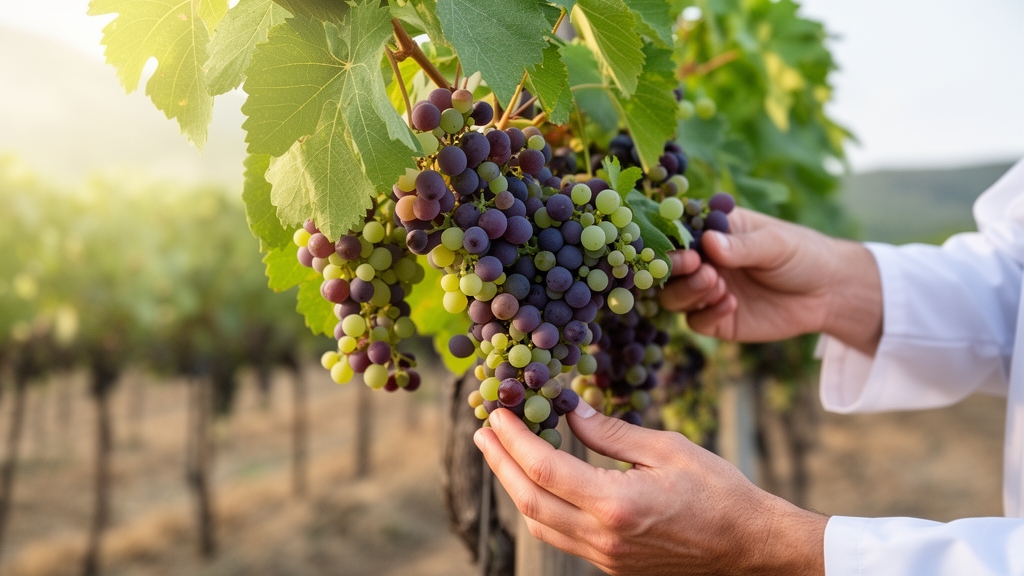
When plant breeders cross two grape varieties, they are essentially shuffling a deck of thousands of chemical cards and hoping the hand that comes out is better than either parent. A new study published in Food Chemistry: X has now watched that shuffle happen in extraordinary detail, tracking how three young Chinese table grape varieties inherited, remixed, and in some cases completely rewrote the metabolic legacies of their famous parents. The findings offer one of the clearest pictures yet of how hybridization reshapes the chemistry that makes a grape taste, look, and smell the way it does.
The research team, led by scientists at Shanxi Agricultural University, focused on three newly bred table grape varieties known as Baoguang, Cuiguang, and Miguang. All three were created by crossing Kyoho, a widely grown Japanese Euro-American hybrid beloved for its sweet, juicy berries and classic strawberry aroma, with Zaoheibao, a tetraploid Chinese variety developed through colchicine treatment and prized for its intense rose fragrance and large clusters. The question was simple but ambitious: what actually happens, molecule by molecule, when these two distinct flavor worlds collide in a single berry?
To answer it, the researchers grew all five varieties side by side in Jinzhong City in China’s Shanxi Province, a region whose large diurnal temperature swings and abundant sunshine make it a demanding but revealing natural laboratory. They harvested fruit at commercial maturity in a single season, then subjected the berries to a battery of tests. A seven-person measurement team recorded berry weight, shape, soluble solids, and titratable acidity. A separate fifteen-member trained sensory panel, tasting blind with randomized three-digit codes and palate cleansing between samples, scored each variety on a 100-point scale covering appearance, flavor, and texture.
The phenotypic results alone were striking. Cuiguang emerged as the sugar-acid champion, reaching 19.26 percent soluble solids while posting the lowest titratable acidity of the group at 3.78 grams per liter, yielding a sugar-acid ratio of nearly 51 that far outpaced both parents. Miguang, meanwhile, scored highest in the comprehensive sensory evaluation, combining a strong rose aroma inherited from its male parent with firm, juicy flesh. Baoguang broke new ground entirely, accumulating 14.56 milligrams of anthocyanins per 100 grams of skin, a level significantly higher than either parent, a textbook case of what geneticists call transgressive inheritance, where offspring exceed the range of both parents for a given trait.
But the real story unfolded at the molecular level. Using untargeted metabolomics based on high-resolution liquid chromatography tandem mass spectrometry, the team putatively annotated 2,038 metabolites across the five varieties. A random forest classifier built on these profiles could distinguish the cultivars with a mean accuracy of 97.42 percent under repeated nested ten-fold cross-validation, a rigorous performance estimate that suggests each variety carries a genuinely unique metabolic fingerprint. Principal component analysis separated the varieties cleanly, with the first two axes explaining 54.2 percent of total variance, and orthogonal partial least squares discriminant analysis, validated by permutation testing with a Q-squared intercept well below zero, confirmed the separation was not a statistical artifact.
The volcano plot comparisons between each hybrid and its parents revealed something profound: inheritance is not additive. Comparing Baoguang to Kyoho, 367 metabolites were significantly upregulated and 331 downregulated; against Zaoheibao, the numbers were 393 up and 301 down. Cuiguang leaned metabolically toward its female parent, while Miguang clustered closer to its rose-scented father, overexpressing paternal terpenoid derivatives such as Kankanoside A that likely underpin its signature fragrance. Baoguang, by contrast, stood apart from both parents, forming what the authors describe as a biparental recombinant profile with strong activation of secondary metabolism, including elevated L-phenylalanine, the gateway substrate for the phenylpropanoid pathway that feeds anthocyanin and flavonoid production.
When the researchers mapped these differential metabolites onto KEGG pathways, a single hub emerged above all others: the biosynthesis of amino acids, the most significantly enriched pathway in every hybrid-parent comparison. This finding positions amino acid metabolism as the upstream engine of quality divergence, because amino acids are not merely protein building blocks; they are precursors for esters, terpenoids, phenolic compounds, and the aromatic molecules that define grape flavor. In Cuiguang, elevated L-malic acid and D-gluconic acid tracked with its exceptional sugar-acid balance. In all three hybrids, L-methionine was upregulated, hinting at a shared metabolic foundation for aroma precursor supply.
To connect chemistry back to the traits consumers actually care about, the team deployed a trio of complementary statistical tools. Spearman correlation analysis revealed that flavonoid glycosides correlated strongly and positively with both anthocyanin content and total phenolics, with one compound, DENTICULAFLAVONOL, acting as a possible hub metabolite linking the two networks. Weighted gene co-expression network analysis grouped the 2,038 metabolites into 14 modules, one of which, MEtan, correlated positively with anthocyanin accumulation and berry size while running counter to total phenolics, evidence that these two branches of phenylpropanoid metabolism follow divergent regulatory logic in hybrid berries. Redundancy analysis then tied the whole picture together, explaining 74.39 percent of raw constrained covariance and exposing a fundamental metabolic tension between external appearance and internal quality traits.
Perhaps most intriguingly, membrane lipid metabolites such as LysoPE and glucosyl-C18-sphingosine correlated positively with texture scores, providing a molecular explanation for the crisp flesh that makes Cuiguang attractive to fresh-market consumers. Meanwhile, octyl 2-furoate, a furan ester with fruity and caramel-like notes, correlated with flavor scores and may contribute to Miguang’s rose aroma. These are the kinds of metabolite-trait links that breeders can eventually exploit as markers, turning what has long been an empirical art into a more predictive science.
The broader implications reach beyond the vineyard. Baoguang’s exceptional anthocyanin content positions it as a promising raw material for natural food colorants, an alternative to synthetic dyes in juices, jams, and fermented beverages. Kyoho’s high total phenolic content, at 14.26 milligrams per 100 grams, underscores the antioxidant potential of phenolic-rich grape extracts. And the SSR molecular markers used to confirm the true hybrid status of all three offspring, complete with barcode-based molecular identity cards for each variety, offer a practical tool for variety identification and intellectual property protection in an industry where counterfeit planting material is a persistent problem. The authors caution that their metabolite annotations remain putative at MSI Level 2 or 3 and will require targeted validation with authentic reference standards, and that future work combining transcriptomics with allele-specific expression analysis will be needed to fully dissect the genetic regulatory networks at play. Still, the message is clear: hybrid grapes do not simply average their parents. They reorganize, amplify, and sometimes exceed them, and metabolomics is now powerful enough to watch it happen berry by berry.
Subject of Research: Comparison of fruit quality and metabolome differences between three table grape varieties and their parents
Article Title: Comparison of fruit quality and metabolome differences between three table grape varieties and their parents
Article References: Zhenghai, L., Feng, X., Chenyu, W., Qinghe, Q., Jinpin, L., Min, T., Jinyu, H., Yanxia, Z., Xiaoyu, Y., Jiang, L., Wei, J., Zhigang, D., & Qifeng, Z. (2026). Comparison of fruit quality and metabolome differences between three table grape varieties and their parents. Food Chemistry: X, 40, Article 104567. https://doi.org/10.1016/j.fochx.2026.104567
Image Credits: AI Generated
DOI: 10.1016/j.fochx.2026.104567
Keywords: Comparison, fruit, quality, metabolome, differences, between, three, table, grape, varieties, parents, scientific research
Cite Scienmag News
Bethany Barker. (October 16, 2026). Hybrid Grapes Rewrite Their Own Metabolic Rulebook, New Study Shows. Scienmag. https://scienmag.com/hybrid-grapes-rewrite-their-own-metabolic-rulebook-new-study-shows/
Bethany Barker. "Hybrid Grapes Rewrite Their Own Metabolic Rulebook, New Study Shows." Scienmag, 16 October 2026, https://scienmag.com/hybrid-grapes-rewrite-their-own-metabolic-rulebook-new-study-shows/. Accessed 16 October 2026.
Bethany Barker. "Hybrid Grapes Rewrite Their Own Metabolic Rulebook, New Study Shows." Scienmag. October 16, 2026. https://scienmag.com/hybrid-grapes-rewrite-their-own-metabolic-rulebook-new-study-shows/


