


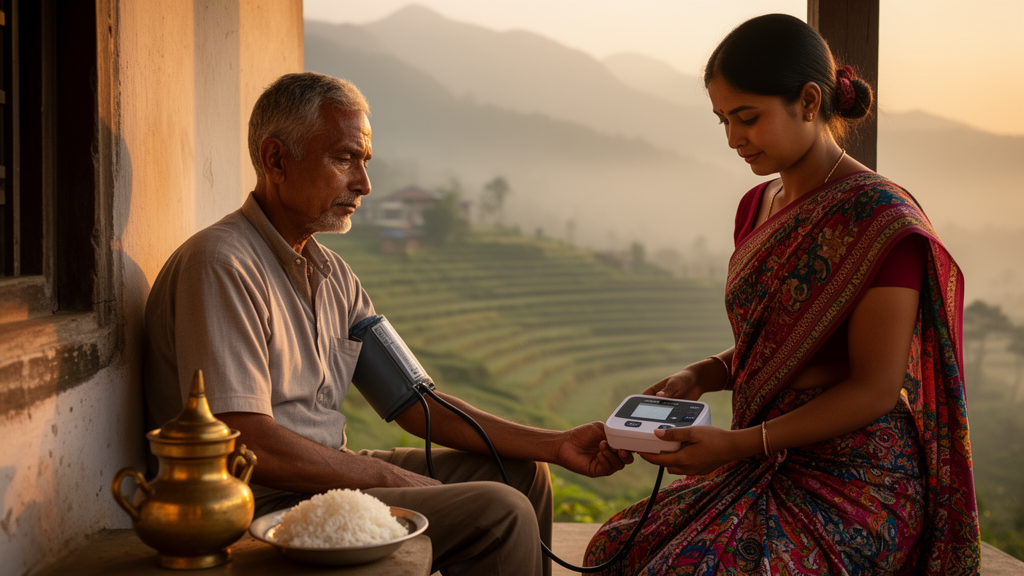
Hypertension is often called the silent killer, but new research from Nepal suggests its quietest toll may be on the mind. A community-based mixed-methods study of 327 adults living with high blood pressure in Kathmandu has found that sleep duration, caste, diet and income are all associated with the severity of depressive and anxiety symptoms among hypertension patients — and that patients’ own accounts of insomnia, stigma and financial strain bring those statistical patterns vividly to life.
The study, led by Lisasha Poudel of Tribhuvan University’s Central Department of Public Health and published in Frontiers in Epidemiology, is among the first in Nepal to move beyond simply counting how many hypertension patients feel depressed or anxious. Instead, the researchers asked which factors track with how severe those symptoms are, and then invited a subset of patients to describe, in their own words, what living with the condition actually feels like. The answer, they say, points to a form of hypertension care that treats sleep, money and social support as seriously as it treats blood pressure.
The quantitative phase drew on a systematically sampled list of 1,253 hypertension patients maintained by Budhanilkantha Municipality, an urban area of nearly 147,000 people in the Kathmandu district. From that frame, the team selected 331 adults aged 18 or older with diagnosed hypertension — defined as systolic pressure of 140 mmHg or more, diastolic pressure of 90 mmHg or more, or use of antihypertensive medication. After excluding missing data, 327 participants entered the analysis. Depressive symptoms were measured with the nine-item Patient Health Questionnaire (PHQ-9) and anxiety with the seven-item Generalized Anxiety Disorder scale (GAD-7), both in validated Nepali versions.
Rather than collapsing those scores into simple positive-or-negative categories, the researchers treated them as continuous measures of symptom severity and modeled them with linear regression in prespecified blocks — socio-demographic, health and medication, and lifestyle — before fitting a fully adjusted model. That approach preserved the full variability in how bad patients’ symptoms were, avoiding the information loss that comes from dichotomizing outcomes. Blood pressure was classified as controlled or uncontrolled using the average of the last two of three readings taken five minutes apart with a digital device.
The headline quantitative finding concerned sleep. In fully adjusted models, sleeping six hours or more per day was associated with substantially lower depressive symptom scores (β = −3.20, 95% CI −4.40 to −2.10, p < 0.001) and lower anxiety scores (β = −2.60, 95% CI −3.70 to −1.60, p < 0.001). The magnitude of that association dwarfed every other independent predictor. Participants who slept less than six hours — just 7.65 percent of the sample — carried a measurably heavier psychological burden than those who slept longer.
Social position also left its mark. Participants from non-high-caste groups, including Dalits who face longstanding marginalization in Nepali society, scored on average 1.80 points higher on the PHQ-9 than high-caste participants (95% CI 0.59 to 3.10, p = 0.004), an association that persisted after full adjustment. Older age, by contrast, was linked to lower anxiety scores (β = −0.05 per year, p < 0.001), and eating more than two servings of fruits and vegetables daily was associated with lower depressive scores (β = −1.00, p = 0.040). Higher household income and controlled blood pressure showed borderline inverse associations with anxiety that did not reach conventional significance after adjustment.
Only five participants (1.53 percent) screened positive for depressive symptoms at the PHQ-9 cut-off of 10 or higher, and five screened positive for anxiety at the GAD-7 cut-off of 9 or higher — figures the authors note are lower than in some prior Nepali studies. But the continuous-score analysis revealed that psychological distress was distributed across the sample in gradations, not confined to a small screening-positive group. That gradation is precisely what the regression models were designed to capture.
The qualitative phase then re-contacted 16 purposively selected participants — eight with elevated depressive or anxiety symptoms and eight without — for in-depth interviews lasting 30 to 35 minutes, analyzed thematically and interpreted through a biopsychosocial framework. The contrast between the two groups was stark. Patients with symptoms described persistent insomnia, sometimes relying on sleeping pills for six or seven years; bothersome medication side-effects such as dizziness, headaches and weakness; activity restriction; loneliness and stigma; sudden anger and unexplained fear; collapsed self-confidence; and crushing financial strain.
One 55-year-old woman with symptoms told interviewers she often felt profoundly lonely, describing an isolation so heavy it drained her energy for everyday tasks and even for enjoying time with her family. A 52-year-old man with symptoms said he hid his medication from coworkers and claimed his hypertension was improving when it was not, because colleagues treated him differently once they knew about his condition. Another participant with symptoms said her sons lived abroad and her marriage was conflict-ridden, leaving her feeling like a burden. By contrast, patients without symptoms generally described temporary side-effects that resolved after dose changes, strong family support, and high confidence in managing their condition.
The mixed-methods integration showed strong convergence on sleep: both the survey and the interviews identified sleep disturbance as closely tied to psychological burden, though the cross-sectional design means directionality cannot be established. The interviews complemented the quantitative patterns on financial burden — patients with symptoms described being unable to afford daily medicines even with an elderly allowance — and on medication experiences, while providing contextual elaboration of perceived symptoms such as headaches, dizziness and fear that patients attributed to hypertension regardless of measured blood pressure control.
The authors are careful about what the study can and cannot claim. The cross-sectional design precludes causal interpretation, reverse causality and residual confounding cannot be excluded, and the sampling frame — a municipality-maintained list of patients who had sought care at public facilities — may not represent those treated privately or not at all. The interviews were designed to explore lived experiences, not to test mechanisms underlying specific associations. Still, the integrated findings argue for hypertension care that routinely assesses sleep, attends to medication-related concerns, strengthens social support and addresses financial barriers — dimensions that, in Nepal’s urban municipalities, may matter as much to patients’ minds as to their arteries.
Subject of Research: Mental health among adults with hypertension in Nepal
Article Title: Factors associated with common mental disorder symptoms and lived experiences among adults with hypertension in Nepal: a mixed-methods study
Article References: Poudel, L., Acharya, B., Shrestha, B., Shrestha, S., Shrestha, A., Bhandari, B., Kohrt, B. A., Gurung, D., & Rai, S. (2026). Factors associated with common mental disorder symptoms and lived experiences among adults with hypertension in Nepal: a mixed-methods study. Frontiers in Epidemiology, 6, Article 1769884. https://doi.org/10.3389/fepid.2026.1769884
Image Credits: AI Generated
DOI: 10.3389/fepid.2026.1769884
Keywords: hypertension, mental health, Nepal, depression, anxiety, mixed-methods, public health, Factors, associated, common, mental, disorder
Cite Scienmag News
Glenn Wilkins. (October 16, 2026). Sleep, caste and diet shape mental health in Nepal’s hypertension patients, mixed-methods study finds. Scienmag. https://scienmag.com/sleep-caste-and-diet-shape-mental-health-in-nepals-hypertension-patients-mixed-methods-study-finds/
Glenn Wilkins. "Sleep, caste and diet shape mental health in Nepal’s hypertension patients, mixed-methods study finds." Scienmag, 16 October 2026, https://scienmag.com/sleep-caste-and-diet-shape-mental-health-in-nepals-hypertension-patients-mixed-methods-study-finds/. Accessed 16 October 2026.
Glenn Wilkins. "Sleep, caste and diet shape mental health in Nepal’s hypertension patients, mixed-methods study finds." Scienmag. October 16, 2026. https://scienmag.com/sleep-caste-and-diet-shape-mental-health-in-nepals-hypertension-patients-mixed-methods-study-finds/


