


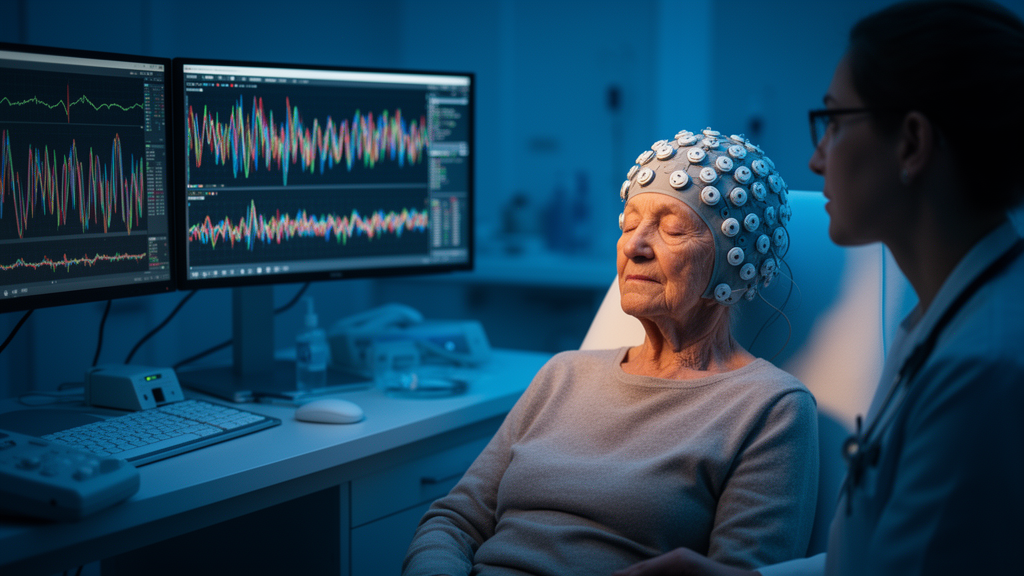
Alzheimer’s disease affects tens of millions of people worldwide, and the World Health Organization estimates that over 55 million people currently live with dementia, a figure expected to rise sharply in the coming decades. Because Alzheimer’s is progressive and irreversible, early diagnosis matters enormously: it allows patients and families to plan, gives drug treatments their best chance of working at an early stage, reduces long-term health care costs, and opens the door to preventive interventions. Yet the gold-standard diagnostic tools—structural MRI, PET imaging of amyloid and tau, and cerebrospinal fluid biomarkers—are expensive, intrusive, and often unavailable in resource-poor settings. A new study published in Frontiers in Neuroinformatics proposes a striking alternative: a self-supervised spatio-temporal transformer, called STT-EEG, that reads ordinary resting-state electroencephalography (EEG) and detects Alzheimer’s disease with 96.42% accuracy.
The appeal of EEG as a screening tool is obvious. It is cheap, non-invasive, widely available, and offers excellent temporal resolution, recording the functional changes in the cerebral cortex that reflect neuronal degeneration even before clear behavioral symptoms appear. Decades of research have established three characteristic EEG signatures of Alzheimer’s disease: diffuse slowing, in which spectral power decreases in higher frequency bands (alpha, beta, gamma) and increases in lower bands (delta, theta); reduced signal complexity, measurable with entropy-based metrics; and disrupted functional connectivity between cortical areas, signaling the breakdown of large-scale brain networks. These neurophysiological changes are thought to arise from cholinergic dysfunction, cortical hyperexcitability, and neocortical disconnection. The problem has never been whether the information is in the signal—it is whether machine learning models can extract it reliably, interpretably, and across different recording hardware.
That is where existing approaches have fallen short. Traditional methods rely on hand-crafted features—spectral power, entropy, connectivity measures—fed into classifiers such as support vector machines and random forests. These pipelines cannot capture long-range temporal dependencies in resting-state EEG, tend to overfit on small single-dataset cohorts, and perform inconsistently across different EEG systems and montages. Deep learning architectures such as EEGNet, EEGInception, and EEGConformer learn features end-to-end, and transformer-based foundation models like LaBraM, BIOT, and CBraMod pretrained on massive unlabeled EEG corpora have pushed the field further. But labeled pathological EEG data remains scarce, most studies classify only binary disease presence rather than predicting continuous cognitive decline, and the models remain largely black boxes—unacceptable properties for a clinical diagnostic aid.
The STT-EEG framework tackles all of these limitations with four integrated components. First, the model is pretrained self-supervised on 111 healthy controls from the SRM resting-state EEG dataset (OpenNeuro ds003775), recorded on a 64-channel BioSemi ActiveTwo system at 512 Hz. The pretraining objective combines masked auto-encoding with temporal order prediction: 75% of EEG patches are masked using a hybrid strategy—60% via contiguous blocks of 4 to 12 patches and 40% randomly—and a Vision Transformer-style encoder with 12 layers, 12 attention heads, and a 768-dimensional embedding processes only the visible patches, while a lightweight four-layer decoder reconstructs the missing ones. A temporal contrastive loss, weighted at 0.1, forces the model to predict whether neighboring patch pairs are in correct or swapped temporal order. Roughly 48 hours of pretraining on an NVIDIA A100 GPU taught the network the basic statistics of healthy EEG—temporal dynamics, oscillatory structure, and channel relationships—without a single diagnostic label.
Second, the architecture introduces a novel Spatial Attention Module (SAM) alongside multi-head temporal self-attention. The temporal attention captures long-range dependencies across the 10-second epochs, which matters because pathological neural patterns appear intermittently across different segments of a resting-state recording. The SAM explicitly models cross-channel interactions: it applies temporal average pooling to aggregate global information for each channel, then computes spatial attention coefficients that quantify the relative importance of each of the 19 EEG electrodes. This design choice is deliberate. Alzheimer’s disease is a distributed network pathology, not a focal one—chronic alterations in oscillatory dynamics (slowing, reduced complexity, disrupted connectivity) pervade the entire recording—so the SAM identifies which channels are globally important while the temporal module tracks time-varying patterns. A position-wise feed-forward network with GELU activations refines features between attention blocks, and a classification head with global average pooling and a two-layer MLP produces the AD probability score.
Third, the framework demonstrates strong cross-hardware generalization. The pretraining data used a 64-channel BioSemi system, while the downstream Alzheimer’s dataset (OpenNeuro ds004504) was recorded on a 19-channel Nihon Kohden EEG-2100 clinical system at AHEPA General Hospital in Thessaloniki, Greece. The researchers harmonized the datasets by restricting recordings to the 19 electrodes common to both montages under the international 10-20 system, resampling everything to 250 Hz, segmenting into non-overlapping 10-second epochs, and applying epoch-wise z-score normalization per channel. Independent validation on a third dataset (OpenNeuro ds004148, 60 healthy participants on a 64-channel BrainProducts system) showed the pretrained representations transfer effectively, achieving 92.18% accuracy and 95.34% AUC-ROC across different hardware and task paradigms—a critical property for clinical deployment, where EEG systems differ from hospital to hospital.
The headline results are impressive. Fine-tuned with subject-wise stratified 5-fold cross-validation on 65 subjects (36 Alzheimer’s patients, 29 cognitively normal controls), STT-EEG achieved 96.42% accuracy, 98.21% AUC-ROC, 95.83% sensitivity, and 97.14% specificity, with a Matthews Correlation Coefficient of 0.929. The AD and CN groups were matched in age, sex, and education (all p-values above 0.05), so the model was not simply learning demographic confounds. In a multi-class extension distinguishing Alzheimer’s disease, frontotemporal dementia, and healthy controls, the model reached 93.18% accuracy, outperforming LaBraM by roughly 3 percentage points. It also beat 15 baseline methods spanning handcrafted-feature pipelines, supervised deep learning, and EEG foundation models: the best handcrafted approach achieved 95.86%, EEGConformer 94.22%, LaBraM 92.24%, and recent spatial-modeling architectures LUNA and Trace 91.82% and 92.34% respectively. The difference from LaBraM was statistically significant (p = 0.018 by McNemar’s test, p = 0.027 after Benjamini-Hochberg FDR correction).
Ablation studies reveal exactly where the performance comes from. Removing self-supervised pretraining costs the most—a 7.08% accuracy drop from 96.42% to 89.34%—confirming that general EEG representations learned from 111 healthy controls transfer powerfully to the scarce labeled AD task. Removing EEG-specific data augmentation costs 6.30%, and removing the SAM costs 4.86%. The augmentation pipeline is carefully engineered to preserve pathological signatures while simulating real-world variability: Gaussian noise at approximately 20 dB signal-to-noise ratio, channel dropout at 10% probability to simulate poor electrode contact, temporal warping to mimic arousal fluctuations, magnitude scaling to neutralize amplitude differences from skull thickness and impedance, and same-class Mixup to address class imbalance without creating physiologically implausible blends of pathological and normal signals. The SSL-pretrained model also converges in roughly 30 epochs versus over 60 for a supervised baseline, with a final validation loss 34% lower.
Perhaps most strikingly, the model is interpretable—and what it learned matches known neurology. Attention rollout and leave-one-channel-out perturbation analysis identified the temporal (T3-T6), parietal (P3-Pz-P4), and occipital (O1-O2) regions as the most informative electrodes, consistent with the temporoparietal neuropathology of Alzheimer’s disease. Perturbation analysis confirmed this: suppressing channel T4 caused the largest AUC drop at 8.2%, followed by Pz at 7.6% and T5 at 7.1%, while frontal channels showed minimal impact of only 1 to 2%. The convergence between intrinsic attention-based analysis and extrinsic model-agnostic perturbation provides strong validation that the network learned biologically meaningful representations rather than dataset artifacts. The framework also predicts continuous Mini-Mental State Examination (MMSE) scores from a shared representation, achieving a Pearson correlation of 0.872 with a mean absolute error of 2.34 points—within the roughly 2-point test-retest reliability of the MMSE itself, meaning the model explains valid variation in cognitive functioning within the psychometric constraints of the test.
The authors are appropriately candid about limitations. The AD dataset is small at 65 subjects, typical of clinical EEG studies, and larger multi-center cohorts will be needed before the findings are clinically reliable. The MMSE prediction error means the model may not detect subtle longitudinal cognitive changes, so it should be viewed as a supportive screening tool rather than a replacement for clinical assessment or neuroimaging. Future work will explore multimodal integration with MRI and speech biomarkers, longitudinal modeling of cognitive decline, high-density EEG, and privacy-preserving federated learning. Still, the study demonstrates something genuinely important: that self-supervised spatio-temporal representation learning, combined with interpretable attention mechanisms, can turn a cheap and ubiquitous recording technology into a credible AI-driven pathway for early Alzheimer’s detection—one that could be rapidly adopted in clinics where MRI and PET simply are not available.
Subject of Research: self-supervised spatio-temporal transformer for interpretable resting-state EEG analysis in Alzheimer's disease
Article Title: Interpretable self-supervised transformers for resting-state EEG analysis in Alzheimer's disease
Article References: Zareen, S. S., Alzaben, N., Ahmad, U., Alam, T. M., Algarni, A., & Wang, J. (2026). Interpretable self-supervised transformers for resting-state EEG analysis in Alzheimer's disease. Frontiers in Neuroinformatics, 20, Article 1899573. https://doi.org/10.3389/fninf.2026.1899573
Image Credits: AI Generated
DOI: 10.3389/fninf.2026.1899573
Keywords: Alzheimer's disease, EEG, self-supervised learning, transformer, spatio-temporal attention, MMSE prediction, interpretability, transfer learning, masked auto-encoding, deep learning, neuroinformatics, early detection
Cite Scienmag News
Cassandra Pierce. (October 16, 2026). Self-Supervised Transformer Reads Resting-State EEG to Detect Alzheimer’s Disease With 96.42% Accuracy. Scienmag. https://scienmag.com/self-supervised-transformer-reads-resting-state-eeg-to-detect-alzheimers-disease-with-96-42-accuracy/
Cassandra Pierce. "Self-Supervised Transformer Reads Resting-State EEG to Detect Alzheimer’s Disease With 96.42% Accuracy." Scienmag, 16 October 2026, https://scienmag.com/self-supervised-transformer-reads-resting-state-eeg-to-detect-alzheimers-disease-with-96-42-accuracy/. Accessed 16 October 2026.
Cassandra Pierce. "Self-Supervised Transformer Reads Resting-State EEG to Detect Alzheimer’s Disease With 96.42% Accuracy." Scienmag. October 16, 2026. https://scienmag.com/self-supervised-transformer-reads-resting-state-eeg-to-detect-alzheimers-disease-with-96-42-accuracy/


