


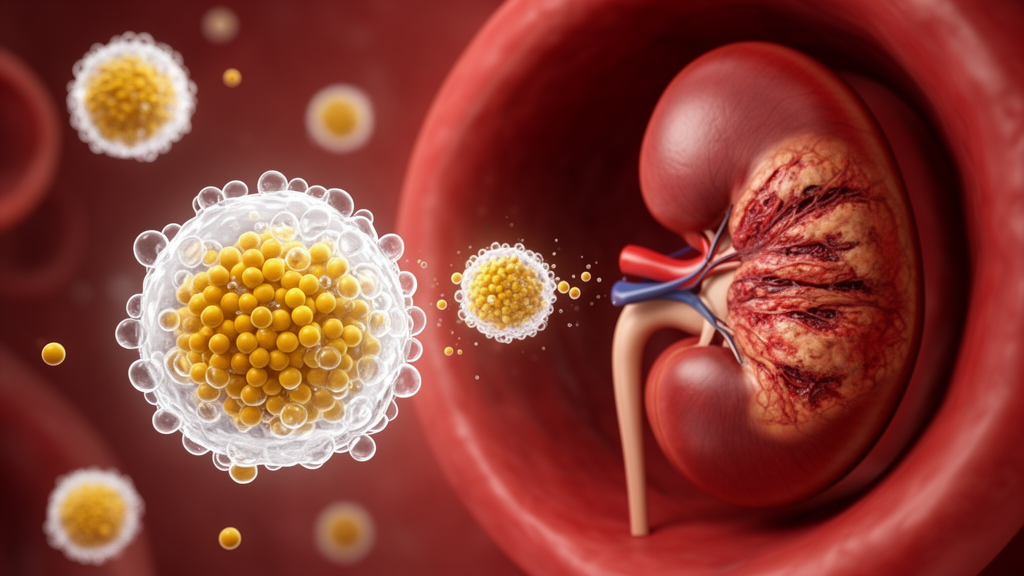
The kidney is one of the most demanding targets in drug delivery. It filters liters of plasma every day, clears therapeutic agents with ruthless efficiency, and yet remains acutely vulnerable to toxicity from the very medicines meant to heal patients, particularly platinum-based chemotherapy drugs such as cisplatin. Now, a research team from Cairo University and the Karolinska Institute has engineered a sophisticated nanocarrier that may change that calculus, wrapping the natural antioxidant curcumin inside cationic, hyaluronic acid-decorated quatsomes that home in on renal tissue and dramatically shield the kidneys from cisplatin-induced injury in rats.
The platform, described in the Journal of Pharmacy & Pharmaceutical Sciences, is built around quatsomes, vesicles formed from the cationic quaternary ammonium surfactant di-dodecyl-dimethyl-ammonium bromide, or DDAB, combined with cholesterol, the monoterpene limonene, and surfactants. DDAB provides the structural backbone of the bilayer while conferring a strongly positive surface charge, a property the researchers exploit deliberately. The negatively charged glomerular basement membrane and tubular epithelium attract these cationic vesicles electrostatically, encouraging drug accumulation precisely where filtration and injury converge. Cholesterol intercalates into the bilayer to stiffen it, preventing premature leakage during circulation until the carrier reaches its renal destination.
Limonene plays a quieter but equally important role. The natural monoterpene, best known as the fragrance of citrus peel, acts as an edge activator that softens the vesicle membrane, improving its deformability and its capacity to carry the lipophilic curcumin. The surfactant Span 80 adds further stability to the colloidal dispersion and improves drug solubilization. Finally, hyaluronic acid is sprinkled onto the optimized vesicles under gentle stirring, endowing the particles with an active targeting ligand. Because hyaluronic acid binds CD44 receptors, which are abundantly expressed on mesangial cells within the glomerulus, the decorated vesicles can be recognized and internalized through receptor-mediated endocytosis, adding a molecular lock-and-key dimension to the purely physical advantages of small size and positive charge.
The choice of cargo is central to the design. Curcumin, the golden polyphenol from turmeric, possesses potent antioxidant, anti-inflammatory, and antifibrotic activity, and has shown genuine nephroprotective effects in experimental models by modulating oxidative stress pathways. Yet its clinical promise has been strangled by physicochemical shortcomings: extraordinarily poor water solubility, instability at alkaline pH, rapid metabolic clearance, and consequently dismal systemic bioavailability. Encapsulation within a nanovesicular bilayer protects curcumin from degradation, solubilizes it within a hydrophobic matrix, and prolongs its presence in circulation, addressing each of these barriers simultaneously.
To build the optimal carrier, the team turned to statistical design rather than trial and error. A full 2 to the power of 3 factorial design varied three critical parameters, the DDAB-to-cholesterol ratio, the limonene-to-drug ratio, and the surfactant concentration, across two levels each, with Design-Expert software modeling how each variable influenced entrapment efficiency, particle size, polydispersity index, and zeta potential. The models proved robust, with high correlation coefficients and adequate precision values well above recommended thresholds. The winning formulation, combining a 3:1 DDAB-to-cholesterol ratio, a 6:1 limonene-to-drug ratio, and 0.8 percent surfactant, achieved a desirability score of 0.950.
The numbers behind that optimized formulation are striking. Curcumin entrapment efficiency reached 87.80 percent, meaning nearly nine of every ten drug molecules were successfully packed into the vesicles. The vesicles measured just 120.55 nanometers in diameter, comfortably below the roughly 150-nanometer threshold associated with efficient mesangial uptake, and carried a zeta potential of +38.30 millivolts, well above the ±20-millivolt mark generally required for electrostatic colloidal stability. Transmission electron microscopy confirmed uniform, spherical, discrete vesicles with no aggregation or deformation, while infrared spectroscopy verified that curcumin was physically incorporated without any chemical incompatibility among the components.
Functional testing amplified the case. In dialysis-based release studies, the formulation displayed a biphasic profile: approximately 44 percent of curcumin escaped within the first two hours as surface-associated drug diffused out, followed by sustained release governed by Higuchi diffusion kinetics from the hydrophobic bilayer interior. That initial burst could provide rapid therapeutic onset while the prolonged phase maintains drug levels and reduces dosing frequency. Most dramatically, the DPPH radical scavenging assay showed the nanoformulated curcumin lowered its IC50 from 10.99 to 2.90 micrograms per milliliter, an approximately 3.8-fold boost in antioxidant potency, reflecting enhanced solubilization, protection from degradation, and improved access to reactive oxygen species. Refrigerated storage for three months left particle size, charge, entrapment, and release behavior essentially unchanged.
The decisive test came in living animals. Rats receiving a single intraperitoneal dose of cisplatin showed the expected biochemical catastrophe, with serum creatinine rising 2.3-fold and blood urea nitrogen climbing 1.8-fold compared with healthy controls. Standard curcumin suspension offered partial relief, cutting creatinine by 37.2 percent and urea by 33.3 percent. The optimized quatsomes, delivered orally at the same 25 milligram per kilogram dose of curcumin, outperformed the free drug decisively: creatinine fell 60.5 percent and urea 40 percent relative to cisplatin-only animals, a statistically significant advantage over the plain suspension.
Histology told the same story at the cellular level. Kidneys from cisplatin-treated rats exhibited severe tubular epithelial damage, irreversible necrobiotic changes, and multiple collapsed glomeruli, earning the maximum lesion score of 3. Standard curcumin reduced the score to 2, with residual urinary space expansion and necrobiotic alterations still visible. The nanoformulated curcumin achieved a score of 1, showing only minimal, reversible cell damage and limited nuclear pyknosis in scattered renal tubules, evidence of structural preservation that tracked closely with the biochemical protection.
The authors are candid about the limits of their work. No direct biodistribution studies, such as LC-MS quantification or fluorescence imaging of kidney tissue, were performed, so renal targeting remains inferred from biomarkers and histology rather than directly measured, and CD44-mediated uptake should be treated as a plausible hypothesis rather than a confirmed mechanism. The study also lacked a drug-free nanocarrier control group. Even so, the convergence of rational design, rigorous optimization, dramatic antioxidant potentiation, and clear in vivo nephroprotection positions these hyaluronic acid-decorated quatsomes as a compelling template for the next generation of kidney-targeted nanomedicines, one that could eventually allow lower, safer doses of renoprotective agents for patients facing drug-induced kidney injury.
Subject of Research: Development of hyaluronic acid-decorated quatsomes for renal-targeted curcumin delivery and nephroprotection
Article Title: Innovative hyaluronic acid-decorated quatsomes for enhanced renal targeting: design, optimization and in-vivo biochemical and nephroprotective assessments
Article References: Ahmed, S., ElBishbishy, R. M., Sadek, M. A., & Saher, O. (2026). Innovative hyaluronic acid-decorated quatsomes for enhanced renal targeting: design, optimization and in-vivo biochemical and nephroprotective assessments. Journal of Pharmacy & Pharmaceutical Sciences, 29, Article 16787. https://doi.org/10.3389/jpps.2026.16787
Image Credits: AI Generated
Keywords: quatsomes, curcumin, renal targeting, cisplatin-induced nephrotoxicity, hyaluronic acid, DDAB, limonene, nanocarrier, CD44 receptors, mesangial uptake, antioxidant activity, nephroprotection
Cite Scienmag News
Ophelia Keating. (October 16, 2026). Hyaluronic Acid-Wrapped Nanovesicles Steer Curcumin to Damaged Kidneys in Rats. Scienmag. https://scienmag.com/hyaluronic-acid-wrapped-nanovesicles-steer-curcumin-to-damaged-kidneys-in-rats/
Ophelia Keating. "Hyaluronic Acid-Wrapped Nanovesicles Steer Curcumin to Damaged Kidneys in Rats." Scienmag, 16 October 2026, https://scienmag.com/hyaluronic-acid-wrapped-nanovesicles-steer-curcumin-to-damaged-kidneys-in-rats/. Accessed 16 October 2026.
Ophelia Keating. "Hyaluronic Acid-Wrapped Nanovesicles Steer Curcumin to Damaged Kidneys in Rats." Scienmag. October 16, 2026. https://scienmag.com/hyaluronic-acid-wrapped-nanovesicles-steer-curcumin-to-damaged-kidneys-in-rats/


