


Offshore wind farms in the German Bight may one day do more than generate electricity. A long-running field study, published in Frontiers in Aquaculture, has compiled more than a decade of plankton sampling and collector deployments to test whether the waters surrounding wind farm sites 10 to 40 nautical miles off the German North Sea coast hold enough mussel larvae to support commercial seed collection and grow-out cultivation. The answer, drawn from campaigns spanning 2003 to 2015, is a cautious maybe: the food is there, but the larvae are scarce.
The study, led by Bela H. Buck of the Alfred Wegener Institute Helmholtz Centre for Polar and Marine Research, was motivated by a practical crisis in the German Wadden Sea. Blue mussel (Mytilus edulis) farming there has relied for centuries on harvesting wild seed from natural beds and re-laying it on culture plots, a technique known as on-bottom cultivation. But recruitment and settlement success have declined in Lower Saxony in recent years, shrinking seed availability and pushing farming activity toward Schleswig-Holstein. With extensive nature conservation areas limiting coastal expansion, researchers turned to a multi-use concept: co-locating aquaculture with offshore wind farms, where infrastructure, vessels, and stakeholder cooperation already exist.
To find out whether offshore waters could support mussel farming, the team identified test sites based on strict criteria: proximity to a wind farm, manageable distance from harbor, minimum water depth of 15 meters to reduce wave-induced mechanical stress, suitable water quality, and sufficient larval concentrations in the water column. Eleven locations and a seven-station transect from Bremerhaven to Helgoland were equipped with test moorings in January 2003, deployed adjacent to proposed wind farm sites but at least half a nautical mile away for safety. Each mooring consisted of a 300-kilogram buoyancy marker connected to a two-metric-ton concrete block, with a metal frame fixed three meters below the surface—the depth where long-term observation indicated maximum settlement.
The collectors themselves were engineered for maximum surface area. Each consisted of a polypropylene carrier rope with four inserted transverse elements, each frayed manually into roughly 1,100 single fibers to produce a bow-tie-like bundle. This design, equivalent to collector types previously shown to attract tens of thousands of mussel spat per meter in inshore waters, provided ample threadlike structures for pediveliger larvae, which preferentially settle on hydroids, algae, or the byssus threads of adult mussels.
Larval sampling involved pumping 50-liter seawater samples from three meters depth, filtering them through a 125-micrometer plankton net, and counting larvae under a binocular microscope. The results revealed a strikingly heterogeneous distribution in time and space. Peak abundance occurred in May of each sampling year, ranging from 80 to 25,000 larvae per cubic meter. But the numbers dropped sharply with distance from shore: locations more than 20 nautical miles offshore held significantly fewer larvae than inshore sites, a pattern confirmed statistically using the non-parametric Mann-Whitney test at p < 0.05.
Settlement on the suspended collectors told a similar story. Offshore numbers ranged from zero to 1,100 mussels per meter of collector—orders of magnitude below the several tens of thousands recorded inshore. In the Wash on the UK coast, the same collector type attracted 100,000 to 400,000 spat per meter; at the Lower Saxonian Wadden Sea coast, monthly means of 33,000 to 72,000 individuals per meter were documented. Even long-term collectors exposed from March to August 2000 inshore recorded 28,000 individuals per meter, at least one order of magnitude above offshore figures.
Yet the environmental chemistry suggested the offshore waters were not the problem. Chlorophyll concentrations remained within ranges considered suitable for mussel growth throughout the year, with spring peaks near 16 micrograms per liter and summer values around 7. Inorganic nutrient concentrations showed no indication of limitation, and the low POC/TPN ratios—leveling at roughly 6.5 to 7—suggested a particulate pool enriched in nitrogen-containing organic matter, likely reflecting phytoplankton and bacterial biomass rather than terrestrial detritus. The POC/TCHL ratio dropped from 380 in January to 30 in April, indicating a shift from detrital to non-detrital carbon as the spring bloom developed. In short, food quantity and quality were unlikely to constrain larval or early post-settlement growth between late spring and autumn.
The low offshore larval densities likely stem from a combination of factors. Mytilid spawning along the German North Sea coast generally occurs from May to June, following the spring phytoplankton peak. Larvae then drift with the predominantly tidal currents, which carry a net anticlockwise movement through the German Bight—an export that can take weeks to months. During this extended planktonic phase, larvae face substantial mortality from predation by fish and invertebrates, starvation, and physical stress. The dilution effect of long drift times further reduces concentrations at distant settlement sites. Regional differences also matter: while larval numbers were very low off the Lower Saxonian coast, comparatively high concentrations appeared roughly 10 nautical miles off Schleswig-Holstein, suggesting mussels there were of local origin, whereas Lower Saxonian larvae may have drifted from more westerly sources in Belgium or the Netherlands.
The study also documents a technical reality of offshore work. Stormy weather on two 2003 cruises prevented mooring retrieval, and two moorings were lost entirely—one buoy retrieved a year later by the Swedish Water and Shipping Agency off Strömstad, the other entangled by a shrimp cutter that ignored the safety distance. The author notes that only one mooring per site could be deployed, making collectors subsamples rather than independent replicates; results should be interpreted as exploratory indicators of relative settlement potential rather than fully replicated experimental findings.
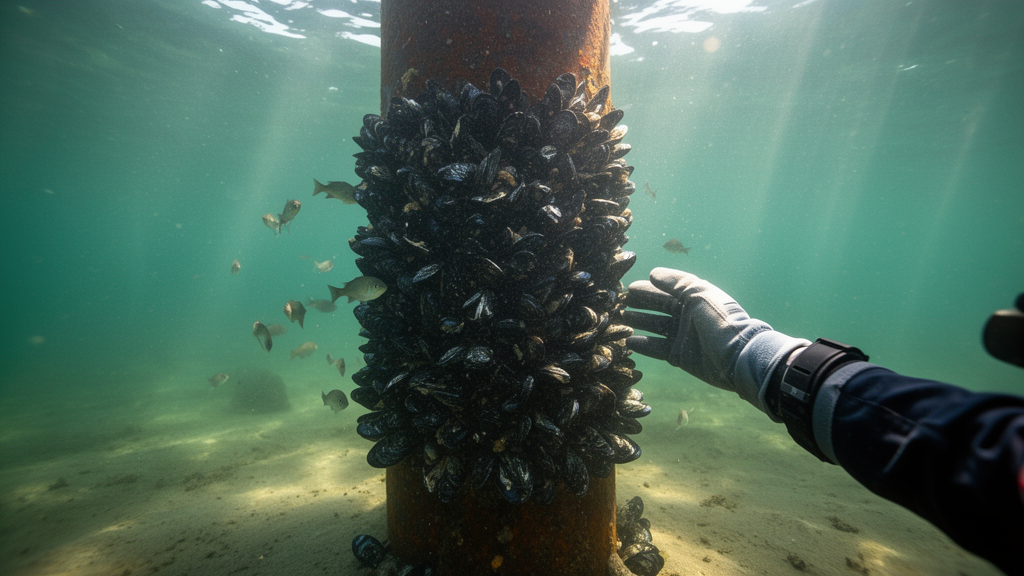
Looking forward, the ongoing expansion of offshore wind farms is expected to substantially increase artificial hard substrate in the German Bight. Jacket-type foundations can support large mussel populations, and the author estimates roughly two metric tons of mussels settling per monopile foundation across the planned clusters—potentially over 1,900 metric tons per year in total. This
Subject of Research: Offshore mussel larval occurrence and settlement at wind farm sites in the German Bight
Article Title: Mytilid larval appearance and settlement at offshore wind farm sites in the German Bight—a trial to estimate multi-use potentials for bivalve seed collection and grow-out cultivation
Article References: Buck, B. H. (2026). Mytilid larval appearance and settlement at offshore wind farm sites in the German Bight—a trial to estimate multi-use potentials for bivalve seed collection and grow-out cultivation. Frontiers in Aquaculture, 5, Article 1823282. https://doi.org/10.3389/faquc.2026.1823282
Image Credits: AI Generated
DOI: 10.3389/faquc.2026.1823282
Keywords: blue mussel, Mytilus edulis, offshore wind farm, German Bight, North Sea, larval distribution, spat settlement, multi-use aquaculture, seed collection, offshore aquaculture, chlorophyll, POC/TPN ratio
Cite Scienmag News
Alan Morgan. (October 16, 2026). Mussels in the Wind: Decades of North Sea Data Reveal Whether Wind Farms Can Double as Mussel Farms. Scienmag. https://scienmag.com/mussels-in-the-wind-decades-of-north-sea-data-reveal-whether-wind-farms-can-double-as-mussel-farms/
Alan Morgan. "Mussels in the Wind: Decades of North Sea Data Reveal Whether Wind Farms Can Double as Mussel Farms." Scienmag, 16 October 2026, https://scienmag.com/mussels-in-the-wind-decades-of-north-sea-data-reveal-whether-wind-farms-can-double-as-mussel-farms/. Accessed 16 October 2026.
Alan Morgan. "Mussels in the Wind: Decades of North Sea Data Reveal Whether Wind Farms Can Double as Mussel Farms." Scienmag. October 16, 2026. https://scienmag.com/mussels-in-the-wind-decades-of-north-sea-data-reveal-whether-wind-farms-can-double-as-mussel-farms/


