


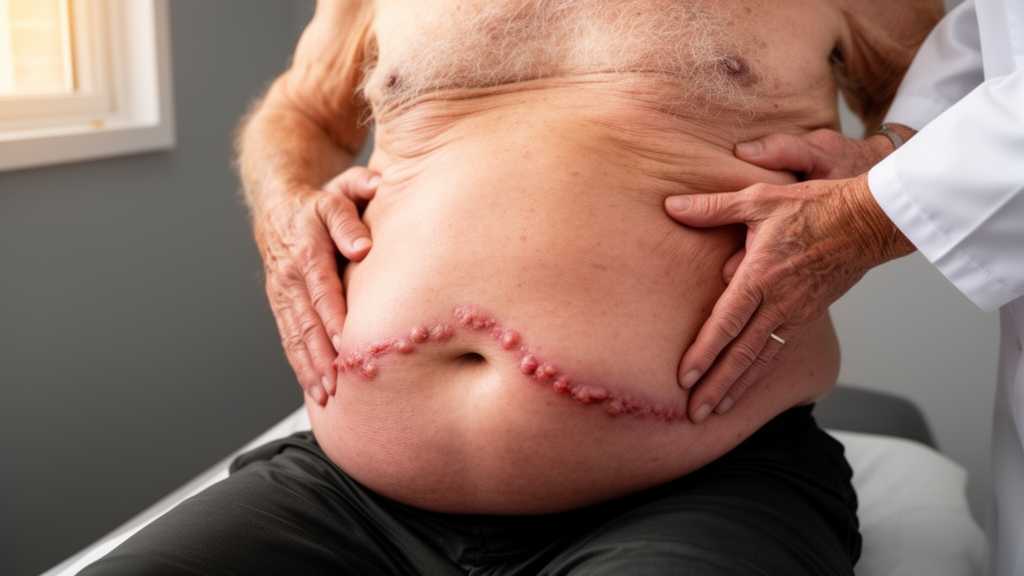
Herpes zoster, the painful dermatomal eruption caused by reactivation of latent varicella-zoster virus in the dorsal root ganglia, is usually recognized by its characteristic unilateral vesicular rash. Yet the virus can also strike the motor nervous system, producing segmental weakness of the abdominal wall muscles that creates a unilateral bulge mimicking a true hernia. This rare complication, known as herpes zoster-associated abdominal pseudohernia, typically develops one to eight weeks after the cutaneous eruption, by which time the preceding rash provides an important diagnostic clue. However, in approximately ten percent of patients with zoster-associated motor paresis, the abdominal bulge appears before the rash, creating a particular risk of misdiagnosis. A new case report published in Frontiers in Medicine describes a 66-year-old man in whom a painful left abdominal bulge preceded the characteristic skin lesions by four days, highlighting the diagnostic challenges of this pre-eruptive presentation and the importance of recognizing herpes zoster as a potential cause of new segmental abdominal wall weakness even in the absence of a rash.
The patient, who had controlled type 2 diabetes mellitus and hypertension managed with oral medications, presented to the dermatology department with a ten-day history of a painful bulge on the left side of his abdomen. He had no history of abdominal surgery or trauma. Ten days before the dermatology visit, he had been evaluated at an outside hospital for the same abdominal bulge. A complete blood count and routine biochemical test results were unremarkable. A whole-abdomen computed tomography scan showed an intact abdominal fascia, no intra-abdominal mass, and no appreciable thinning or asymmetry of the ipsilateral abdominal wall musculature. Thus, CT excluded a true hernia but did not identify an alternative structural cause of the bulge. No virological confirmation was obtained; VZV PCR of a crust or lesion swab, a Tzanck smear, and paired serology were not performed, and electromyography was also not performed.
Approximately four days after the first appearance of the abdominal bulge, erythema developed over the left abdomen, followed by grouped, pruritic, and painful vesicles confined to the left T10–T12 dermatomes without crossing the midline. On dermatologic examination, large areas of postinflammatory hyperpigmentation in a band-like distribution were present over the left lumbodorsal region, with residual lesions and scattered dark-red papules seen within the affected area. A localized soft bulge was observed over the ipsilateral anterior abdominal wall. The overlying skin showed faint erythema and scattered residual papules without fresh vesicles, erosions, or skin breakdown. Notably, between the onset of the vesicular eruption and the dermatology visit, the patient had undergone lamp-fire moxibustion of the affected skin as a folk remedy. This thermal intervention may have contributed to rapid crusting and extensive postinflammatory hyperpigmentation, explaining the absence of fresh vesicles at presentation.
Because no fresh vesicles were present at the time of examination and no virological or electrophysiological confirmation was obtained, a presumptive clinical diagnosis of herpes zoster-associated abdominal pseudohernia was made based on the segmental abdominal bulge, absence of a fascial defect, dermatomal distribution of the skin changes, and reported history of a vesicular eruption. The patient was administered oral mecobalamin, gabapentin, and neurotropin injection and was advised to avoid strenuous exertion. No surgical intervention was undertaken. At follow-up after approximately three months, the abdominal bulge had markedly regressed compared with baseline, a clinical course consistent with the generally favorable recovery described in herpes zoster-associated segmental motor paresis.
Herpes zoster-associated abdominal pseudohernia is a rare segmental motor manifestation of herpes zoster in which paresis of the abdominal wall muscles produces a unilateral bulge without a true fascial defect. Abdominal muscle paralysis associated with herpes zoster was first reported in the late nineteenth century and remains an uncommon complication. Motor paresis has been reported in approximately 0.5 to five percent of patients with herpes zoster, with abdominal wall involvement representing an even rarer subset. The virus may spread from the sensory ganglion to the anterior horn cells, adjacent ventral motor roots, or peripheral motor nerves, resulting in segmental weakness of the ipsilateral abdominal musculature. Weakness of the oblique and transversus abdominis muscles reduces the muscular support of the abdominal wall, allowing the abdominal contents to displace the weakened wall outward and produce a localized bulge that resembles a true hernia despite an intact fascia.
The temporal relationship between the abdominal bulge and the cutaneous eruption can complicate recognition of this condition. In most patients with herpes zoster and skin eruption, the bulge develops one to eight weeks after the eruption. The present patient exhibited the less common sequence in which the bulge appeared first, approximately four days before the vesicular eruption. This pre-eruptive presentation, reported in approximately ten percent of cases with motor paresis, poses a particular diagnostic challenge because the characteristic dermatomal eruption that would suggest herpes zoster has not yet appeared. In the absence of characteristic skin lesions, the presentation may be mistaken for an incisional, Spigelian, or lumbar hernia, potentially leading to repeated or unnecessary imaging and, in some patients, surgical exploration.
Several clinical features in this patient supported the presumptive diagnosis. First, the abdominal bulge was unilateral and segmental, corresponding to the T10–T12 distribution of the subsequent cutaneous eruption. Second, CT imaging demonstrated an intact abdominal fascia and excluded a true hernia and intra-abdominal mass. In herpes zoster-associated abdominal pseudohernia, CT or ultrasonography results typically demonstrate an intact fascia and may additionally reveal thinning or asymmetry of the affected abdominal wall musculature rather than a structural defect. On targeted re-evaluation of the CT images in this patient, no appreciable thinning or asymmetry of the ipsilateral abdominal wall musculature was observed, and therefore, imaging was primarily useful for excluding structural causes rather than providing positive radiological evidence for the diagnosis. Magnetic resonance imaging may be useful when spinal or nerve root compression needs to be excluded.
Given the patient’s history of type 2 diabetes mellitus, diabetic thoracic radiculopathy was an important differential diagnosis. This condition can also present with unilateral truncal pain and segmental abdominal wall weakness or bulging, particularly in patients with diabetes. In this patient, the subsequent development of a unilateral dermatomal vesicular eruption supported herpes zoster as the more likely clinical explanation. Other structural causes of abdominal wall bulging, including incisional, Spigelian, and lumbar hernias and intra-abdominal masses, were not supported by the imaging findings. Risk factors for herpes zoster and its complications, including advanced age, diabetes mellitus, immunosuppression, and underlying malignancy, are relevant to clinical assessment and counseling. Antiviral therapy was not initiated because the patient presented to the dermatology department ten days after symptom onset, during which no fresh vesicles were present and the usual early treatment window had passed.
This case also illustrates an underreported confounding factor: the application of folk thermal remedies to active zoster lesions. Lamp-fire moxibustion involves direct or near-contact heat to the skin and may alter the morphology of vesicular lesions, contributing to crusting and postinflammatory hyperpigmentation that can obscure the characteristic grouped vesicles. Clinicians should be aware that atypical dermatomal lesions may reflect prior moxibustion or other heat-based folk therapies rather than an intrinsically atypical zoster eruption. They should specifically inquire about such practices to avoid delays in diagnosis. Gabapentin and neurotropin were administered for neuropathic pain control. Neurotrophic agents, including mecobalamin, are commonly added to the treatment regimen, although evidence supporting their capacity to fasten motor recovery is limited. Surgical intervention is generally unnecessary once a true structural hernia has been excluded because most pseudohernias resolve spontaneously over several months, although residual weakness may persist in a minority of patients.
This case report has several important limitations, and the diagnosis of herpes zoster-associated abdominal pseudohernia remains presumptive. No virological confirmation was obtained: VZV PCR of the lesional material, a Tzanck smear, and paired serology were not performed. Moreover, electromyography, which can provide neurophysiological evidence of segmental denervation in affected myotomes and paraspinal muscles, was also not performed. Consequently, the motor involvement was inferred clinically rather than being confirmed electrophysiologically. Without electromyographic evidence of denervation in the corresponding myotomes, segmental motor involvement could not be confirmed, and other potential causes of abdominal wall weakness remain possible. In addition, the vesicular stage was not observed by a physician, and no patient-taken photograph of the vesicular eruption was available. Therefore, the cutaneous eruption was documented only in patient history. Targeted re-evaluation of the CT images showed no thinning or asymmetry of the ipsilateral abdominal wall musculature, and therefore, the supportive radiological finding described in some patients with herpes zoster was absent. Thus, the diagnosis was based on the characteristic temporal and anatomical relationship between the segmental abdominal bulge and subsequent dermatomal eruption, the absence of a structural defect on imaging, and the self-limited clinical course. These limitations should be considered when interpreting a case. To conclude, a new unilateral, segmental abdominal bulge without a fascial defect should prompt consideration of herpes zoster, even when a rash is absent or has not yet appeared. Recognizing the pre-eruptive form of abdominal pseudohernia may help avoid unnecessary surgical exploration; the condition is generally self-limited and can be managed conservatively.
Subject of Research: Case Report: Abdominal pseudohernia preceding the herpes rash: a pre-eruptive diagnostic pitfall in herpes zoster
Article Title: Case Report: Abdominal pseudohernia preceding the herpes rash: a pre-eruptive diagnostic pitfall in herpes zoster
Article References: Case Report: Abdominal pseudohernia preceding the herpes rash: a pre-eruptive diagnostic pitfall in herpes zoster. (n.d.). https://doi.org/10.3389/fmed.2026.1975268
Image Credits: AI Generated
DOI: 10.3389/fmed.2026.1975268
Keywords: Case, Report, Abdominal, pseudohernia, preceding, herpes, rash, pre-eruptive, diagnostic, pitfall, zoster, scientific research
Cite Scienmag News
Ophelia Keating. (October 16, 2026). Abdominal pseudohernia preceding the herpes rash: a pre-eruptive diagnostic pitfall in herpes zoster. Scienmag. https://scienmag.com/abdominal-pseudohernia-preceding-the-herpes-rash-a-pre-eruptive-diagnostic-pitfall-in-herpes-zoster/
Ophelia Keating. "Abdominal pseudohernia preceding the herpes rash: a pre-eruptive diagnostic pitfall in herpes zoster." Scienmag, 16 October 2026, https://scienmag.com/abdominal-pseudohernia-preceding-the-herpes-rash-a-pre-eruptive-diagnostic-pitfall-in-herpes-zoster/. Accessed 16 October 2026.
Ophelia Keating. "Abdominal pseudohernia preceding the herpes rash: a pre-eruptive diagnostic pitfall in herpes zoster." Scienmag. October 16, 2026. https://scienmag.com/abdominal-pseudohernia-preceding-the-herpes-rash-a-pre-eruptive-diagnostic-pitfall-in-herpes-zoster/


