


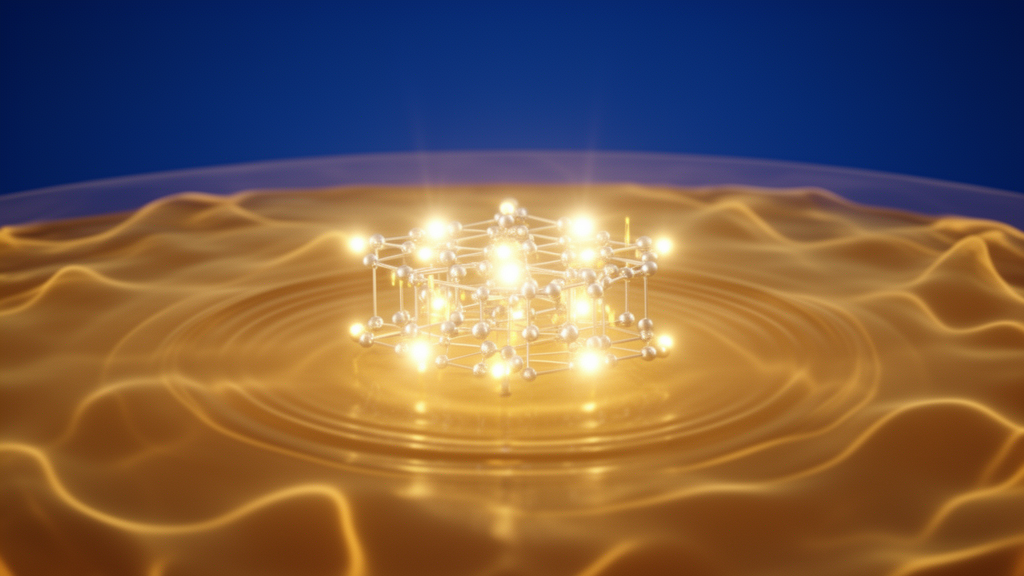
Maxwell’s demon, the mischievous thought experiment dreamed up in 1867, has long stood as physics’ most seductive promise: a tiny creature that watches molecular fluctuations and, armed with nothing but information, extracts usable energy from a system that should be at equilibrium. For more than a decade, experimentalists have built real versions of this demon, using lasers, colloids and electronic circuits to show that information genuinely functions as a thermodynamic resource. Yet nearly all of these demonstrations share a quiet assumption: that the environment surrounding the machine is memoryless, so that any information leaking between system and surroundings is lost forever. A new experiment published in Nature Physics by Lokesh Muruga, Felix Ginot, Sarah A. M. Loos and Clemens Bechinger breaks that assumption wide open, showing that the hidden memory of an environment can itself be harvested as a source of work.
The theoretical backbone of the study is the generalized second law of thermodynamics for feedback-controlled systems, derived by Takahiro Sagawa and Masahito Ueda in 2010. It states that the average net work W extractable from a system obeys W ≤ −ΔF + kBT·I(Z:M), where ΔF is the free-energy difference between the initial and final equilibrium states, kB is Boltzmann’s constant, T the bath temperature, and I(Z:M) the mutual information gained about the true microscopic state Z from a measurement M. In a cyclic machine, ΔF vanishes, so all extracted work must be paid for in information. The subtle point is what Z actually contains. For a real engine, Z includes not only the degrees of freedom an experimenter can see but also the hidden degrees of freedom of the environment, which are only partially accessible to any measurement.
The team proves a striking mathematical fact: if the demon performs a single measurement, hidden degrees of freedom contribute nothing. Because the measurement apparatus samples only the observable variable, the measurement outcome is conditionally independent of the hidden variables given what is observed. That makes the mutual information I((X,Y):M) collapse exactly to I(X:M), the information about the visible coordinate alone. In terms of the outcome-resolved bound on extractable work, expressed through the Kullback–Leibler divergence between the post-measurement distribution and equilibrium, the hidden sector drops out identically. The physical intuition is elegant: environmental memory lives in temporal correlations, and a single snapshot in time simply cannot see correlations. To tap the bath’s memory, you must ask it questions more than once.
The experiment that realizes this idea is a masterclass in microscopic control. The researchers trapped a 2.7-micrometre silica particle with optical tweezers in a viscoelastic solution of wormlike surfactant micelles — an equimolar 8-millimolar mixture of cetylpyridinium chloride and sodium salicylate — whose network relaxes on a timescale of roughly six seconds at room temperature. As the colloid jostles through this tangled micellar web, the network deforms and stores information about the particle’s recent history, but that deformation is invisible to the camera. The micellar network therefore acts as a hidden degree of freedom, and the particle’s motion becomes genuinely non-Markovian: its future depends not only on where it is now, but on where it has been. Particle trajectories were recorded at 100 frames per second with a spatial resolution of about five nanometres, giving the team an exquisitely detailed statistical record of the dynamics.
The measurement protocol was deliberately minimal. At a first time, the particle’s position was compared with a fixed threshold, yielding a binary outcome, |0〉 if the particle sat to the left and |1〉 if it sat to the right. Then, after a controllable delay δt, a second binary measurement was performed, defining four possible two-bit states: |00〉, |01〉, |10〉 and |11〉. Because the first measurement truncates the equilibrium Boltzmann distribution, it prepares a genuine non-equilibrium ensemble; the second measurement, arriving while the micellar network is still deformed, correlates the visible particle configuration with specific thermal excitations of the hidden bath modes. By tracking how the average potential energy of the particle relaxed after each two-bit state, the team could read out the ghostly influence of the bath. With a delay of about one second, the relaxation curves depended strongly on both measurement outcomes, and for the state |10〉 the energy behaved non-monotonically — direct evidence that stored bath energy was flowing back into the particle.
Quantifying the memory required a clever control trick. Simply comparing the two-measurement ensemble with a single-measurement ensemble would conflate two effects, because the ensembles start from different position distributions. The researchers therefore constructed a history-blind control distribution by randomly resampling trajectories so that its initial positions exactly matched those of the two-measurement state. In a memoryless system, this control ensemble and the true two-measurement ensemble would then relax identically, and the Kullback–Leibler divergences measuring their information content relative to equilibrium would decay in lockstep. Instead, with a delay near one second, the two curves diverged: information in the double-measurement ensemble persisted longer for some states and decayed faster for others. The team distilled this discrepancy into an integrated order parameter Φ(δt), which vanishes for Markovian dynamics and peaks sharply at δt ≈ 1 second — a temporal window set jointly by the micellar relaxation time and the particle’s relaxation in the trap.
The climax of the study came when the team converted that recovered information into actual work. After the second measurement, they translated the optical trap at constant velocity over three seconds, dragging the potential sideways and measuring the fluctuating work along the way. For a Markovian particle in a harmonic potential, theory fixes a hard ceiling: the extractable work cannot exceed κ〈X〉²/2, where κ is the trap stiffness and 〈X〉 the mean post-measurement displacement — essentially the potential energy stored in the shifted distribution. The experimental results smashed through that ceiling. For the |10〉 state, with a one-second delay between measurements, the extracted work reached roughly three times the Markovian bound. Since the visible coordinate alone cannot supply that much energy, the surplus could only have come from the excess free energy stashed in the deformed micellar network — energy retrieved purely through the information carried by the delayed second measurement.
Remarkably, the order parameter Φ proved predictive across the whole state space. The |10〉 state, which showed the largest information backflow, also delivered the biggest relative boost in work beyond the Markovian limit. The |11〉 state yielded the largest absolute work, thanks to a large contribution from ordinary potential energy, while |01〉 underperformed and |00〉 produced systematically negative work, meaning energy had to be invested rather than harvested. Numerical simulations of a minimal model — a fictitious bath particle elastically coupled to the observed colloid — reproduced all of these features, from the non-monotonic energy relaxation to the state-resolved work output, reinforcing the interpretation that the hidden network modes were genuinely fuelling the engine. The efficiency of memory harvesting tracks the timing of the demon’s operations: act too fast, before correlations have built structure in the bath, or too slow, after the network has equilibrated, and the advantage disappears.
What the Konstanz team has delivered is more than a clever colloid trick. It establishes environmental memory — long treated as a nuisance that complicates entropy production and breaks standard bounds — as an experimentally accessible thermodynamic resource that can be systematically characterized and exploited without any direct access to the hidden variables themselves. The operational recipe, using time-delayed or repeated measurements to infer the state of an unseen environment, could translate into memory-aware feedback strategies for systems where ordinary Markovian shortcuts to rapid equilibration fail, from biopolymer solutions to active and driven matter. The same logic even offers a practical criterion for memory erasure: when the order parameter Φ collapses to zero, the hidden modes have forgotten everything. And because information storage and backflow in unobserved environmental modes are central themes in the theory of open quantum systems, where non-Markovianity is a flourishing field, the results hint at a unifying framework in which classical and quantum demons alike learn to mine the past for energy. Maxwell’s demon, it turns out, does not need to see everything. It just needs to ask twice.
Subject of Research: Experimental extraction of thermodynamic work from environmental memory and non-Markovian hidden degrees of freedom in an information engine
Article Title: The extraction of work from hidden degrees of freedom
Article References: The extraction of work from hidden degrees of freedom. (n.d.). https://doi.org/10.1038/s41567-026-03442-w
Image Credits: AI Generated
DOI: 10.1038/s41567-026-03442-w
Keywords: Maxwell's demon, information thermodynamics, non-Markovian dynamics, hidden degrees of freedom, optical tweezers, Brownian particle, viscoelastic fluid, information backflow, work extraction, Sagawa-Ueda bound, Kullback-Leibler divergence, colloidal engine
Cite Scienmag News
Denise Maddox. (October 16, 2026). Physicists Pull Extra Energy From a Hidden Memory in the Bath. Scienmag. https://scienmag.com/physicists-pull-extra-energy-from-a-hidden-memory-in-the-bath/
Denise Maddox. "Physicists Pull Extra Energy From a Hidden Memory in the Bath." Scienmag, 16 October 2026, https://scienmag.com/physicists-pull-extra-energy-from-a-hidden-memory-in-the-bath/. Accessed 16 October 2026.
Denise Maddox. "Physicists Pull Extra Energy From a Hidden Memory in the Bath." Scienmag. October 16, 2026. https://scienmag.com/physicists-pull-extra-energy-from-a-hidden-memory-in-the-bath/


