


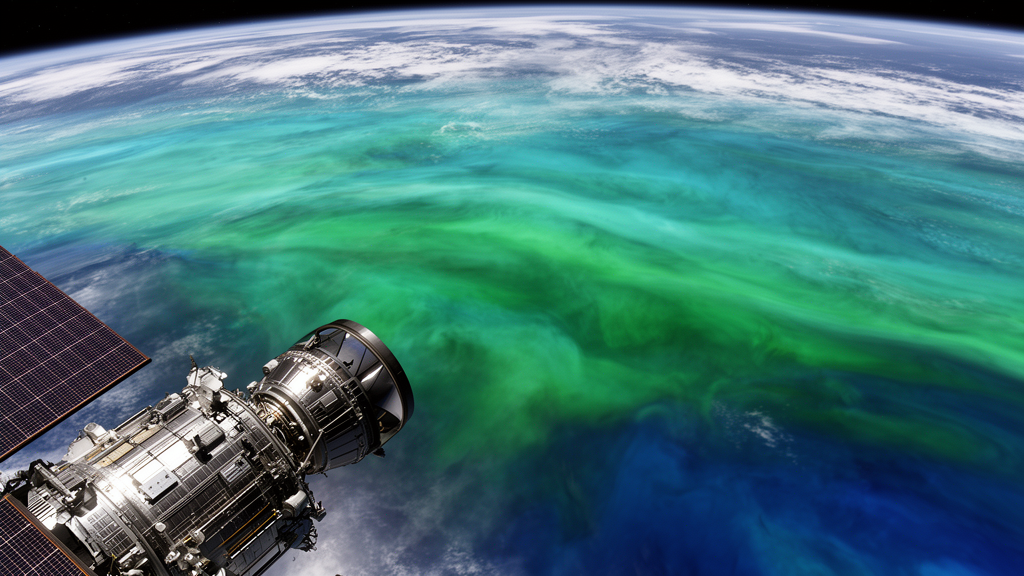
Every day, Copernicus Sentinel-3 glides over the world’s oceans, its Ocean and Land Colour Instrument collecting the faint spectrum of sunlight that scatters back out of the sea. Hidden in those colors is a chemical census of the ocean: the pigments that phytoplankton use to capture light. Now a team of European researchers has trained artificial intelligence to decode that census, retrieving 13 distinct phytoplankton pigments simultaneously from OLCI observations — and their convolutional neural network beat every rival architecture they tested, in what they describe as the first systematic benchmark built specifically around the sensor’s spectral configuration.
The study, published in Frontiers in Remote Sensing, was led by Borja Sánchez-López and Marco Talone of the Institut de Ciències del Mar in Barcelona, together with colleagues from Spanish, Italian, and Slovenian institutions. Pigment concentrations matter because they reveal the composition of marine ecosystems and drive biogeochemical cycling: which phytoplankton groups dominate the water, how much carbon they fix, and how communities shift as oceans warm. Traditionally, the only way to measure them is to bottle seawater, filter it, and run it through High Performance Liquid Chromatography — a precise but slow and expensive technique that limits sampling to a few stations and cruises.
Satellites promise the opposite: daily, near-global coverage. But turning multispectral radiometry into pigment concentrations is a hard inverse problem, because many pigments share overlapping absorption features and vary by orders of magnitude in abundance. Machine learning has been applied before to sensors like MODIS and SeaWiFS, yet no study had systematically exploited OLCI’s additional bands — including wavelengths near 442, 560, 620, and 673 nanometers — for the simultaneous retrieval of multiple diagnostic pigments. The new work fills that gap with a controlled comparison of five architectures: Random Forest, eXtreme Gradient Boosting, a Dense Neural Network, a one-dimensional Convolutional Neural Network, and a Bidirectional Long Short-Term Memory network.
Training and evaluation relied on 185 co-located in situ measurements of remote-sensing reflectance and HPLC pigment concentrations collected between 2014 and 2021 across optically diverse European waters — the Mediterranean Sea, the Black Sea, the Atlantic, and the English Channel — within the BiOMaP programme. The radiometry was deliberately rigorous: hyperspectral TriOS RAMSES radiometers or multispectral BioSpherical Instruments C-OPS profilers, processed under strict protocols to keep uncertainty low, then linearly interpolated to OLCI’s 11 relevant center-wavelengths. The waters ranged from near-oligotrophic Balearic Sea conditions to the sediment- and CDOM-laden Adriatic and Black Sea, giving the models a genuinely diverse optical training domain.
The results were striking. The CNN consistently outperformed all other architectures across all evaluation metrics, achieving coefficients of determination between 0.70 and 0.93 and mean absolute percentage errors of 25 to 55 percent across the 13 target pigments. For the five best-retrieved compounds — chlorophyll a, chlorophyll c1+c2, fucoxanthin, beta-carotene, and diadinoxanthin — errors approach the roughly 20 percent inter-laboratory differences documented in HPLC round-robin experiments, suggesting the retrieval is close to the physical limit of what multispectral data can deliver. The CNN’s advantage over the BiLSTM also carries a scientific lesson: pigment retrieval appears governed by localized spectral features confined to a few consecutive bands, rather than long-range spectral dependencies.
A key methodological innovation was a novel two-phase deep learning training strategy. Pigment-specific modules were first trained independently, each optimized for a single compound with its own early stopping and hyper-parameters. The modules were then concatenated into a joint multi-output model with a shared dense head, first trained with frozen weights and later unfrozen for joint optimization at a reduced learning rate. This design prevents dominant, easily retrieved pigments — chiefly chlorophyll a, whose strong absorption features and wide concentration range give it statistical leverage — from degrading performance for rarer accessory pigments that are less represented in the dataset.
To extend the method to operational satellite products, the team applied transfer learning: the CNN pre-trained on the high-quality regional in situ data was fine-tuned on a global matchup dataset combining HPLC measurements from the MAREDAT, NOMAD, and TARA databases with Copernicus-GlobColour satellite reflectance. In a controlled comparison, the fine-tuned model systematically outperformed an identical architecture trained from scratch on satellite data alone across all 13 pigments. Mean absolute percentage errors were generally lower than 70 percent and roughly 20 to 25 percent smaller than the from-scratch version, and the coefficient of determination decreased by only about 0.2 relative to the in situ baseline, versus about 0.3 for the from-scratch model. The gains suggest the convolutional layers learned robust, transferable spectral-biogeochemical features that hold across oceanic regimes.
The team also built and validated a spectrally reduced five-wavelength version, using bands at 412, 442, 490, 555, and 670 nanometers, for compatibility with the Copernicus-GlobColour and ESA Ocean Colour Climate Change Initiative merged archives. That version retains comparable in situ performance for most pigments — with the largest degradation for 19′-butanoyloxyfucoxanthin — and preserves the transfer learning advantage after fine-tuning. A SHAP interpretability analysis confirmed that green reflectance near 560 nanometers provides the highest relative contribution across most pigments, with blue bands near 442 and 490 nanometers as key secondary contributors, consistent with established ocean color algorithm design.
Not every pigment surrendered easily. Zeaxanthin and 19′-butanoyloxyfucoxanthin remained challenging regardless of model complexity, most likely due to low concentrations, poor representation in the training data, and heavy spectral overlap with dominant pigments — a limitation the authors expect hyperspectral sensors such as NASA’s PACE OCI may partially resolve. The geographical concentration of the BiOMaP dataset in European waters may also limit global transferability, and the authors call for expanding coincident radiometric and HPLC measurements to underrepresented regions including the tropical Pacific, the Southern Ocean, and major upwelling systems.
Still, the implications reach far beyond one sensor. The five-wavelength model can be applied retrospectively to a continuous satellite record extending back to 1997, enabling 26-year climatological analysis of phytoplankton community composition. The authors also envisage applying their framework to current and future hyperspectral missions, noting that historical in situ HPLC measurements collected alongside multispectral radiometry — spectrally incompatible with hyperspectral sensors — need not be discarded: they can serve as pre-training foundations for hyperspectral CNN models, fine-tuned later on the smaller hyperspectral matchup datasets that PACE and ESA CHIME will progressively generate. The trained models and implementation code are publicly available on GitHub, opening the door for the ocean color community to map the ocean’s microscopic garden in unprecedented chemical detail.
Subject of Research: Simultaneous retrieval of 13 phytoplankton pigments from Sentinel-3 OLCI using convolutional neural networks and transfer learning
Article Title: Simultaneous retrieval of 13 phytoplankton pigments from Sentinel-3 OLCI using convolutional neural networks and transfer learning
Article References: Sánchez-López, B., Talone, M., Cerquides, J., Di Cicco, A., Martínez-Fornos, G., & Slavinec, P. (2026). Simultaneous retrieval of 13 phytoplankton pigments from Sentinel-3 OLCI using convolutional neural networks and transfer learning. Frontiers in Remote Sensing, 7, Article 1880618. https://doi.org/10.3389/frsen.2026.1880618
Image Credits: AI Generated
DOI: 10.3389/frsen.2026.1880618
Keywords: phytoplankton, Sentinel-3, OLCI, ocean colour, machine learning, convolutional neural network, transfer learning, remote sensing, Simultaneous, retrieval, pigments, convolutional
Cite Scienmag News
Blake Davidson. (October 16, 2026). AI Reads the Ocean’s Colors to Map 13 Phytoplankton Pigments From Space. Scienmag. https://scienmag.com/ai-reads-the-oceans-colors-to-map-13-phytoplankton-pigments-from-space/
Blake Davidson. "AI Reads the Ocean’s Colors to Map 13 Phytoplankton Pigments From Space." Scienmag, 16 October 2026, https://scienmag.com/ai-reads-the-oceans-colors-to-map-13-phytoplankton-pigments-from-space/. Accessed 16 October 2026.
Blake Davidson. "AI Reads the Ocean’s Colors to Map 13 Phytoplankton Pigments From Space." Scienmag. October 16, 2026. https://scienmag.com/ai-reads-the-oceans-colors-to-map-13-phytoplankton-pigments-from-space/


