


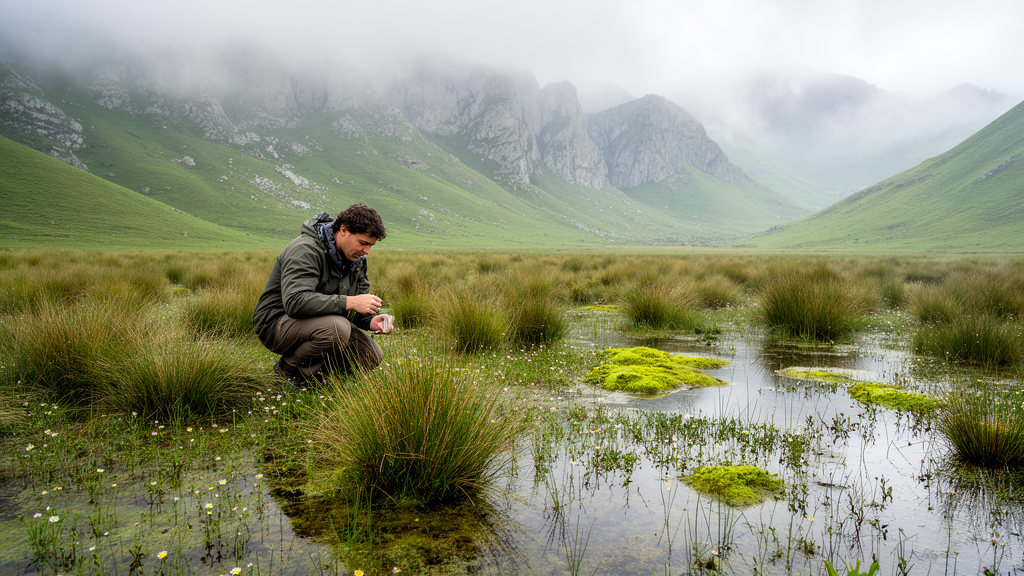
High in the Madonie and Nebrodi mountains of Sicily, botanists have documented a chain of previously unrecorded mountain wetlands, and the plants growing there are turning out to be far more remarkable than their modest size suggests. A new survey published in Italian Botanist describes fourteen wetland sites, including springs, peaty springs, and temporary ponds, scattered across two unexplored mountain localities. From fifty carefully measured vegetation plots, the researchers distinguished ten new plant communities alongside several associations already known from other parts of Sicily and southern Italy, significantly expanding the known range of two rare wetland alliances that define the island’s highland aquatic flora.
Wetlands are a cornerstone of Mediterranean biodiversity, and Sicily stands out for the extraordinary heterogeneity of its wetland biotopes. The island’s mountain wetlands carry particular biogeographic weight: the Sphagnum-transitional mires of the Madonie are the southernmost in Europe, while wet meadows and springs host hygrophilous plant communities endemic to southern Italy. Temporary ponds, whose water balance swings between rainy winters and dry summers, have driven the evolution of aquatic plant communities found nowhere else. Yet while the flora of most Sicilian mountains has been well studied, the vegetation of mountain wetlands remains scarce or outdated in many areas, a knowledge gap that recent surveys have begun to close through the discovery of new plant communities in previously little-known localities.
The study focused on two mountain sectors. In the Madonie, within the municipality of San Mauro Castelverde in the province of Palermo, six sites comprising springs and peat bogs were surveyed on flat ground at the foothills of Cozzo Signorina and Pizzo Voturo. In the Nebrodi, eight sites were investigated within the municipality of Mistretta in the province of Messina, including three temporary ponds and five springs and peaty springs distributed on the northern and southern slopes of Monte Castelli. The sites range in altitude from roughly 800 to more than 1,300 meters above sea level, and in area from about 200 to over 3,000 square meters.
Geology plays a decisive role in why these wetlands exist at all. The Madonie sites sit on Upper Oligocene to Lower Miocene formations of dark grey mudstones, brown clays, and thick beds of yellowish quartzarenites, in contact with marly clays and micaceous quartz siltstones of the Lower Miocene. The Nebrodi sites lie on Upper Miocene deposits of grey sands and clayey sands with rare marly outcrops. Fine-grained arenaceous substrates limit rainwater percolation and promote the retention of groundwater, a mechanism also observed in wetland sites of the Apennines, allowing water to pool and saturate the surface long enough for distinctive vegetation to establish.
The fieldwork, carried out in June and July 2025 at the phenological peak of most species, combined vegetation recording with direct hydrochemical measurement. Because water pH and electrical conductivity were measured in every plot, the researchers selected a plot size of one square meter, smaller than the four square meters generally recommended for aquatic vegetation, in order to obtain a more precise relationship between plant composition and the measured abiotic variables. Portable instruments recorded pH and conductivity in the field, and stand topography, whether flat or in a depression, was noted for each plot. Plots were randomly distributed within physiognomically homogeneous areas with uniform slope, topography, and water table conditions.
The data analysis relied on constrained correspondence analysis, a unimodal ordination method appropriate for compositional gradients spanning 7.4 standard deviation units. The ordination model, built on pH, electrical conductivity, and topography, explained 19.74 percent of the total variation in species composition, with the first axis alone accounting for 9.28 percent. A variation partitioning test showed that topography and the hydrochemical variables each explained 7.3 percent of community variability, with virtually no overlap between their explanatory power. Permutation tests confirmed that all environmental variables played a significant role in shaping community composition, and species fidelity calculations using the Phi coefficient with Fisher’s exact test verified the floristic distinctiveness of the groups the ordination distinguished.
The most striking result was the power of topography as an ecological filter. Plots on flat stands, which are springs fed by groundwater or silted-up ponds, separated clearly from plots in depressions, which are temporary ponds and shady pools mostly fed by rainwater. Flat stands remain permanently or semi-permanently water-saturated during the growing season, while depression stands dry out for most of the summer after storing a larger water volume from winter to early summer. The two groups also differed in biological form spectra: although both were dominated by hemicryptophytes, rooted hydrophytes were far more frequent in the depression group at 36 percent compared with 4.5 percent in the flat group, and the flat group was notably richer in species, hosting 65 species against 25, probably because its biotopes offer a wider spectrum of ecological niches and lie in close contact with xeric grasslands.
On the flat, groundwater-fed sites, the vegetation belonged to the alliance Dactylorhizo sacciferae-Juncion striati, characterizing mountain humid swards of Calabria and Sicily that differ from their central European counterparts by the presence of several thermophilous differential species. Among the communities described here are peaty meadows dominated by Juncus articulatus with high cover and a moss layer, fen grasslands with summer dryness co-dominated by Juncus inflexus and Carex otrubae, wet meadows of the tall tufted grass Deschampsia cespitosa representing the driest successional stage, flooded meadows on clay-rich substrates with alkaline pH dominated by Cyperus longus, and peaty-clay wet meadows characterized by the tall sedge Carex acutiformis together with the orchid Dactylorhiza maculata subsp. saccifera. Slightly acidic peaty spring communities with Carex punctata showed the lowest electrical conductivity values, reflecting markedly peaty substrates where organic matter decomposition produces organic acids.
In the depressions, the vegetation belonged to the Sicilian endemic alliance Alopecuro-Glycerion spicatae, which includes upland marshy communities dominated by rooted hydrophytes such as Glyceria spicata and Peplis portula forming dense mats with only their terminal parts emerging. Annual aquatic communities of shallow temporary ponds with silty-clay bottoms were assigned to Glycerio spicatae-Oenanthetum aquaticae, where vegetation phenology tracks pond seasonality: ponds are covered only by Glyceria spicata through winter until late spring, when the robust Oenanthe aquatica starts growing, and the whole community declines and disappears as ponds dry from mid to late summer. Small shaded pools at spring margins hosted floating mats of Callitriche stagnalis with Ranunculus omiophyllus in slightly acidic water with conductivity below 130 microsiemens per centimeter, while flooded pond shores supported communities of Eleocharis palustris with constant Oenanthe fistulosa. Notably, two neighboring ponds differing in hydrochemistry, one alkaline with conductivity above 750 microsiemens per centimeter and one neutral below 232, possibly reflect different cattle densities causing eutrophication.
Beyond their scientific novelty, these wetlands serve as essential refugia for microalgal communities, amphibians, and associated terrestrial vertebrates, and the georeferenced floristic data provide a foundation for biodiversity databases and targeted conservation regulation. The threats are real: some sites suffer from water subtraction and uncontrolled grazing, where livestock urine released into small temporary ponds increases salinity in waters with limited mixing, and trampling damages springs and peatlands, disrupts surface hydrology, and promotes eutrophication. Such pressures facilitate the invasion of nitrophilous species, leading to floristic homogenization and accelerated successional processes that result in wetland infilling. The survey demonstrates that field investigations collecting information on vegetation, flora, and environmental features remain crucial for the conservation of wetland habitats, and that similar ecological contexts in the Sicilian and southern Italian mountains deserve urgent future investigation.
Subject of Research: Vegetation ecology and hydrochemistry of newly discovered mountain wetlands in Sicily
Article Title: Vegetation survey and hydrochemical characterization of newly discovered mountain wetlands in the Madonie and Nebrodi mountains (Sicily)
Article References: Bajona, E., Raimondo, F. M., Di Gristina, E., Domina, G., Pardi, R., & Cirlincione, F. (2026). Vegetation survey and hydrochemical characterization of newly discovered mountain wetlands in the Madonie and Nebrodi mountains (Sicily). Italian Botanist, 21, 81-107. https://doi.org/10.3897/italianbotanist.21.171191
Image Credits: AI Generated
DOI: 10.3897/italianbotanist.21.171191
Keywords: Sicily, Madonie, Nebrodi, mountain wetlands, temporary ponds, peaty springs, plant communities, vegetation survey, hydrochemistry, biodiversity conservation, Mediterranean Basin, phytosociology
Cite Scienmag News
Margaret Porter. (October 16, 2026). Hidden Mountain Wetlands of Sicily Reveal Ten New Plant Communities. Scienmag. https://scienmag.com/hidden-mountain-wetlands-of-sicily-reveal-ten-new-plant-communities/
Margaret Porter. "Hidden Mountain Wetlands of Sicily Reveal Ten New Plant Communities." Scienmag, 16 October 2026, https://scienmag.com/hidden-mountain-wetlands-of-sicily-reveal-ten-new-plant-communities/. Accessed 16 October 2026.
Margaret Porter. "Hidden Mountain Wetlands of Sicily Reveal Ten New Plant Communities." Scienmag. October 16, 2026. https://scienmag.com/hidden-mountain-wetlands-of-sicily-reveal-ten-new-plant-communities/


