


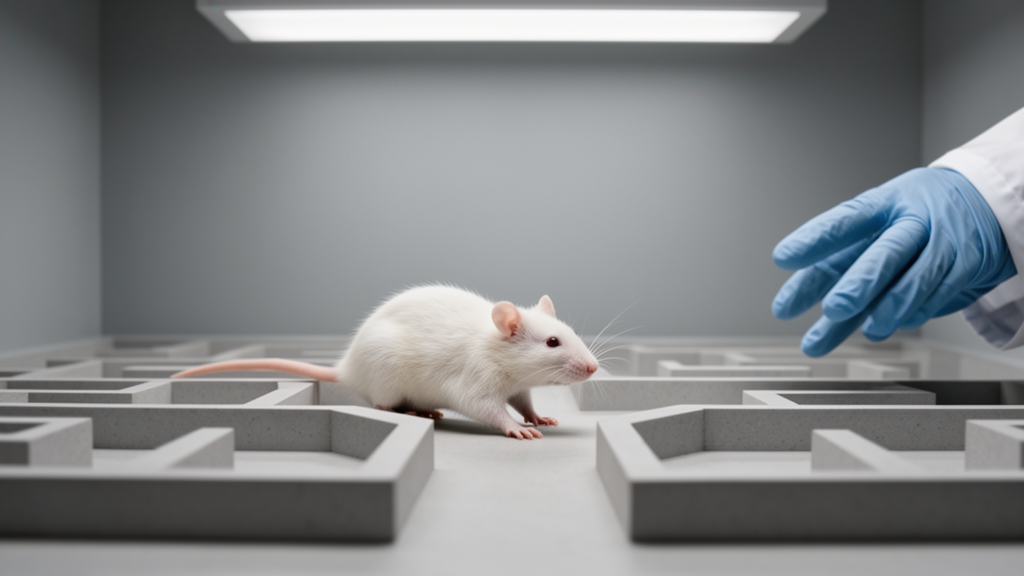
Three gene mutations that reliably cause intellectual disability in humans — and that are frequently co-diagnosed with autism spectrum disorder — appear to leave a fundamental form of learning untouched in rats. That is the striking conclusion of a new study from researchers at the University of Stirling, the University of Manchester, and the University of Edinburgh, who put rat models of Fragile X syndrome, SYNGAP1-related intellectual disability, and GRIN2B-related neurodevelopmental disorder through a rigorously controlled water maze. The work, published in Frontiers in Behavioral Neuroscience, challenges a long-standing assumption that these mutations should impair spatial memory, and it delivers a bonus finding about how rats actually navigate the world: they may rely on individual landmarks rather than the full constellation of cues that spatial learning theory has traditionally assumed.
The three genes under investigation sit at the heart of synaptic plasticity, the molecular machinery that allows connections between neurons to strengthen or weaken with experience. FMR1 mutations cause Fragile X syndrome, an inherited condition affecting roughly 1 in 4,000 males and 1 in 7,000 females, in which a CGG repeat expansion on the X chromosome silences production of the FMRP protein. FMRP is strongly expressed in neurons of the cortex, hippocampus, thalamus, and cerebellum, and its loss disrupts spine formation and pruning, synaptic plasticity, and protein synthesis. SYNGAP1, by contrast, encodes a protein found in the postsynaptic density, and mutations of this gene account for up to 1 percent of all non-syndromic intellectual disability. GRIN2B governs expression of the GluN2B subunit of the NMDA receptor, a molecular gatekeeper of plasticity itself. All three conditions are associated with IQs of 70 or below in affected males, making them among the most consequential monogenic causes of cognitive impairment known.
Yet when scientists have tried to reproduce these human deficits in rodents, the results have been maddeningly inconsistent. Studies of Fmr1 knockout mice have reported everything from modest water maze impairments to no deficits at all, depending on strain, task, and laboratory. Fmr1 knockout rats have fared no more clearly: one study found fewer platform crossings during probe trials but no difference in quadrant occupancy, while another found no impairment whatsoever in reference memory, reversal learning, or delayed matching to place. The picture in SYNGAP1 models is somewhat more consistent in mice, with impairments reported on T-maze alternation, Barnes maze learning, and water maze probe preference — but even here, some studies found deficits only during the first 15 seconds of a probe trial, with mutant and wild-type mice converging over the full 60 seconds. GRIN2B rodent work has been similarly split, with one mouse study showing impairments in long-term potentiation, long-term depression, and maze performance, while another found no water maze deficits despite a 30 to 50 percent reduction in GluN2B expression.
The research team, led by Anuj Vadher and Paul Dudchenko, suspected that part of the problem lay in the testing paradigm itself. In the traditional Morris water maze, rats swim in a pool of opaque water searching for a submerged platform, using visual landmarks scattered around the laboratory room. But which landmarks the animals actually use — a lantern, a poster, a curtain edge — is assumed rather than demonstrated. The team had recently observed that head direction cells, neurons that putatively underpin the rodent’s sense of direction, show significant alterations in Fmr1 knockout rats. A task that taps the animals’ use of directional information might therefore be especially sensitive to deficits in this model. To make the task genuinely informative, they built a variant in which the only visual landmarks available were four specified objects — a lantern, a white board, a hi-vis jacket, and a sombrero hat — hung on black curtains surrounding the pool. Critically, at the start of each day, the landmarks and the platform were rotated together by a pseudorandom angle, dissociating the platform’s location from any uncontrolled cues in the testing room and rendering the specified landmarks the only reliable external guides.
The pilot work also revealed an unexpected behavioral wrinkle. When tested in an open pool, both mutant and wild-type Fmr1 rats developed an annular search strategy, swimming in circles at roughly the correct distance from the pool walls rather than relying on the landmarks. Radial band analysis confirmed that this ring-search preference was statistically significant in both genotypes. Such a strategy requires no landmark learning at all — the animals simply learn the platform’s distance from the walls. To force genuine landmark use, the team added eight transparent acrylic triangular wall inserts to the pool, dividing it into eight alleyways that opened into a central circle. Now the rats could not simply swim in a ring; they had to swim into and out of each alleyway, making the search far more costly and the use of directional information far more apparent.
Across 10 days of training in this directional water maze, all three mutant models learned the task robustly. Fmr1 knockout rats and their wild-type littermates both showed steep decreases in the time needed to find the hidden platform, and in the platform-removal probe trials — in which the platform stayed submerged and held down by magnets for 60 seconds — both groups showed increasing preference for the target octant, the alleyway containing the platform’s direction. By day 4, both genotypes performed significantly above the 12.5 percent chance level. Remarkably, the Fmr1 knockout rats actually showed a small but significant advantage over wild-type animals in acquisition speed, though the authors attribute this to unusually slow wild-type performance on day 3. In the more robust measure of octant bias during probe sessions, there was no difference between the groups at all.
The Syngap1 heterozygous rats told a similar story, with one nuance. Across two cohorts totaling 8 mutant and 11 wild-type animals, both groups learned the platform direction equally well, with no difference in probe trial octant occupancy. Mutant rats did take slightly longer to find the platform during training — a significant overall genotype effect — but this latency difference never translated into a memory deficit when the platform was removed. The Grin2b heterozygous rats, tested with both males and females, were indistinguishable from wild-type littermates in every measure, and both groups showed significant target octant preference as early as day 2, the fastest learning of any model tested. For a gene whose product directly gates NMDA receptor currents — the very substrate of long-term potentiation — the intact performance is perhaps the most surprising result of the study.
The landmark removal probes delivered the study’s most conceptually significant finding. When three of the four trained landmarks were removed, leaving only one, performance remained above chance for almost every group and almost every landmark, with the exception of the Syngap1 rats, whose preference approached but did not reach statistical significance. Crucially, within each session, some individual animals performed at or below chance while others showed more than 80 percent occupancy of the correct octant. This pattern is inconsistent with configural learning, in which animals triangulate the platform using the full geometry of the landmark array — that strategy would have impaired all animals equally when only one cue remained. Instead, it suggests that different rats had learned directional associations with different individual landmarks, and that each animal’s performance depended on which specific cue happened to survive the deletion. The authors liken this to pattern completion, the same process that keeps hippocampal place fields intact when only a subset of trained landmarks is available.
The implications cut both ways. On one hand, the intact landmark learning in all three models — despite mutations that disrupt RNA binding, postsynaptic signaling, and receptor subunit expression — suggests that basic associative processes are spared in these genetic conditions, and that higher-order tasks involving sensory conflict may be needed to reveal the deficits that clearly exist in affected humans. When a single source of information is sufficient to guide performance, inflexibility in integrating other sensory streams may simply never become apparent. On the other hand, the finding that rats may navigate by individual landmarks rather than landmark configurations — at least in a directional water maze — revises a central assumption of spatial learning research that has gone largely untested for decades. For a field that has long treated the water maze as a window into cognitive map formation, the message is sobering: what looks like map-based navigation may sometimes be a collection of simple stimulus-response associations, each animal carrying its own private compass needle pointed at a single familiar object.
Subject of Research: Intact spatial learning in Fmr1–/y, Syngap1+/–, and Grin2b+/– rat models of neurodevelopmental disorders
Article Title: Intact spatial learning in Fmr1–/y, Syngap1+/–, and Grin2b+/– rat models of neurodevelopmental disorders
Article References: Vadher, A., Duszkiewicz, A. J., Wood, E. R., & Dudchenko, P. A. (2026). Intact spatial learning in Fmr1–/y, Syngap1+/–, and Grin2b+/– rat models of neurodevelopmental disorders. Frontiers in Behavioral Neuroscience, 20, Article 1929983. https://doi.org/10.3389/fnbeh.2026.1929983
Image Credits: AI Generated
DOI: 10.3389/fnbeh.2026.1929983
Keywords: Intact, spatial, learning, Fmr1, Syngap1, Grin2b, models, neurodevelopmental, disorders, scientific research
Cite Scienmag News
Ophelia Keating. (October 16, 2026). Landmark learning survives in rat models of Fragile X, SYNGAP1, and GRIN2B disorders. Scienmag. https://scienmag.com/landmark-learning-survives-in-rat-models-of-fragile-x-syngap1-and-grin2b-disorders/
Ophelia Keating. "Landmark learning survives in rat models of Fragile X, SYNGAP1, and GRIN2B disorders." Scienmag, 16 October 2026, https://scienmag.com/landmark-learning-survives-in-rat-models-of-fragile-x-syngap1-and-grin2b-disorders/. Accessed 16 October 2026.
Ophelia Keating. "Landmark learning survives in rat models of Fragile X, SYNGAP1, and GRIN2B disorders." Scienmag. October 16, 2026. https://scienmag.com/landmark-learning-survives-in-rat-models-of-fragile-x-syngap1-and-grin2b-disorders/


