


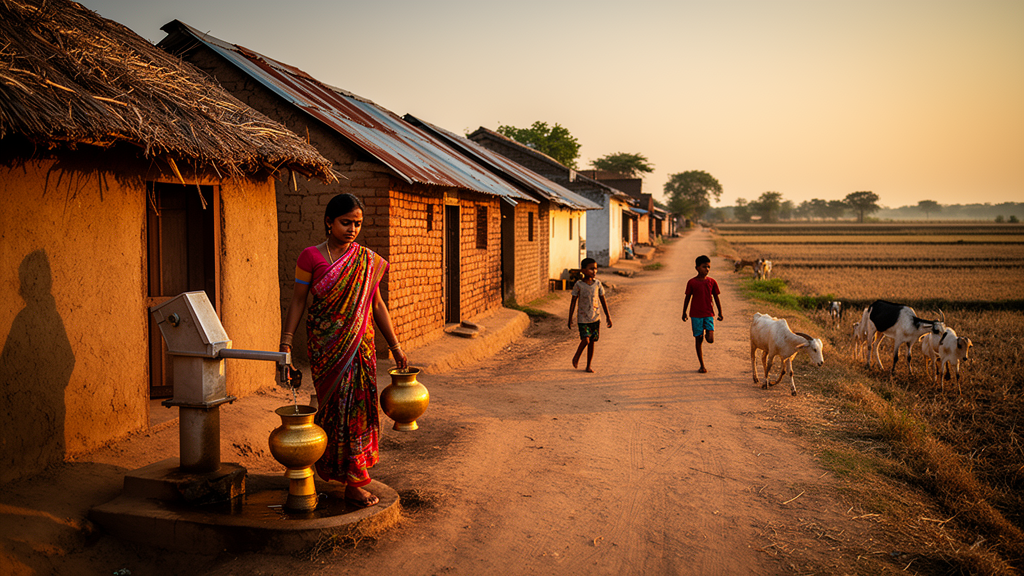
India’s most closely watched development experiment has produced some of its starkest numbers yet. A new analysis of household conditions across the country’s 112 aspirational districts reveals that nearly half of rural households in the Empowered Action Group (EAG) states remain highly deprived of basic amenities, with Scheduled Tribe and uneducated households bearing the heaviest burden. The findings, published in SN Social Sciences, arrive with the 2030 Sustainable Development Goals deadline looming and suggest that two decades of targeted policy have not yet broken the geography of disadvantage.
The study, conducted by Punyatoya Patra of Aditi Mahavidyalaya, University of Delhi, Shashi Kala Saroj of the Indian Council of Medical Research, and Gaurav Sikka of Patliputra University in Patna, draws on data from the fifth round of the National Family Health Survey conducted between 2019 and 2021. The researchers focused on the districts selected under the Aspirational District Programme, launched in 2018 by NITI Aayog to accelerate progress in the country’s most underdeveloped areas. Of India’s 770 districts, 112 were chosen for intensive monitoring across key sectors including health, nutrition, education, and basic infrastructure.
To measure deprivation, the team constructed a composite household deprivation index using Principal Component Analysis, a statistical technique that condenses information from twelve household indicators into a single score by identifying the combinations of variables that explain the greatest variation in the data. Each household was then classified into one of three categories: low, medium, or high deprivation. The twelve indicators spanned dimensions of living standards that international agencies such as the Oxford Poverty and Human Development Initiative have long used to track multidimensional poverty, including access to clean water, sanitation, electricity, cooking fuel, and housing quality.
The headline figure is arresting. In the aspirational districts of the EAG states, 47.6 percent of rural households fall into the high deprivation category. The EAG states, comprising eight of India’s twenty-nine states, were first identified in 2001 as requiring special attention for population stabilization and socio-economic development, and they include Bihar, Uttar Pradesh, Jharkhand, and Odisha. The comparison with non-EAG aspirational districts reveals a persistent divide: the legacy of the EAG designation, now more than two decades old, still tracks closely with where deprivation is concentrated.
The disaggregated results expose which households are being left behind. Among women-headed households in EAG aspirational districts, 45.5 percent experience high deprivation. Educational attainment emerges as a powerful predictor: 56.2 percent of households whose male members lack education, and 50.4 percent of those whose female members lack education, are highly deprived. Family structure matters too, with 47.1 percent of nuclear families classified as highly deprived, a finding that complicates the common assumption that smaller households fare better under resource constraints.
Religion and caste affiliation show equally pronounced gradients. Households identifying as Christian show a high deprivation rate of 48.5 percent, followed closely by Muslim households at 46.9 percent. Among social groups, Scheduled Castes record 46.4 percent high deprivation, while Scheduled Tribes fare worst at 56.2 percent. The concentration of deprivation among tribal communities echoes findings from earlier district-level analyses of eastern India and underscores how historical patterns of marginalization continue to shape access to basic services.
Geography compounds the picture. The majority of highly deprived households cluster in India’s North-Eastern region, where 46.9 percent of households are highly deprived, followed by the Eastern region at 45.6 percent and the Central region at 40.0 percent. The researchers used bivariate analysis to map these patterns and then applied ordered logistic regression, a statistical model suited to outcomes with more than two ordered categories, to test whether the associations between deprivation and household characteristics held after accounting for the categorical structure of the index. The regressions confirmed significant associations across the socio-economic variables examined.
The methodological choice to use Principal Component Analysis rather than equal weighting of indicators reflects a broader shift in poverty measurement. Since the introduction of the global Multidimensional Poverty Index, researchers have increasingly favored data-driven weighting schemes that let the underlying structure of deprivation emerge from the data itself. The approach also aligns the study with the framework used by the United Nations Development Programme and OPHI, whose 2025 global report highlighted the overlapping hardships of poverty and climate hazards, making the Indian district-level findings part of a comparable international evidence base.
For policy, the study identifies specific states where target-based interventions are most urgent. Among the EAG states, the aspirational districts of Jharkhand, Odisha, Bihar, and Uttar Pradesh require focused action, while in the non-EAG group, Assam and Nagaland stand out. The researchers frame these priorities against Sustainable Development Goals 1, 6, and 10, which respectively target the eradication of poverty, access to clean water and sanitation for all, and the reduction of inequality within countries. With the 2030 deadline less than five years away, the analysis suggests that India’s ranking of 130th in the 2025 Human Development Report will not improve without concentrated investment in exactly these districts.
The study’s reliance on nationally representative survey data gives its findings considerable weight, though the authors note that the analysis is based on publicly available secondary data and that statistical work was performed using Stata version 14. As India’s Aspirational District Programme continues to be promoted as a model of data-driven grassroots governance, this new evidence provides a sobering baseline: the districts selected for special attention in 2018 remain, by the measure of household deprivation, among the hardest places in the country to live without basic amenities, and the communities least equipped to change that fact are the ones the programme was designed to reach.
Subject of Research: Household deprivation in India’s aspirational districts in 2019-21: Comparing EAG and non-EAG states
Article Title: Household deprivation in India’s aspirational districts in 2019-21: Comparing EAG and non-EAG states
Article References: Household deprivation in India’s aspirational districts in 2019-21: Comparing EAG and non-EAG states. (n.d.). https://doi.org/10.1007/s43545-026-01645-9
Image Credits: AI Generated
DOI: 10.1007/s43545-026-01645-9
Keywords: Household, deprivation, India, aspirational, districts, Comparing, non-EAG, states, scientific research
Cite Scienmag News
Courtney Benton. (October 16, 2026). Nearly Half of Rural Households in India’s Aspirational Districts Face High Deprivation, Study Finds. Scienmag. https://scienmag.com/nearly-half-of-rural-households-in-indias-aspirational-districts-face-high-deprivation-study-finds/
Courtney Benton. "Nearly Half of Rural Households in India’s Aspirational Districts Face High Deprivation, Study Finds." Scienmag, 16 October 2026, https://scienmag.com/nearly-half-of-rural-households-in-indias-aspirational-districts-face-high-deprivation-study-finds/. Accessed 16 October 2026.
Courtney Benton. "Nearly Half of Rural Households in India’s Aspirational Districts Face High Deprivation, Study Finds." Scienmag. October 16, 2026. https://scienmag.com/nearly-half-of-rural-households-in-indias-aspirational-districts-face-high-deprivation-study-finds/


