


When 422 Catholics filed out of a London conference hall in February 2025 after two days with Bishop Robert Barron, they left behind more than empty seats. They left behind survey data that, according to a new study published in the Journal of Religious Education, reveals a quiet statistical revolution in English Catholicism. Led by Leslie J. Francis of the University of Warwick, together with Helen Frances Vaudrey, Francis Davis and Ursula McKenna of Lincoln Bishop University and the University of Birmingham, the research team found that the spiritual DNA of the Catholic Charismatic Renewal, a movement once defined by lay-led emotional worship, has been fundamentally rewritten by Barron’s digitally savvy followers. The charisms have not disappeared. They have been repurposed.
The Catholic Charismatic Renewal traces its origins to the Duquesne Weekend of February 1967, when students at Duquesne University in Pittsburgh reported transformative encounters with the Holy Spirit, including the hallmark Pentecostal practice of speaking in tongues. The movement spread rapidly across American university campuses such as Notre Dame and Michigan State, and by the early 1970s had crossed the Atlantic to Britain. Archival records from Liverpool Metropolitan Cathedral show that by 1975 the Diocese of Arundel and Brighton alone hosted 13 charismatic groups within a wider network of 41 prayer groups involving upwards of 650 people, while a letter from the Bishop of Menevia estimated around 5,000 English Catholics were committed to the movement. Globally, the numbers are staggering: more than 160 million Catholic charismatics are estimated worldwide, with growth overwhelmingly concentrated in the Global South.
Yet in Britain the movement stagnated, and the new study argues this was no simple failure but a three-front strategic dilemma. The CCR was constrained from above by institutional suspicion from a hierarchy that prized clerical control, outflanked from the side by more radical independent Pentecostal churches in Britain’s urban centres, and confronted by a dominant secular culture of rationalism and intellectual scepticism to which a purely experience-driven faith was often ill-suited. A 1977 address by Archbishop Derek Worlock described the prevailing Catholic model as a hierarchical, clergy-dominated structure creating a separation of the sanctuary from the world, a stark contrast to the CCR’s championing of direct personal experience, lay-led groups and emotionally expressive worship.
To measure what has replaced that contained movement, the researchers drew on religious orientation theory, specifically a family of scales that quantify openness toward distinct religious practices. Participants at Barron’s 2025 London event, styled Evangelism and Culture: The Bible, completed short nine-item forms of the Traditional Catholic Orientation Scale and the Charismatic Orientation Scale, rating how important each practice was to their faith on a five-point scale. The Catholic scale spans practices from going to confession and Eucharistic adoration to devotion to the Blessed Virgin Mary and saying the Rosary. The charismatic scale spans experiences from receiving the baptism of the Holy Spirit and praying in the Spirit to glossolalia, prophesying and being slain in the Spirit.
The statistical results are technically precise and striking. Factor analysis using a varimax rotated solution with Kaiser normalisation, constrained to two factors, recovered a clear structure with factor one accounting for 26.9 percent of the variance and factor two for 22.4 percent, confirming that the two orientations are empirically distinct. Both scales showed strong internal consistency reliability, with Cronbach’s alpha coefficients of .86 for the Catholic orientation scale and .87 for the charismatic scale. Devotion to the Blessed Virgin Mary recorded the highest item correlation with the rest of the Catholic scale at r = .75, while speaking or praying in tongues anchored the charismatic scale, replicating the pattern found among 490 participants at Barron’s 2023 London conference.
The endorsement data tell the deeper story. Among Barron’s followers, 81 percent rated going to confession as highly important, 79 percent Eucharistic adoration, 77 percent devotion to the Blessed Virgin Mary and 76 percent loyalty to the Pope, while 72 percent valued saying the Rosary. By contrast, fewer than a quarter endorsed the embodied, public expressions of charismatic faith: 13 percent valued speaking or praying in tongues, 12 percent singing in tongues, 15 percent prophesying and 18 percent attending charismatic prayer-group meetings. The correlation between the two orientations, a robust r = .62 in the 2013 general Catholic sample from Liverpool, shrank to a statistically small r = .10 in the 2025 Barron cohort. The researchers describe this as a statistical uncoupling of two spiritual orientations that were previously complementary.
The study proposes a four-part typology to explain this selective reordering. Authoritative Practices, reliant on the formal sacramental mediation of an embodied priest, are the cohort’s most valued mode, exemplified by confession and adoration. Autonomous Practices, traditional acts of individual piety such as the Rosary, are reframed into Authoritative Devotions through guided, priest-led YouTube recitations. Cognitive Charisms, private and informational experiences such as receiving a word of knowledge, valued by 41 percent, are accepted precisely because they preserve rational control. Corporeal Charisms, the ecstatic and public expressions involving surrender of conscious control, are almost universally rejected. Notably, the cohort still values receiving the baptism of the Holy Spirit at 59 percent, far above venerating relics at 31 percent, suggesting the group retains a private affinity for charismatic experience while rejecting its communal manifestations.
The researchers map this pattern onto established models of cognitive psychology. The preference for authoritative and cognitive practices aligns with what Daniel Kahneman termed System 2 thinking, the slow, deliberate and logical cognitive mode. Confession, endorsed by 81 percent of the cohort against just 45 percent of the 2013 Liverpool baseline, is described as an act of structured narrative construction in which the ego remains the primary agent. Conversely, glossolalia engages System 1 thinking, the fast, intuitive and emotional faculty, and is ego-dystonic. A SPECT scan study cited in the paper found decreased blood flow in the prefrontal cortex, the brain region associated with willed control, during glossolalia, confirming the experience as one of letting go of the rational ego rather than actively engaging it.
Why would a highly educated, professionally established cohort, 44 percent holding bachelor degrees, 34 percent master degrees and 8 percent doctorates, gravitate toward such a structured system? The study invokes Compensatory Control Theory, which holds that when feelings of personal control are threatened by the chaos of liquid modernity, individuals endorse external systems offering vicarious order, and Terror Management Theory, which posits that embedding one’s life in a timeless heroic narrative buffers existential anxiety. The ministry’s reframing of confession is telling: a Word on Fire video titled Why Men Need the Sacraments explicitly connects the repetitive act of confession to the virtue of grit, with the speaker shown performing a tyre flip up a steep hill, forging a symbolic link between physical discipline and spiritual perseverance. The ministry’s three most-viewed videos are all guided recitations of the Rosary, commanding a combined viewership of over 13.4 million, suggesting a profound need not simply for the Rosary but for the Rosary as a priest-led, intellectually rich catechesis.
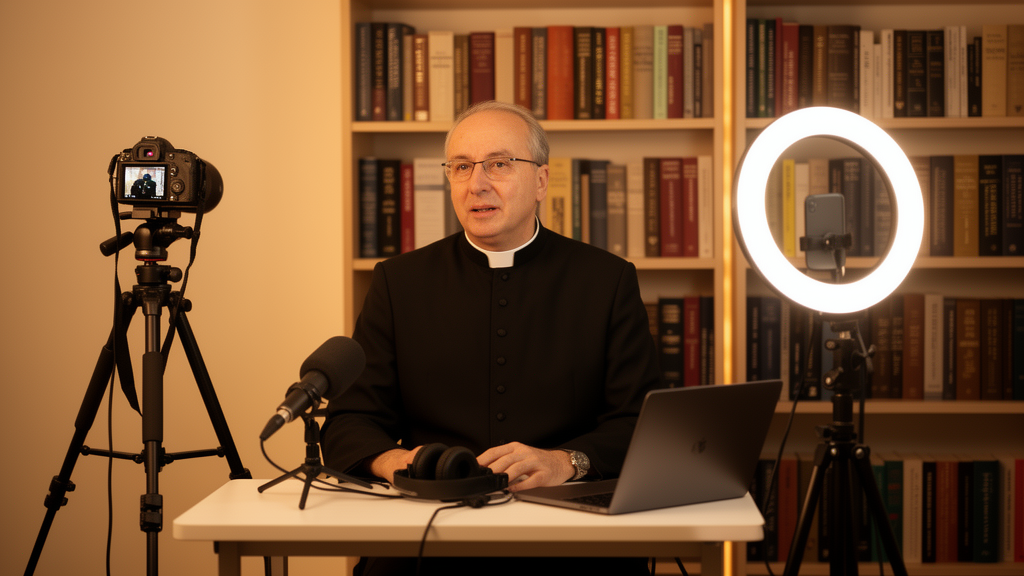
The study situates this shift within the digital divide that has created two fundamentally different religious economies. With internet penetration in Nigeria recorded at 39 percent as of 2023, the religious economy of the Global South remains primarily local, physical and communal, where charismatic Christianity thrives by competing effectively with independent Pentecostal churches. The United Kingdom, by contrast, exists in a state of digital saturation exceeding 95 percent accessibility, creating a hyper-connected, global and disembodied religious marketplace where a local volunteer-run prayer group must compete with polished, well-resourced digital ministries operating without geographical limits. Quantitative studies of YouTube’s recommendation engine demonstrate how it systematically funnels users toward the most engaging and ideologically coherent content within a given topic, an algorithmic amplification that particularly advantages intellectually focused movements. In a historical irony, the study concludes, the solution to an institutional predicament of the Old World now appears to be facilitated by a digital ministry from the New World. The researchers advance the suggestion that distinctive charisms at the heart of the Catholic Charismatic Renewal have been repurposed to accommodate a priest-led cognitive faith, in the mind, in place of a lay-led affective faith, in the heart, while cautioning that ongoing replications and studies of Barron’s far larger online audiences are needed to confirm and extend these findings.
Subject of Research: Exploring how the followers of Bishop Barron in England repurpose the influence of the Catholic Charismatic Renewal: a study in religious orientation theory
Article Title: Exploring how the followers of Bishop Barron in England repurpose the influence of the Catholic Charismatic Renewal: a study in religious orientation theory
Article References: Francis, L. J., Vaudrey, H. F., Davis, F., & McKenna, U. (2026). Exploring how the followers of Bishop Barron in England repurpose the influence of the Catholic Charismatic Renewal: a study in religious orientation theory. Journal of Religious Education. https://doi.org/10.1007/s40839-026-00309-3
Image Credits: AI Generated
DOI: 10.1007/s40839-026-00309-3
Keywords: Bishop Barron, Catholic Charismatic Renewal, religious orientation theory, digital ministry, Word on Fire, empirical psychology of religion, glossolalia, traditional Catholicism, YouTube, replication study, England, sacrament of confession
Cite Scienmag News
Courtney Benton. (October 16, 2026). How Bishop Barron’s English Followers Turned Charismatic Faith Into a Digital, Priest-Led Movement. Scienmag. https://scienmag.com/how-bishop-barrons-english-followers-turned-charismatic-faith-into-a-digital-priest-led-movement/
Courtney Benton. "How Bishop Barron’s English Followers Turned Charismatic Faith Into a Digital, Priest-Led Movement." Scienmag, 16 October 2026, https://scienmag.com/how-bishop-barrons-english-followers-turned-charismatic-faith-into-a-digital-priest-led-movement/. Accessed 16 October 2026.
Courtney Benton. "How Bishop Barron’s English Followers Turned Charismatic Faith Into a Digital, Priest-Led Movement." Scienmag. October 16, 2026. https://scienmag.com/how-bishop-barrons-english-followers-turned-charismatic-faith-into-a-digital-priest-led-movement/


