


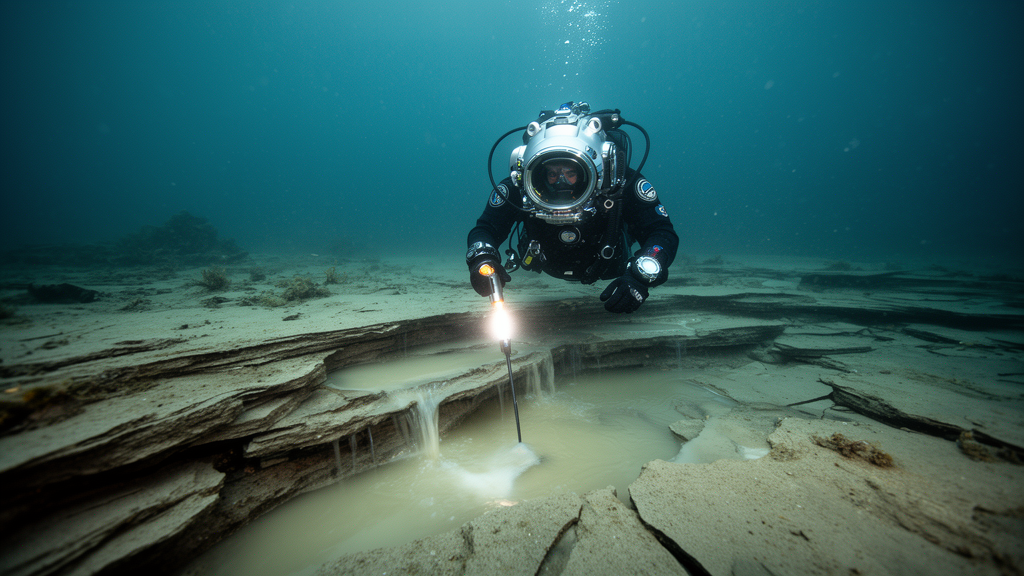
Scientists have identified what may be one of Europe’s most significant untapped water resources: enormous bodies of fresh and brackish groundwater lying hidden beneath the sea floor of the Northern Adriatic. A new study, published in Frontiers in Water, presents the first systematic, infrastructure-based framework for ranking offshore freshened groundwater (OFG) sites across the Euro-Mediterranean region, and its detailed case study off the coast of Rimini, Italy, suggests that this unconventional resource could be developed at a cost meaningfully lower than conventional seawater desalination.
Offshore freshened groundwater is water stored in the pores of sediments and fractures of rocks below the seabed, with a total dissolved solids concentration lower than that of seawater. These reserves are far from exotic curiosities. They have been documented on continental shelves around the world, from the New Jersey Shelf in the United States to the Canterbury Bight in New Zealand, the Pearl River Estuary in China, and the waters offshore Malta. Coastal communities have known about and used freshwater discharging from the sea floor for centuries, with records stretching back as far as 1,000 BC. What has been missing, according to the research team led by Ariel T. Thomas of the University of Malta, is a rigorous, cost-effective method for deciding which of these buried reservoirs are actually worth pursuing before expensive site-specific surveys are commissioned.
The new study addresses that gap with a two-step, data-driven framework built entirely on openly available datasets. In the first step, the researchers compiled a geospatial database combining confirmed OFG occurrences from the OFF-SOURCE database, predicted OFG volumes for coastal unconsolidated aquifers, global bathymetry, paleo-coastline reconstructions from the Last Glacial Maximum, regional water stress indicators from the Aqueduct 3.0 platform, and the locations of existing desalination plants and offshore oil and gas platforms. Sites were then classified into three feasibility tiers based on four cost-relevant criteria: seafloor depths of less than 125 metres, where offshore drilling is considerably cheaper and technically simpler; distances of less than 15 kilometres from the shoreline, corresponding to the upper range of typical infield pipeline lengths; the presence of nearby desalination plants; and the existence of offshore platforms that could be repurposed for water exploration.
The screening exercise produced a striking result. Of seven potential OFG sites evaluated, only one met all four infrastructure criteria alongside high regional water stress: the Northern Adriatic Sea offshore Rimini, Italy. Several boreholes in this area indicate salinity levels below 1 gram per litre at shallow seafloor depths of less than 30 metres, all within 15 kilometres of the coast, with multiple offshore platforms and desalination plants already operating along the nearby shoreline. The analysis also flagged new high-potential exploration zones offshore southern Spain, Belgium, and Malta, regions where high water stress and existing infrastructure co-exist even though OFG has not yet been confirmed there. According to the authors, this finding supports a strategic shift from reacting to incidental discoveries toward proactive exploration targeting in areas with the highest pre-existing economic viability.
With the Tier 1 site identified, the team turned to a detailed quantitative assessment of the Northern Adriatic resource. They extracted the depths and thicknesses of fresh and brackish water intervals from 37 borehole datasets, many drawn from Italy’s public ViDEPI archive of hydrocarbon exploration wells, and used kriging interpolation on a 400-metre grid to map the OFG body across an area of 9,343 square kilometres. Cross-validation confirmed a well-calibrated interpolation, with a root mean square error of 152.9 metres and a standardised error ratio of 0.97. The mapped interval thicknesses range from about 300 metres near Venice to roughly 500 metres along the coast near Rimini, thinning to approximately 170 metres at the farthest offshore extent of the study area.
A key geological insight emerged from this mapping. The spatial distribution of the freshwater body reveals an elongated, channelized trend that correlates directly with the reconstructed position of the Po River paleochannel, the ancient riverbed that flowed across the exposed Adriatic shelf during the Last Glacial Maximum, when sea levels were far lower than today. The researchers conclude that this proto-riverbed most likely acted as a primary conduit for meteoric recharge during sea-level lowstands, allowing rainwater to infiltrate deep into the shelf sediments. This correlation, they argue, marks paleochannels as high-priority exploration targets not only in the Adriatic but in similar deltaic settings worldwide.
To quantify the resource while honestly accounting for uncertainty, the team ran a Monte Carlo simulation of one million iterations. Because the legacy oil-exploration wells only recorded salinity data from depths of roughly 200 to 400 metres below the seabed, the shallower overlying interval of unknown salinity represented the dominant uncertainty. Drawing on empirical fresh-fraction analysis from eight wells within the study area, which yielded freshwater fractions ranging from 14 to 100 percent with a mean of 72 percent, the researchers assigned probabilistic distributions to each volumetric component. The results are remarkable: a conservative mean volume of 766 cubic kilometres based on confirmed freshwater intervals alone, rising to a broader mean estimate of 2,413 cubic kilometres when the overlying interval is probabilistically included, with an 80 percent confidence interval spanning 1,516 to 3,215 cubic kilometres. For context, the adjacent Venetian-Friulian Plain currently extracts groundwater at 48.6 cubic metres per second against a recharge rate of only 43.7 cubic metres per second, a deficit the estimated offshore reserve exceeds by a factor of more than 4,000 in annual terms.
The economic case rests on a simple physical principle: the energy required to push water through reverse-osmosis membranes scales with salinity. Energy typically accounts for 40 to 50 percent of the cost of seawater reverse osmosis, and the pressure needed to overcome osmotic pressure is the single largest component. Using industry-standard simulation software calibrated to state-of-the-art efficiency, the researchers found that desalinating OFG at salinities of 1 to 10 grams per litre requires only about 23 to 56 percent of the membrane energy needed for seawater at a 75 percent recovery rate, compared with the 35 to 50 percent recovery typical of seawater plants. Applied across a full cost model for a large-scale facility, this translates into total desalination costs 10.6 to 18.4 percent lower than seawater over the same salinity range. Because previous work has estimated the at-sea extraction costs of OFG at less than 10 percent of overall costs, the authors conclude that OFG could plausibly be cost-competitive with, or cheaper than, conventional seawater desalination.
The framework is not a green light for immediate exploitation. The authors caution that a full economic assessment, including capital costs for offshore drilling, pipelines, and infrastructure conversion, remains necessary, and that any future development would need careful environmental evaluation. Sustained offshore pumping could reduce onshore groundwater availability, promote seawater intrusion into coastal aquifers, and alter submarine groundwater discharge, with knock-on effects for benthic ecosystems. Subsidence is a particular concern in the Northern Adriatic, where land sinking already threatens cities such as Venice. Brine effluent from brackish-water desalination, though considerably less saline than seaward brine, would still require management. What the study delivers instead is a replicable methodology: a transparent, data-driven bridge from regional prioritisation to site-specific feasibility that water-stressed coastal nations can apply wherever borehole records and open datasets exist. As climate change intensifies pressure on coastal aquifers that already supply more than one billion people worldwide, the vast freshwater volumes quietly resting beneath shallow continental shelves may soon move from geological curiosity to strategic asset.
Subject of Research: Infrastructure-based prioritization and cost analysis of offshore freshened groundwater in the Northern Adriatic Sea
Article Title: Infrastructure-based prioritization and cost analysis of offshore freshened groundwater: a Northern Adriatic case study
Article References: Thomas, A. T., Tschaikowski, J., Katz, D., & Micallef, A. (2026). Infrastructure-based prioritization and cost analysis of offshore freshened groundwater: a Northern Adriatic case study. Frontiers in Water, 8, Article 1828540. https://doi.org/10.3389/frwa.2026.1828540
Image Credits: AI Generated
DOI: 10.3389/frwa.2026.1828540
Keywords: offshore freshened groundwater, desalination, Northern Adriatic, water resources, reverse osmosis, Po River paleochannel, Monte Carlo simulation, unconventional water, Infrastructure-based, prioritization, cost, analysis
Cite Scienmag News
Violet Maxwell. (October 16, 2026). Vast Freshwater Reserves Hidden Beneath the Sea Floor Could Slash Desalination Costs. Scienmag. https://scienmag.com/vast-freshwater-reserves-hidden-beneath-the-sea-floor-could-slash-desalination-costs/
Violet Maxwell. "Vast Freshwater Reserves Hidden Beneath the Sea Floor Could Slash Desalination Costs." Scienmag, 16 October 2026, https://scienmag.com/vast-freshwater-reserves-hidden-beneath-the-sea-floor-could-slash-desalination-costs/. Accessed 16 October 2026.
Violet Maxwell. "Vast Freshwater Reserves Hidden Beneath the Sea Floor Could Slash Desalination Costs." Scienmag. October 16, 2026. https://scienmag.com/vast-freshwater-reserves-hidden-beneath-the-sea-floor-could-slash-desalination-costs/


