


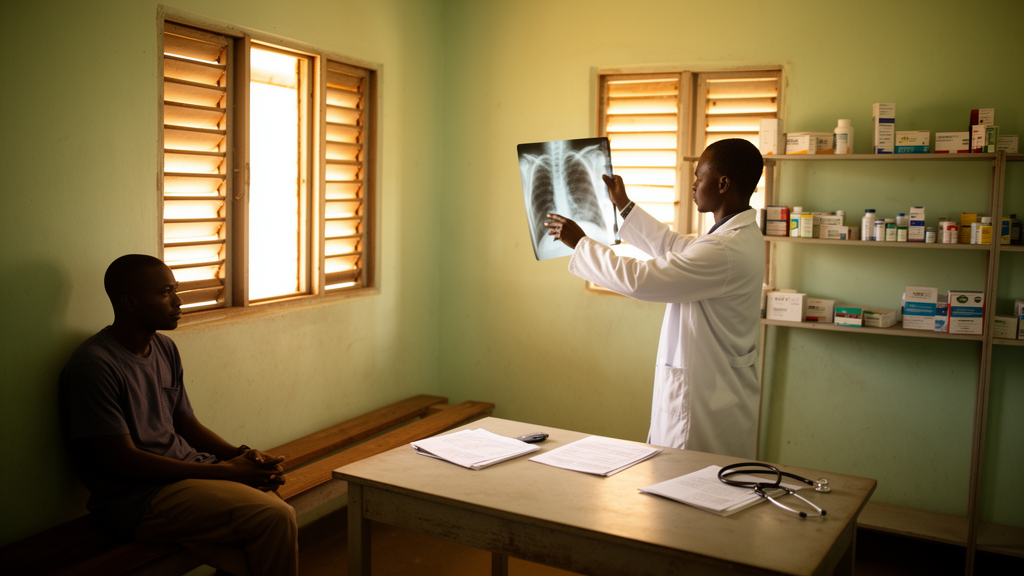
Tuberculosis remains one of the world’s most persistent infectious disease challenges, and Angola sits squarely at its center. A new scoping review published in Public Health Reviews has assembled the most comprehensive picture to date of how the country prevents, detects, treats, and tracks tuberculosis, revealing both meaningful progress and stubborn structural obstacles that continue to fuel transmission in one of Africa’s highest-burden settings.
The review, led by researchers at the University of São Paulo’s Ribeirão Preto College of Nursing in collaboration with Angolan institutions, followed the Joanna Briggs Institute methodology and the PRISMA-ScR reporting standard. The team searched six databases, including PubMed, Embase, LILACS, Web of Science, Scopus, and Google Scholar, and screened 564 records. After removing duplicates and applying eligibility criteria, 13 studies were included, covering a combined 24,652 participants ranging from adults to children under five years of age.
The epidemiological backdrop is stark. In 2023, Angola reported an estimated tuberculosis incidence of 325 cases per 100,000 population, with the disease concentrated among people aged 15 to 44 years. Across the African continent, which accounts for roughly a quarter of the world’s population infected with Mycobacterium tuberculosis, approximately 2.5 million new cases and 424,000 deaths were recorded in 2022. Against this landscape, the review’s authors set out to answer a deceptively simple question: what does the scientific evidence actually say about strategies, challenges, and opportunities for strengthening comprehensive tuberculosis care in Angola?
The answer, distilled through thematic content analysis, spans five interconnected domains. The first concerns prevention and diagnostic capacity. Bacille Calmette-Guérin vaccination, the cornerstone of childhood tuberculosis prevention, achieved approximately 90 percent coverage among children under five in the studies examined. Diagnostic approaches documented across the included research ranged from clinical evaluation and chest radiography to sputum smear microscopy and rapid molecular testing with GeneXpert MTB/RIF, alongside tuberculin skin testing, HIV serology, and drug susceptibility testing.
Yet the review found that diagnostic expansion alone is insufficient. Supply shortages were reported in every single included study, a finding the authors describe as universal across the evidence base. Underreporting of cases, gaps in epidemiological surveillance, and treatment initiation without bacteriological confirmation further weakened the system’s ability to detect and respond to the epidemic. In pediatric populations, diagnostic challenges were particularly acute, with low sputum yield in children requiring alternative approaches such as gastric lavage sample collection, and one pilot study demonstrating that molecular testing on stool samples from acutely malnourished children achieved high acceptance and simplified collection, though a significant number of invalid results remained a technical hurdle.
The second major theme addresses continuity of care and treatment support. Directly observed treatment, short-course, known as DOTS, has been implemented in various forms across the country, and community health workers have played a documented role in case follow-up and community-based contact tracing. Free access to medications and diagnostic tests emerged as a consistent strength. However, loss to follow-up remains a critical weakness, compounded by the absence of structured strategies for retrieving patients who discontinue treatment, limited computerization of health facilities, and interruptions in social support interventions such as food basket distribution, which one study found improved treatment outcomes when consistently provided.
Structural and organizational barriers form the third thematic pillar. Drug stockouts, insufficient diagnostic supplies, the absence of national guidelines for diagnosing and managing latent tuberculosis infection, inadequate laboratory infrastructure, and shortages of trained human resources collectively constrain the health system’s capacity. The review also documented the difficulties of implementing electronic medical record systems in settings where electricity supply is unreliable, internet connectivity is limited, and digital literacy among healthcare workers remains low. These information system gaps directly undermine surveillance, treatment monitoring, and coordination between services.
The fourth theme situates tuberculosis within its social determinants. Stigma and discrimination, food insecurity, limited awareness that tuberculosis testing and treatment are free, armed conflict, and the COVID-19 pandemic all shaped access to and continuity of care. The authors argue, drawing on comparative evidence from India and Brazil, that tuberculosis is not solely a biomedical problem but a socially determined disease requiring intersectoral responses that address poverty, educational inequality, and food security alongside clinical interventions.
The fifth and final theme highlights community-based strategies as actionable strengths. The involvement of community health workers, free testing and clinical evaluation, nutritional support, multidisciplinary care and counseling, and the commitment of health workers themselves all emerged as feasible, context-adapted approaches that bring care closer to affected populations. The authors emphasize that strengthening tuberculosis programs in Angola does not necessarily depend on advanced technological solutions but on sustainable organizational strategies tailored to local realities.
Looking forward, the review identifies clear priorities: updating national guidelines to incorporate modern latent tuberculosis infection diagnostics such as interferon-gamma release assays and shorter preventive regimens, expanding professional training, decentralizing services to underserved rural areas, investing in reliable supply chains and digital health infrastructure, and generating locally relevant evidence through operational research. These steps, the authors conclude, are essential if Angola is to align with the World Health Organization’s End TB Strategy, which targets a 90 percent reduction in tuberculosis deaths and an 80 percent reduction in new cases by 2030. Without addressing the structural and social barriers documented across two decades of evidence, those targets will remain out of reach for one of the countries that needs them most.
Subject of Research: Comprehensive tuberculosis care strategies, challenges, and opportunities in Angola
Article Title: Strengthening comprehensive tuberculosis care in Angola: a scoping review of strategies, challenges, and potentialities in a high-burden setting
Article References: Strengthening comprehensive tuberculosis care in Angola: a scoping review of strategies, challenges, and potentialities in a high-burden setting. (n.d.). https://doi.org/10.3389/phrs.2026.1609466
Image Credits: AI Generated
DOI: 10.3389/phrs.2026.1609466
Keywords: tuberculosis, Angola, public health, scoping review, global health, infectious disease, health systems, End TB Strategy, Strengthening, comprehensive, care, scoping
Cite Scienmag News
Ophelia Keating. (October 16, 2026). Scoping Review Maps Angola’s Tuberculosis Care Gains and Gaps. Scienmag. https://scienmag.com/scoping-review-maps-angolas-tuberculosis-care-gains-and-gaps/
Ophelia Keating. "Scoping Review Maps Angola’s Tuberculosis Care Gains and Gaps." Scienmag, 16 October 2026, https://scienmag.com/scoping-review-maps-angolas-tuberculosis-care-gains-and-gaps/. Accessed 16 October 2026.
Ophelia Keating. "Scoping Review Maps Angola’s Tuberculosis Care Gains and Gaps." Scienmag. October 16, 2026. https://scienmag.com/scoping-review-maps-angolas-tuberculosis-care-gains-and-gaps/


