


A small electrical current passed through the body may soon do the work of an X-ray scanner. Researchers in Malaysia have put one of the most advanced commercial body composition analyzers to a rigorous head-to-head test against dual-energy X-ray absorptiometry, the undisputed gold standard for measuring what our bodies are actually made of. Their verdict: the impedance device tracked the scanner with remarkable precision, explaining up to 97 percent of the variance in fat-free mass, lean mass, and body fat percentage among healthy Malaysian adults. The findings, published in Frontiers in Analytical Science, could reshape how obesity and sarcopenia are screened across Southeast Asia, where access to expensive imaging equipment remains scarce.
The stakes are far higher than a laboratory curiosity might suggest. Globally, more than one billion people now live with obesity, including 650 million adults, and Southeast Asia is among the regions where the trend is climbing fastest. Malaysia reports one of the highest adult obesity rates in the ASEAN bloc, exceeding 15 percent, driven by rapid urbanization, dietary shifts toward calorie-dense processed foods, and increasingly sedentary lifestyles. Precisely quantifying body composition matters because the body mass index, the workhorse of public health, cannot distinguish fat from muscle. A person with a normal BMI may carry dangerous visceral fat, while an athletic individual may be misclassified as overweight. Accurate, accessible measurement tools are therefore essential for early detection and intervention.
Dual-energy X-ray absorptiometry, or DXA, has long occupied the top tier of body composition analysis. The technique transmits X-ray beams at two distinct energy levels through the body and exploits the fact that bone mineral, lean tissue, and fat absorb radiation differently. A sensor array above the patient detects tissue-specific absorption, allowing clinicians to partition the body into bone mineral content, lean mass, and fat mass with high accuracy. But DXA scanners are costly, immobile, and require specialized personnel, which limits their use in large epidemiological studies and community health settings. This constraint has fueled interest in bioelectrical impedance analysis, or BIA, a portable, non-invasive, and inexpensive alternative that estimates body composition by measuring how tissues resist and react to a small electrical current.
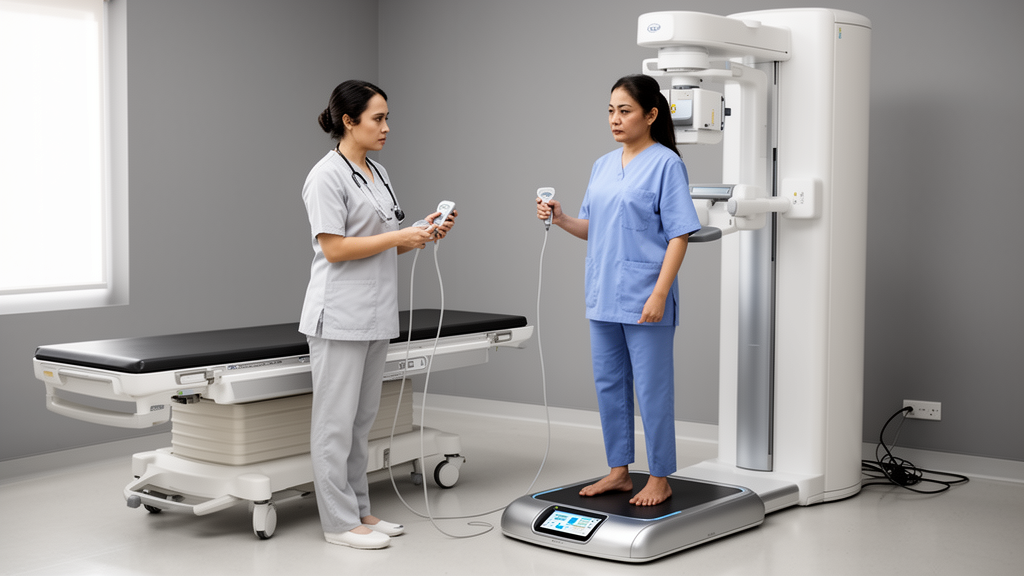
Multi-frequency BIA devices represent a significant leap over their single-frequency predecessors. The InBody 970S, the device validated in this study, injects currents at six frequencies ranging from 5 to 3000 kilohertz across five body segments: the right arm, left arm, trunk, right leg, and left leg. Eight tactile electrodes, positioned on the palms, thumbs, and soles, introduce and detect the current. The underlying physics is elegant: at lower frequencies, current flows primarily through water-rich lean tissue, while at higher frequencies it penetrates cell membranes more completely, allowing better estimation of total body water. Because fat-free mass is roughly 73 percent water, accurate total body water estimation translates directly into more reliable fat-free mass and fat mass calculations. The device also performs segmental analysis, offering regional detail that whole-body impedance cannot provide.
Yet a critical question has lingered: do these devices work equally well across different populations? Many BIA devices are initially calibrated using Western populations, and accumulating evidence suggests Asian populations exhibit distinct body composition characteristics, including higher body fat percentages and greater visceral adiposity at lower BMI values compared with Western counterparts. Differences in body build, limb length proportions, and fat distribution patterns may all influence impedance-derived estimates. Malaysia, with its multiethnic population of Malays, Chinese, Indians, and indigenous groups, presents a particularly demanding test case. The research team, led by Norsham Juliana of Universiti Sains Islam Malaysia, set out to validate the InBody 970S against DXA in healthy Malaysian adults for the first time.
The prospective validation study enrolled 148 healthy adults aged 20 to 45 years at Damansara Specialist Hospital between April 2024 and February 2025. Participants underwent standardized assessments using both the InBody 970S and a full-body Hologic Discovery DXA scanner. To minimize bias, the operators were blinded to each other’s results: the DXA technician did not see the BIA findings, and vice versa. Participants were required to abstain from strenuous exercise, alcohol, and caffeine for 24 hours before testing, and measurements were conducted at least three to four hours after eating and after bladder voiding to control hydration status. All assessments were performed in the morning to minimize diurnal variation, and BIA measurements were taken twice consecutively with the mean used for analysis to improve reliability.
The results were striking. Linear regression analyses demonstrated strong correlations between the two methods across all body composition parameters, with coefficients of determination ranging from 0.72 to 0.97. The predictive models for body fat mass, lean body mass, and fat-free mass were particularly impressive, explaining 96 to 97 percent of the variance in DXA-measured values. The root mean square error across all parameters corresponded to less than 10 percent of the mean DXA values, indicating high predictive accuracy. Bland-Altman analysis, which plots the difference between methods against their average, confirmed acceptable limits of agreement for all parameters, though some proportional bias was observed in certain variables, particularly among individuals with higher body fat percentages.
When the researchers evaluated diagnostic performance for classifying obesity and sarcopenia risk, the picture became more nuanced. For obesity classification using percent body fat thresholds, the device achieved perfect specificity and positive predictive value of 100 percent, meaning that when it flagged someone as obese, that person was indeed obese by DXA standards. However, sensitivity was moderate at 75.2 percent, indicating the device missed roughly one in four obese cases, potentially due to variability in fat distribution or hydration status influencing impedance measurements. For sarcopenia risk, the device performed exceptionally well, with sensitivity of 95.1 percent and negative predictive value of 98.0 percent, meaning it reliably identified individuals who were not at risk. These metrics underscore its effectiveness as a non-invasive screening tool, especially in primary care and community settings where DXA access is limited.
The findings align with a growing international literature. A systematic review on cancer patients supported the viability of BIA as a substitute for DXA and CT in assessing muscle mass, highlighting its potential even in clinical populations with altered body composition. The Singapore Clinical Practice Guidelines for Sarcopenia explicitly recommend BIA as a frontline tool for sarcopenia screening in older adults, emphasizing its convenience, cost-efficiency, and acceptable accuracy. However, a recent systematic review emphasized that device model, prediction algorithm, population age, and health status significantly influence the diagnostic accuracy of BIA, supporting the need for population-specific calibration when applying BIA clinically.
The study has limitations that warrant cautious interpretation. It was conducted at a single centre, which may limit generalisability to broader Malaysian populations. The age range was relatively narrow, comprising primarily healthy adults, thereby limiting extrapolation to older individuals or those with chronic conditions. The proprietary nature of device-specific prediction algorithms may introduce systematic bias that cannot be fully evaluated. Nevertheless, the research team concludes that MF-BIA offers a clinically valid, non-invasive, and accessible method for body composition assessment in Malaysian adults, and its utility in identifying obesity and sarcopenia risk supports its integration into routine clinical practice and public health screening, especially in resource-limited settings. Future work should explore ethnic-specific calibration to enhance diagnostic precision across diverse populations, potentially unlocking the full potential of this technology for the millions at risk across the region.
Subject of Research: Validation and diagnostic accuracy of a multi-frequency bioelectrical impedance analysis device with dual-energy X-ray absorptiometry (DXA) for estimating body composition among healthy Malaysian adults
Article Title: Validation and diagnostic accuracy of a multi-frequency bioelectrical impedance analysis device with dual-energy X-ray absorptiometry (DXA) for estimating body composition among healthy Malaysian adults
Article References: Juliana, N., Zulkefly, M. I. H., Maluin, S. M., Halim, H. A., Roslly, M. Z., Ithnin, M., Fuad, S. H., Hamid, N. A., & Azmani, S. (2026). Validation and diagnostic accuracy of a multi-frequency bioelectrical impedance analysis device with dual-energy X-ray absorptiometry (DXA) for estimating body composition among healthy Malaysian adults. Frontiers in Analytical Science, 6, Article 1767078. https://doi.org/10.3389/frans.2026.1767078
Image Credits: AI Generated
DOI: 10.3389/frans.2026.1767078
Keywords: Validation, diagnostic, accuracy, multi-frequency, bioelectrical, impedance, analysis, device, dual-energy, X-ray, absorptiometry, estimating
Cite Scienmag News
Ophelia Keating. (October 16, 2026). Validation and diagnostic accuracy of a multi-frequency bioelectrical impedance analysis device with dual-energy X-ray absorptiometry (DXA) for estimating body composition among healthy Malaysian adults. Scienmag. https://scienmag.com/validation-and-diagnostic-accuracy-of-a-multi-frequency-bioelectrical-impedance-analysis-device-with-dual-energy-x-ray-absorptiometry-dxa-for-estimating-body-composition-among-healthy-malaysian-adul/
Ophelia Keating. "Validation and diagnostic accuracy of a multi-frequency bioelectrical impedance analysis device with dual-energy X-ray absorptiometry (DXA) for estimating body composition among healthy Malaysian adults." Scienmag, 16 October 2026, https://scienmag.com/validation-and-diagnostic-accuracy-of-a-multi-frequency-bioelectrical-impedance-analysis-device-with-dual-energy-x-ray-absorptiometry-dxa-for-estimating-body-composition-among-healthy-malaysian-adul/. Accessed 16 October 2026.
Ophelia Keating. "Validation and diagnostic accuracy of a multi-frequency bioelectrical impedance analysis device with dual-energy X-ray absorptiometry (DXA) for estimating body composition among healthy Malaysian adults." Scienmag. October 16, 2026. https://scienmag.com/validation-and-diagnostic-accuracy-of-a-multi-frequency-bioelectrical-impedance-analysis-device-with-dual-energy-x-ray-absorptiometry-dxa-for-estimating-body-composition-among-healthy-malaysian-adul/


