


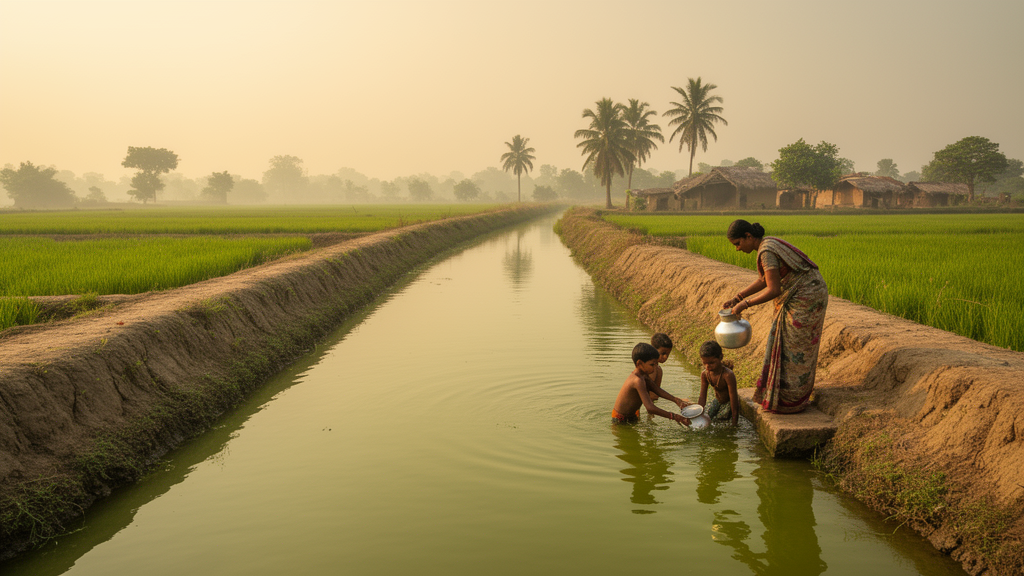
Along the Gostani Velpuru Canal in India’s Western Godavari Delta, the water that sustains farming, aquaculture, and daily life may also be quietly delivering a toxic burden. A new study published in Frontiers in Environmental Science has quantified, station by station, how heavy metals accumulate along this semi-perennial waterway—and revealed that the communities facing the highest chemical hazard are often the least equipped to recognize or escape it. By fusing water chemistry with census-derived social data, the research offers a rare compound risk picture that could reshape how water safety interventions are prioritized in deltaic South Asia.
The research team, led by Penupothula Raju of SRKR Engineering College in Bhimavaram and UiT The Arctic University of Norway, sampled ten monitoring stations along the canal on a single day in March 2022, capturing six diurnal time points per station for a total of sixty samples. Using flame atomic absorption spectrophotometry with standard quality assurance protocols, they measured four heavy metals: cadmium, copper, manganese, and zinc. The choice of cadmium was particularly consequential—it is classified as a Group I human carcinogen by international cancer agencies, with well-documented renal toxicity and links to lung cancer even at low ingestion rates.
The results are stark. The cumulative Hazard Index, which integrates the targeted hazard quotients of all four metals into a single non-carcinogenic risk metric for adult exposure, ranged from 1.46 to 13.62 across the ten stations—exceeding the safety threshold of 1 at every single location. Copper emerged as the dominant contaminant in the upstream reaches, present in all sixty samples and exceeding the Indian standard of 0.05 mg/L throughout, with a maximum concentration of 4.821 mg/L at station B. But the most alarming finding concerned cadmium: negligible upstream, it surged to 0.203 mg/L at the downstream station J—67.7 times the drinking-water guideline of 0.003 mg/L.
Spatial analysis and Spearman rank correlations helped the researchers disentangle the sources. Copper’s statistical independence from cadmium and manganese (correlation coefficients of just 0.04 and 0.15 respectively) points to a distributed origin—consistent with agricultural runoff and aquaculture or poultry-feed inputs, where copper is commonly used as a supplement. In contrast, the moderate correlation between cadmium and manganese (0.64) suggests a probable shared point source near the paper mill industry in the downstream reach, though the authors caution that confirming a specific facility would require discharge data beyond the scope of this study.
What sets this work apart is its refusal to stop at chemistry. The team constructed a Physical Vulnerability Index from the normalized Hazard Index values, then integrated it with a Social Vulnerability Index built from five census-derived indicators: the proportion of Scheduled Caste and Scheduled Tribe populations, illiteracy rates, children aged zero to six, agricultural labourers dependent on canal water, and households lacking a functional tap connection. The two indices were averaged into a single Compound Risk Score, following the IPCC AR6 conceptualization of risk as a function of hazard, exposure, and vulnerability.
The compound picture revealed a troubling spatial truth: peak physical hazard and maximum social vulnerability co-occur at the canal’s tail end. Station J at Dirusumarru recorded the highest Compound Risk Score of 0.734, driven by the maximum physical vulnerability (1.000) combined with moderate social vulnerability (0.468)—where the dominant social driver is illiteracy, meaning the most chemically hazardous settlement is simultaneously among the least equipped to understand water quality notices or seek medical care. Station I at Yenamadurru followed with a score of 0.609, the only station to achieve high classifications in both physical and social vulnerability simultaneously.
Not every high-social-vulnerability community faces high chemical exposure. Station A at Settipeta recorded the highest Social Vulnerability Index (0.697), driven by the highest proportion of SC and ST populations and a severe deficit in functional tap connections—yet its physical vulnerability remained low at 0.080. The authors flag this divergence as precisely why single-dimension chemical indices systematically misidentify priority communities: a socially vulnerable settlement upstream may be one industrial expansion or dry-season pollutant surge away from crisis, while a chemically contaminated settlement downstream may lack the literacy to recognize the danger.
A sensitivity analysis tested the robustness of the equal-weighting assumption between physical and social indices. Station J’s critical classification held firm across the full weighting range from 30:70 to 70:30, but Station I’s designation shifted from High to Critical depending on the weighting—signalling that while the tail-end crisis is robust, intermediate classifications warrant cautious interpretation. Six of the ten stations shifted classification somewhere across the range, underscoring that compound risk frameworks require careful, context-specific calibration rather than one-size-fits-all thresholds.
The study is candid about its limitations. Sampling occurred on a single day in the pre-monsoon season, capturing spatial and diurnal variation but not seasonal dynamics. Duplicate-sample precision and percentage-recovery results were not obtained, and formal limits of detection and quantification were not determined through dedicated blank-replicate measurements—a constraint of the rural field campaign. Copper’s quantification is best supported, with 52 of 60 samples falling within the calibrated range, while manganese and zinc findings are reported as indicative rather than quantitatively resolved. The authors recommend recalibration at lower concentration ranges before these specific values are used beyond this study.
Despite these constraints, the framework’s implications are immediate. The authors identify three intervention priorities: immediate remediation at the tail-end stations targeting cadmium and manganese at their probable shared point source, alongside alternative safe drinking water and health surveillance; addressing the tap-connection deficit at stations E and G through infrastructure investment under India’s Jal Jeevan Mission; and expanding literacy across all settlements to reduce the impact of physical contamination and improve healthcare access. By demonstrating that chemical hazard and social fragility converge in predictable spatial patterns, the Compound Risk Score offers water quality managers in deltaic regions worldwide a blended decision-support tool—one that speaks directly to Sustainable Development Goals 6 and 3, and one that recognizes that the communities drinking the most contaminated water are often those least able to demand something better.
Subject of Research: Compound risk of cadmium, copper, manganese and zinc in canal-fed communities, South India: linking physical and social vulnerability
Article Title: Compound risk of cadmium, copper, manganese and zinc in canal-fed communities, South India: linking physical and social vulnerability
Article References: Raju, P., Eregno, F. E., Calay, R. K., Raju, P., & Basha Shaik, T. (2026). Compound risk of cadmium, copper, manganese and zinc in canal-fed communities, South India: linking physical and social vulnerability. Frontiers in Environmental Science, 14, Article 1919975. https://doi.org/10.3389/fenvs.2026.1919975
Image Credits: AI Generated
DOI: 10.3389/fenvs.2026.1919975
Keywords: Compound, risk, cadmium, copper, manganese, zinc, canal-fed, communities, South, India, linking, physical
Cite Scienmag News
Violet Maxwell. (October 16, 2026). Cadmium Crisis in India’s Godavari Delta: Canal Water Hazards Hit Vulnerable Communities Hardest. Scienmag. https://scienmag.com/cadmium-crisis-in-indias-godavari-delta-canal-water-hazards-hit-vulnerable-communities-hardest/
Violet Maxwell. "Cadmium Crisis in India’s Godavari Delta: Canal Water Hazards Hit Vulnerable Communities Hardest." Scienmag, 16 October 2026, https://scienmag.com/cadmium-crisis-in-indias-godavari-delta-canal-water-hazards-hit-vulnerable-communities-hardest/. Accessed 16 October 2026.
Violet Maxwell. "Cadmium Crisis in India’s Godavari Delta: Canal Water Hazards Hit Vulnerable Communities Hardest." Scienmag. October 16, 2026. https://scienmag.com/cadmium-crisis-in-indias-godavari-delta-canal-water-hazards-hit-vulnerable-communities-hardest/


