


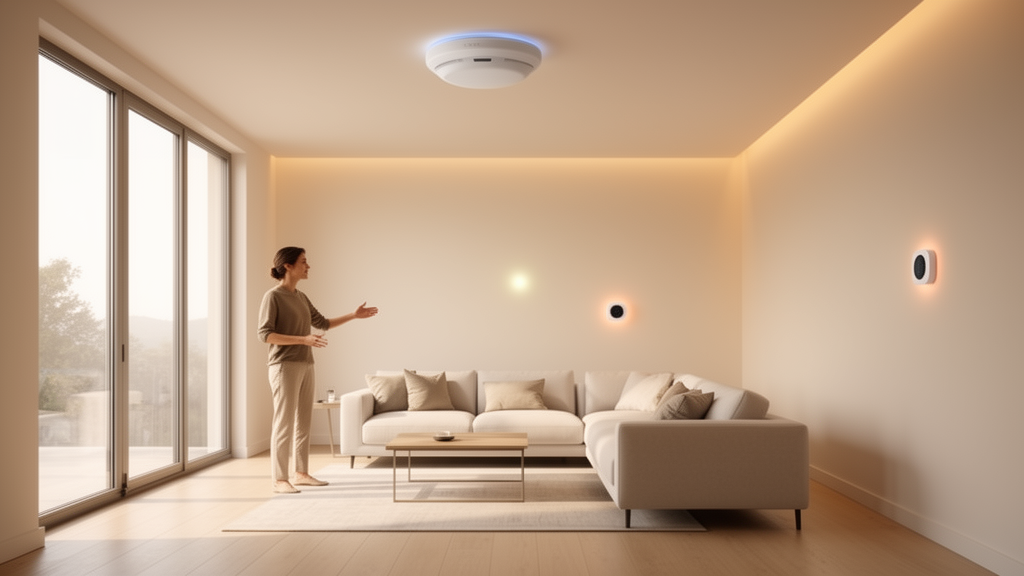
Imagine walking into a hospital room where a ball-shaped controller, a gesture sensor, a smart lamp and a thermostat have spontaneously joined forces to help a patient communicate or adjust the lighting. Nobody configured these devices by hand. Nobody wrote a manual. Instead, the room assembled itself into a working system and then, remarkably, wrote its own instructions for the person standing in front of it. That is the vision behind a new study from the University of Lübeck, where researchers have built and tested a framework that lets smart environments manage their own applications and generate user guidance on the fly.
The research, published in Frontiers in the Internet of Things by Börge Kordts, Lea C. Brandl and Andreas Schrader of the Institute of Telematics, tackles one of the most stubborn problems in pervasive computing. The Internet of Things promises environments filled with sensors, actuators and interfaces that quietly extend our abilities, but the sheer variety of devices and services makes manual integration complex and tedious. Self-organization has long been proposed as the remedy: devices describe themselves, discover each other and form functional ensembles without a technician in the loop. The catch is that when a room reconfigures itself dynamically, users often have no idea how to interact with the result. The system may work perfectly, yet remain a mystery to the very people it is meant to help.
To bridge that gap, the team extends a concept they call Ambient Applications. Unlike ordinary apps, which live on a rectangular screen and have little connection to the physical world, ambient applications are software components defined by their close relationship to a smart environment. They are either controlled by components of the environment or provide output that controls other ambient applications or smart objects. The hardware they run on is, in principle, interchangeable. This opens the door to decoupling interaction from application logic: input devices, output devices and the software in between can be combined in different ways depending on the situation, the user and the resources available. Interfaces need not be graphical at all; projections onto objects in the room or voice-based interaction are equally conceivable.
The technical foundation is the Ambient Reflection framework, which the authors extended for this study. The framework already consisted of three core components. A Smart Object Library lets developers integrate smart objects directly, handling network communication over an event bus. A Virtual Device Daemon, together with its API, acts as a web-socket-based bridge for software that cannot use the library, such as web applications running in restricted environments. And a Description Mediator connects smart objects and applications based on their self-descriptions, using a probabilistic brute-force algorithm as a best-effort solution to the ensembling problem. Every component describes itself in a human- and machine-readable language, covering its input and output interfaces and basic behavior. Applications are deliberately modeled as black boxes: the descriptions explain how to control them, not their internal logic.
The novel contribution is an application management layer bolted onto this architecture. Devices that can host applications run a manager that describes itself and the restrictions of its hardware. When an application is requested, the manager pulls the specified version from a trusted repository, verifies its integrity with a checksum comparison, extracts the archive and launches it with the appropriate runtime environment and configuration. Because some resources, such as a display or audio output, cannot be shared, the team introduced a Limited Application Manager built around a clever device upgrade scheme. A device starts as a minimal idle instance whose only job is to be discoverable and to accept launch requests. When an application arrives, the idle instance shuts down to free its resources, the new application starts as a subprocess, and once the application terminates the idle instance reboots to await the next request. This prevents resource deadlocks on constrained hardware.
Distribution is handled by the Description Mediator, whose REST interface was extended to accept application launch requests. A distribution algorithm matches requested applications to discovered devices based on their capabilities, both hardware and software. Software capabilities are expressed using MIME types, the standard format for indicating media types, while the authors propose a MIME-inspired format for describing hardware properties, including connected peripherals. An application that needs a graphical interface will only be dispatched to a device that can actually display one. After launch and connection, the mediator merges the self-descriptions of all components in the ensemble into an aggregated description, which serves as the raw material for generating user instructions.
That instruction generation is where the self-explainability comes in. An HTML-based rendering engine produces multimedia guides that combine textual descriptions with graphical representations of the required input actions and the corresponding system responses, including animations of the interaction steps. For multi-step tasks, an overview page links to detailed explanations of each task, with navigation elements at the top and bottom. The result is a manual that did not exist until the moment the ensemble formed, tailored precisely to the devices and applications actually present.
To find out whether such automatically generated instructions actually work, the researchers ran a quasi-experimental laboratory study with twelve students from the University of Lübeck, seven male and five female, with an average age of 25 years. Participants completed five tasks of increasing difficulty across three ensembles drawn from representative domains: a smart home scenario and two medical scenarios. They used a ball-shaped interaction device called BIRDY to control an augmentative and alternative communication application, a camera-based Leap Motion hand gesture controller to operate a room-control application with Philips Hue smart lights and a FRITZ!DECT smart thermostat, and finally a finger-worn LITHO touch controller plus a Flic smart button to drive a pain documentation application intended for hospital wards. Instructions were displayed on a separate smart whiteboard, and a wizard-of-Oz setup meant the applications were remotely controlled by the investigator while participants believed they were interacting with the system.
The results were strikingly positive. Every participant solved every task successfully, and all but one identified the correct devices on the first attempt. Questionnaire responses rated the self-explainability of the environment as very well intelligible, with particular praise for the assistance during the learning process. Interviews reinforced this: five participants explicitly found the instructions and their structure clear, and the illustrations and animations drew positive mentions. Yet the study also surfaced instructive failures. Several participants misinterpreted the still images illustrating Leap Motion gestures and the Flic button, and some missed that the LITHO controller required placing the thumb on the device while swiping. Four participants admitted their mistakes came from skimming the instructions rather than reading them carefully. Notably, no consensus emerged on whether animations, illustrations or text were most helpful; all three formats were rated helpful, suggesting that different learning styles demand different modalities. On placement, eleven participants could imagine instructions on a separate device and ten favored integration into the application itself, with a telling split: separate displays were preferred in medical contexts, while integrated guidance seemed suitable for smart homes.
The authors are candid about the limitations. The sample consisted entirely of digitally fluent students, the wizard-of-Oz setup left system autonomy untested, and the evaluation relied on fairly traditional applications displayed on conventional monitors. Still, the core finding stands: given good self-descriptions, the framework can generate comprehensible instructions for even complex, dynamically assembled ensembles, and it answers the question of where self-explaining ambient applications come from and how they enter an environment. The team sees this as a first step toward a genuine application store for smart spaces, where users could publish, install, update and remove self-explaining applications as easily as they install apps on a phone. Future work includes factoring device positions and network topology into the distribution algorithm, deploying the system at scale in real-world settings such as teaching scenarios and ambient serious games, and exploring non-visual instruction formats, from audio guides to augmented reality assistance. If the vision holds, the smart environments of the future may not only run themselves but also teach us, politely and on demand, how to use them.
Subject of Research: Self-explaining ambient application management in smart IoT environments
Article Title: Managing self-explaining ambient applications
Article References: Kordts, B., Brandl, L. C., & Schrader, A. (2025). Managing self-explaining ambient applications. Frontiers in the Internet of Things, 4, Article 1623733. https://doi.org/10.3389/friot.2025.1623733
Image Credits: AI Generated
DOI: 10.3389/friot.2025.1623733
Keywords: Internet of Things, pervasive computing, smart environments, ambient applications, self-explainability, self-organization, service composition, application management, user study, human-computer interaction, smart objects, Ambient Reflection framework
Cite Scienmag News
Josephine Dean. (October 16, 2026). Smart Rooms That Explain Themselves: New Framework Lets IoT Apps Deploy and Teach Their Own Use. Scienmag. https://scienmag.com/smart-rooms-that-explain-themselves-new-framework-lets-iot-apps-deploy-and-teach-their-own-use/
Josephine Dean. "Smart Rooms That Explain Themselves: New Framework Lets IoT Apps Deploy and Teach Their Own Use." Scienmag, 16 October 2026, https://scienmag.com/smart-rooms-that-explain-themselves-new-framework-lets-iot-apps-deploy-and-teach-their-own-use/. Accessed 16 October 2026.
Josephine Dean. "Smart Rooms That Explain Themselves: New Framework Lets IoT Apps Deploy and Teach Their Own Use." Scienmag. October 16, 2026. https://scienmag.com/smart-rooms-that-explain-themselves-new-framework-lets-iot-apps-deploy-and-teach-their-own-use/


